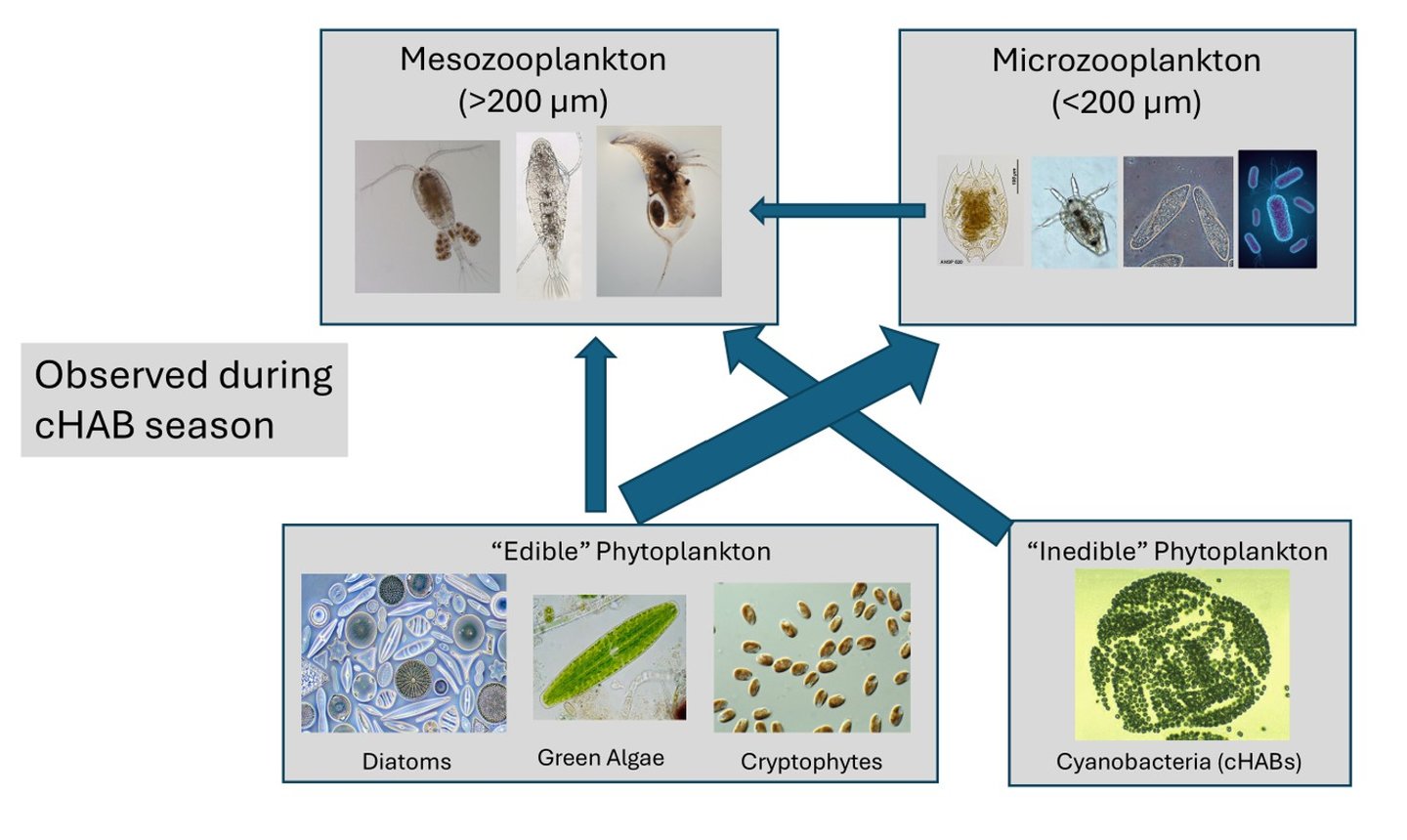
When we think about how cyanobacterial harmful algal blooms (cHABs) will affect food webs, we tend to assume they are a dead end for energy transfer. The blooms are considered simply too toxic and nutritionally poor for zooplankton to graze, preventing energy from moving up to the fish that feed on them. Compounding this, the prevailing paradigm also assumes that smaller zooplankton (microzooplankton) will graze cyanobacteria, while larger mesozooplankton will avoid the cHAB and decline, thus lowering energy transfer efficiency from zooplankton to fish. But this view rests largely on single-species lab experiments using zooplankton not previously exposed to cHABs. What actually happens in large lakes such as Lake Erie, which has experienced recurring cHABs for over 20 years? Who really grazes the bloom, and is energy transfer truly restricted during cHAB events?
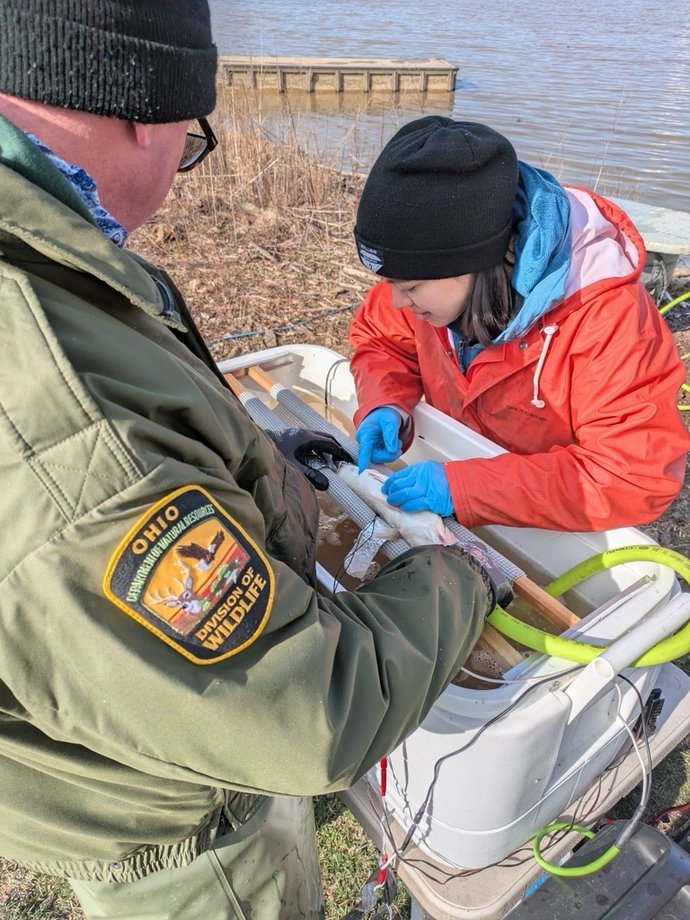
My Ph.D. dissertation addressed these questions in western Lake Erie by pairing nearly three decades of plankton monitoring data with zooplankton grazing experiments to characterize how meso- and microzooplankton graze on cHABs and to quantify energy transfer from blooms to mesozooplankton. This research was conducted in conjunction with the Hood lab at The Ohio State University, the Ohio Division of Natural Resources, and NOAA’s Great Lakes Environmental Research Laboratory.
What we found ran counter to our expectations: mesozooplankton, not microzooplankton, were the primary grazers of cyanobacteria. Moreover, these larger grazers kept feeding at high rates from before the bloom through its peak. This observation was supported by our long-term monitoring results, where cladoceran production and energy transfer efficiency increased non-linearly with cyanobacteria—peaking under moderate bloom conditions before declining slightly during severe cHAB years. Invertebrate predators were positively associated with cladoceran production, and planktivorous fish had only a limited ability to suppress zooplankton populations, emphasizing that cHAB effects must be understood alongside the other stressors that co-occur with blooms. We anticipate this work will help predict how freshwater food webs respond to nutrient pollution and biological invasion and inform ecosystem-based management of the fisheries that communities across the Laurentian Great Lakes and other large lakes worldwide depend on.
What we found ran counter to our expectations: mesozooplankton, not microzooplankton, were the primary grazers of cyanobacteria.