Let’s start with the good news. Globally, people report medium to high trust in scientists. The bad news is that a minority of people worldwide distrust scientists. Even worse, that minority strongly impacts policy making, and thus should be taken seriously (Cologna 2025).
Trust is the variable scientists and science communicators often forget when engaging with people outside of their field. Many believe audiences will naturally trust them because they are scientists, incorrectly relying on a presumed universal trust in the scientific process. Research has repeatedly shown this belief to be unfounded (Tyson 2024). Unfortunately for scientists, in a world where the line between fact and fiction is becoming increasingly blurred, building trust is more important than ever.
Building trust takes time. Building trust takes humility. Building trust takes self reflection. Building trust also requires putting faith in your audience’s unique expertise, even though they may not be researchers. To be effective communicators, scientists and science communicators need to start by reflecting on who they are and leaning into that authenticity. In identifying these characteristics, scientists can apply them to their outreach and how they communicate with others. When they can communicate authentically, they are able to connect with their audience on a personal level, and in return, their audience can provide feedback and connect the content with their own lived experiences. This makes the content not only relevant and relatable, which are key characteristics in making something memorable, it also makes it realistic and applicable to the audience’s specific needs. Creating the space to be vulnerable by being authentic while also being receptive to feedback creates a foundation of trust.
To be effective communicators, scientists and science communicators need to start by knowing who they are and leaning into that authenticity.
Not too long ago, I was fortunate to be at the right place at the right time to help a communicator learn this very important lesson.
“What do you think of my shoes?” A middle-aged woman at the museum asked me this—no greeting, no context, just a swift motion toward her black-and-white checkered Vans. Puzzled but honest, I replied, “They’re cute but not my style or my size.” She laughed and followed up, “Do you think this looks like me?” Now even more confused, I listened as she explained: She’s an emergency room doctor, and that day a young patient refused to talk to her. The patient said, “Don’t come in here thinking you are like me because you have those shoes on. I bet you can’t even skateboard.” That moment and those words stuck with her and now with me.
After hearing that story, I immediately pictured myself and every other scientist/adult that I have worked with engaging with younger people. I thought about how we instantly, without thinking, alter how we speak and dress—even our mannerisms—to make us seem like their peer. Looking back, I realize that it’s incredibly awkward and cringy and identical to the situation with the ER doctor.
Why do we do this when we communicate with people younger than us? We do it to make us relatable and relevant. In reality, when we, as scientists and science communicators, awkwardly throw in slang like “delulu” or “sus” to seem relatable, we’re doing the exact opposite because the character we embody is not who we truly are. We think it helps us connect, but in reality, it creates distrust. If we can’t be truthful about who we are, then how are others supposed to trust anything we have to say?
Younger audiences know we’re old, at least by comparison. Pretending otherwise is disingenuous. I am using age as an example, but this concept applies to any population we are engaging that is different from us. Real trust is earned by being authentic and sharing the parts of ourselves that make us unique, coupled with being open to the idea of our audience being experts in their own lived experiences. If a scientist walks into a classroom and acknowledges that students are the experts on being students, it shifts the dynamic. Instead of lecturing, we create a dialogue that allows them to show us how our work connects to their world. Communication is not a one-way street; it’s a conversation built on mutual respect for each other’s experiences, which builds trust.
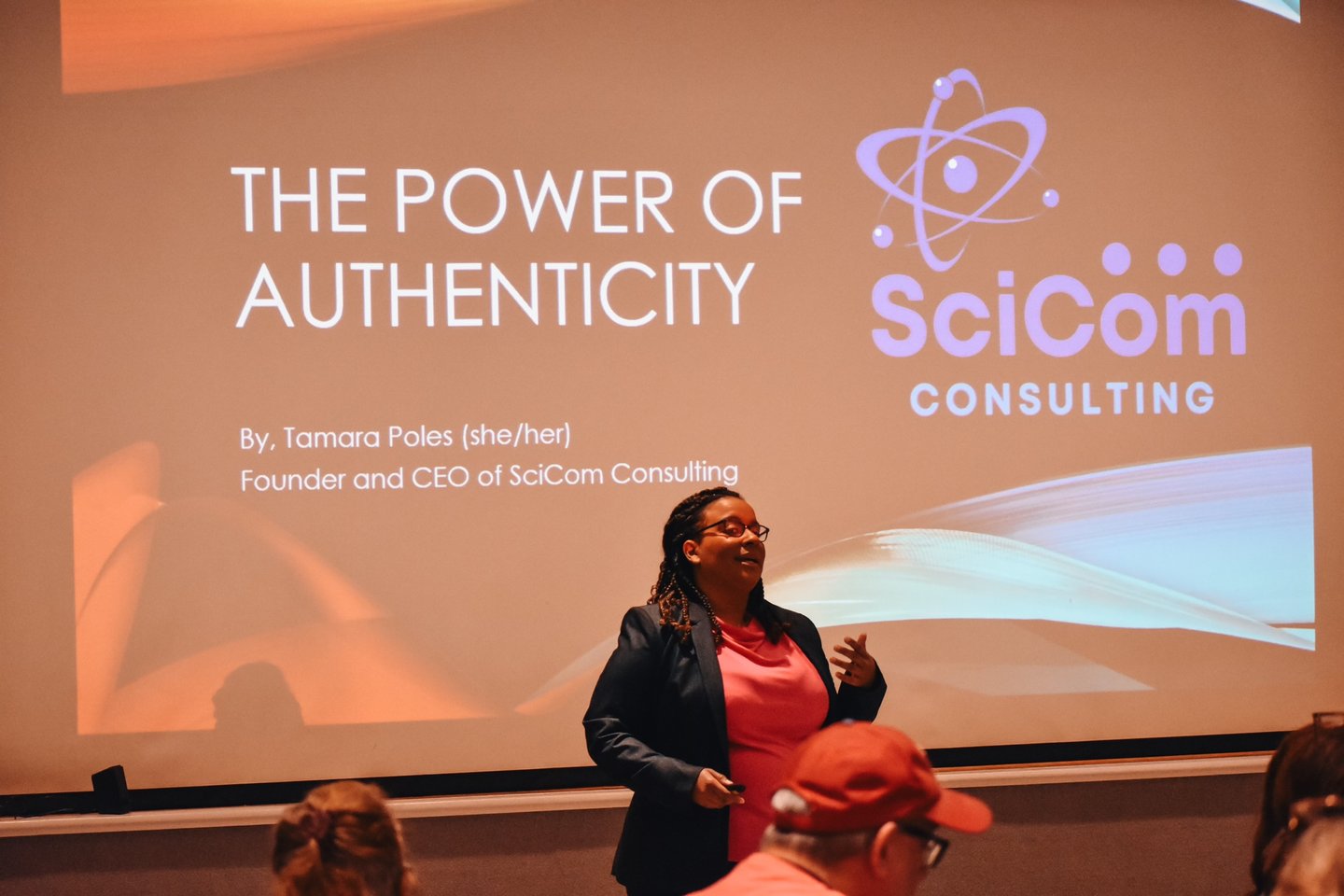
I try to embrace who I am and what I am to the audience in which I am speaking. I’m a Black female science communicator who plays competitive sports, is sarcastic, has a child’s sense of humor, and loves “Bob’s Burgers.” That might seem niche, but there’s always someone in my audience who connects with at least one of those attributes, and if not, they connect with my humanity. By showing up as my full self, I become more relatable and I create real connections, which makes my communication more impactful. One caveat is to be mindful that prejudice is real, and not all identities are universally accepted; therefore, it is essential to be aware of the identities that you feel safe revealing to your audience.
The thing is, a majority of the public supports the idea of having more scientists engage them (Cologna 2025). They want to hear from the experts. With this in mind, one way scientists can gain public trust is by investing more effort into communicating about science frequently. Being authentic and relatable are ways to make this possible. Storytelling is a common way to create opportunities for your audience to relate to you and feel safe to share their personal experiences with you. Once they do that, you can then tailor how you deliver your content to make it relevant to them. This verbal dance creates a stronger connection between you and your audience. Your audience is more likely to not only remember the content you teach them but also apply it to their lives.
That same respect applies when engaging with communities. Too often, researchers enter unfamiliar spaces and impose solutions they assume are needed. I call this phenomenon “community colonization.” An example of this is when a researcher gets a grant and decides a rural town needs computers without ever consulting with the residents of that town. What if they really need mobile hotspots and cell phones? Or tablets?
True community engagement requires the scientist or communicator to take the time to build trust, listen to community leaders, and then use our resources to co-create solutions that serve that community, not just our research. Everything we do should be a conversation based on trust and mutual respect.
Authenticity is the foundation of trust, and trust is essential in science communication. If scientists feel we must hide parts of ourselves to be taken seriously, how can we expect the public to believe in us? When we embrace who we truly are, we make science more accessible, inclusive, and trustworthy for everyone.
Cologna, V., Mede, N.G., Berger, S. et al. Trust in scientists and their role in society across 68 countries. Nat Hum Behav (2025). https://doi.org/10.1038/s41562-024-02090-5
Tyson, A.; Kennedy, B. (2024, November 14). Public Trust in Scientists and Views on Their Role in Policymaking. Pew Research Center. https://www.pewresearch.org/science/2024/11/14/public-trust-in-scientists-and-views-on-their-role-in-policymaking/