Many of our scientist friends are inadvertent storytellers. You can’t go into the water with an aquatic ecologist without experiencing the curiosity, the wonder, and yes, even the heartbreaks of their work as it might have unfolded over decades. Likewise you can’t go into the water with Indigenous colleagues and friends without experiencing the curiosity, the wonder, and yes, the still deeper heartbreaks of our more-than-human world as it has unfolded over centuries. One difference, though, is that our Indigenous colleagues intentionally keep sacred stories of water alive in a vibrant practice of ecocultural knowledge-building.
As biodiversity, climate, and water crises reshape the Laurentian Great Lakes, making sense of our region’s complicated ecocultural relationships should be a calling for all of us in IAGLR. For how can people value and evolve their connections to a river or lake without narrating their own symbiotic histories with that river or lake? How can science-based restoration initiatives persist without heartfelt advocacy emanating from local communities through today’s contested political and policy spaces, and ultimately through these turbulent times?
But when you bring nature and culture together in conversation, you’re moving into the realm of storytelling. Storytelling rather than science-telling can open emotional and spiritual pathways for people to connect with environmental research. Unfortunately, though, emotion and spirituality still fit most comfortably within the arts and humanities, whose narrative traditions delve deep for meaning, touch the heart, connect heart with mind.
When you bring nature and culture together in conversation, you’re moving into the realm of storytelling. Storytelling rather than science-telling can open emotional and spiritual pathways for people to connect with environmental research.
So how to escape an unhelpful either/or proposition—scientist or artist, researcher or storyteller? We see practitioners of all disciplinary (and cultural) leanings becoming intentional rather than inadvertent storytellers. In this extraordinarily disruptive and demoralizing time for Great Lakes research, our individual or collective storytelling might be the most important communications we undertake. What follows are examples of ecocultural storytelling.
A living river
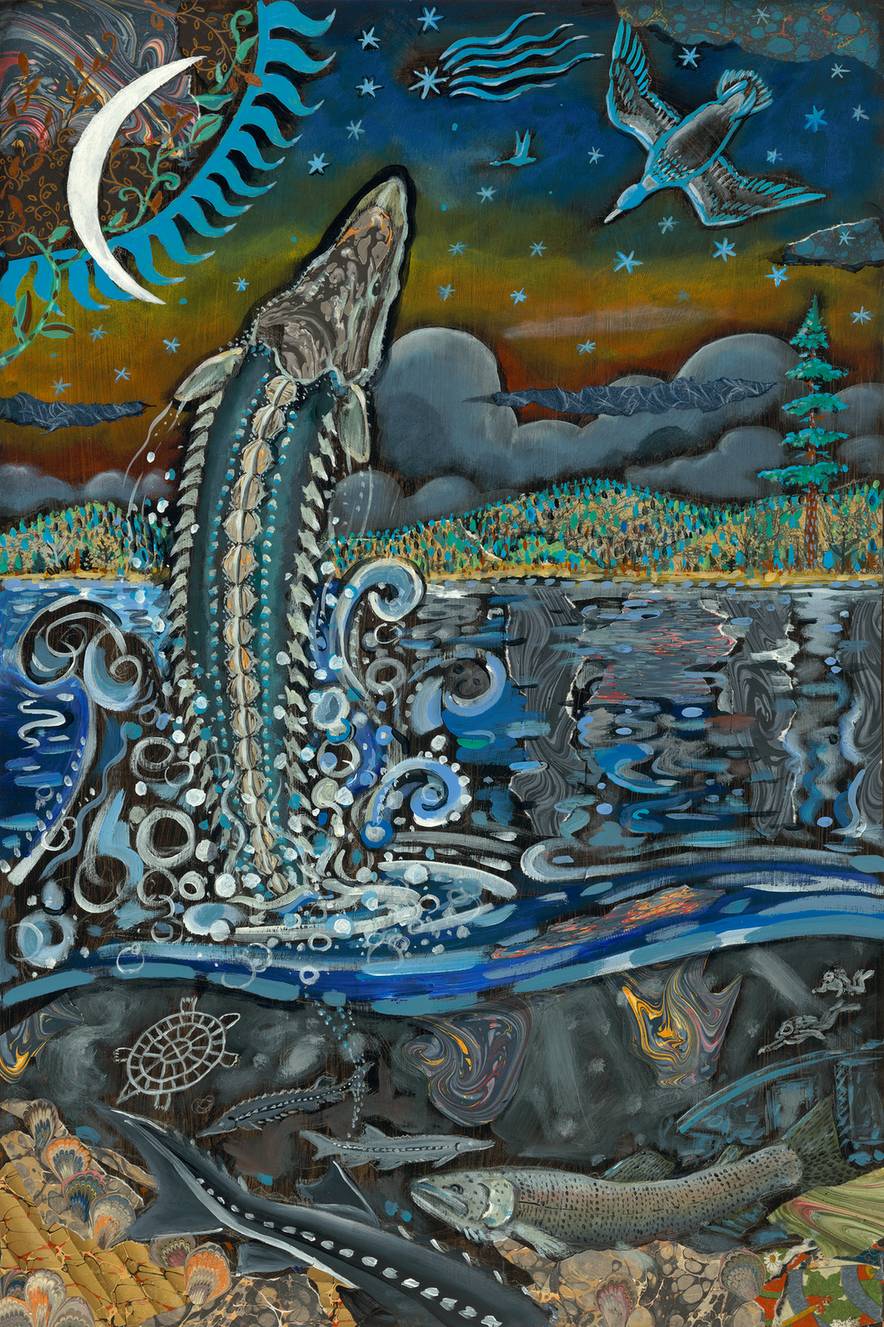
The first example begins with the illustration below, which is a mixed media painting by Glenn Wolff. This is also the front cover for Lynne Heasley’s book, “The Accidental Reef and Other Ecological Odysseys in the Great Lakes.” The book foregrounds the St. Clair River, a connecting water and international maritime corridor between lakes Huron and St. Clair spanning Canadian, U.S., and Bekejwanong Territorial waters.
One storytelling challenge is escaping the industrial narrative of a dying river, which in its simplest form goes like this: The St. Clair suffered a century and a half of continuous toxic industrial waste streams and pollution events; and these made for a historical process of ecological violence against river and people alike. Reinforcing this toxic story are the shoreline smokestacks of Chemical Valley in Sarnia, Ontario, home to 40% of Canada’s petrochemical industry.
No doubt your average visitor would not see the St. Clair as a river of wonder; a living river; benighted but also awe-inspiring; home to the largest population of lake sturgeon in the Great Lakes; home to the largest freshwater delta in the world; a migratory landing pad for two international flyways; a resilient ecological meeting place. Yet stories from this living river have been both catalyst and outcomes of long-term restoration initiatives to delist the St. Clair as an international Area of Concern. Glenn’s painting is a counter-visual to smokestacks, with a porpoising sturgeon reaching for the stars, an exquisite underwater world below, and two scuba divers entering the scene from stage right (who will soon share their own stories!). Collaborating in visual storytelling opens portals to new or unexpected dimensions of places like the St. Clair River.
Dreamscapes
The illustration below begins our second set of examples. This is Glenn’s mixed-media triptych, “Dreamscapes,” and also the working title of Lynne’s long-term exploration of ecocultural relationships in three Great Lakes landforms. “Dreamscapes” took much longer for Glenn to conceptualize, mostly because of Lynne’s narrative muddles. But we were patient in trying to see the many stories in each landform from our different perspectives.
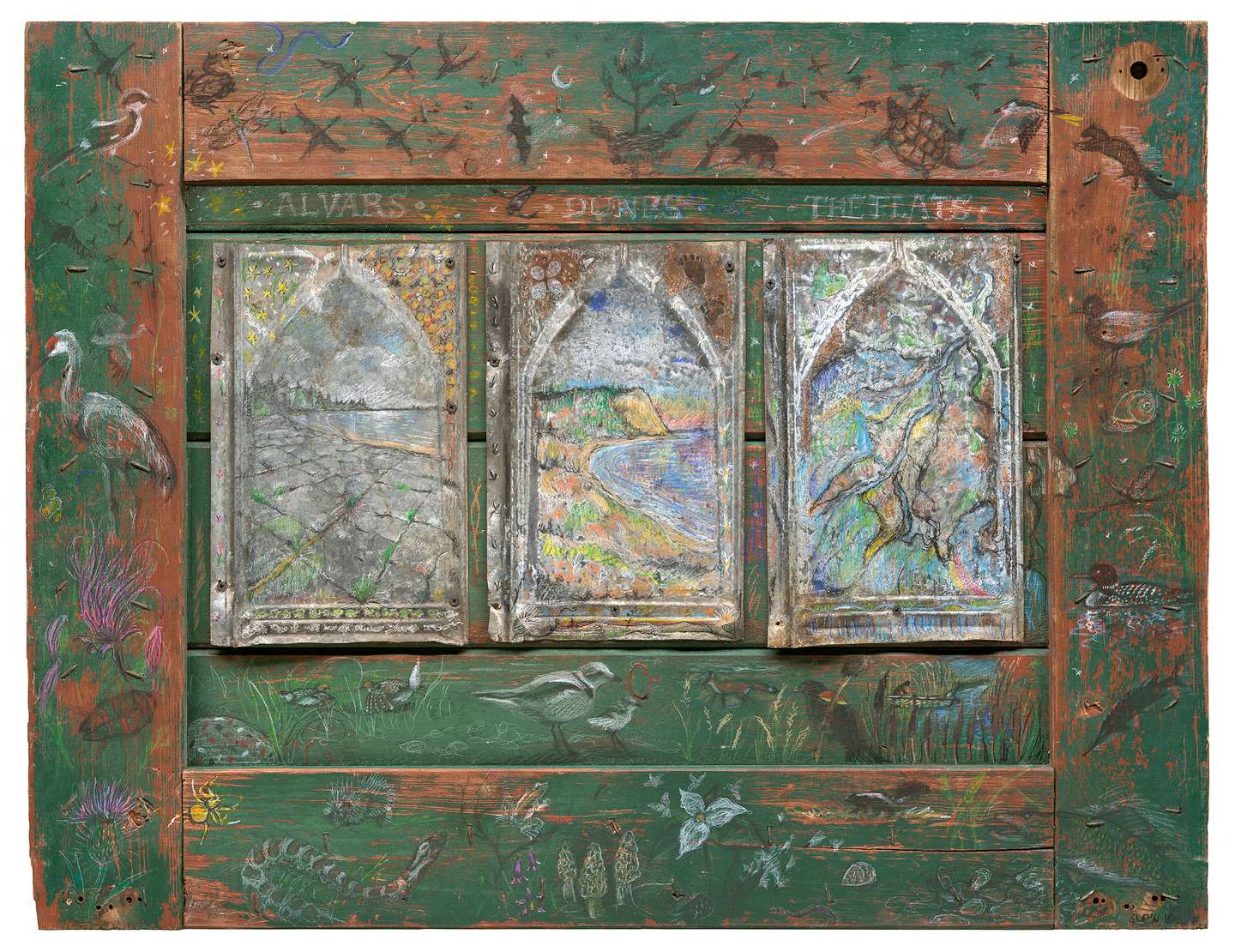
Left-to-right, the three landforms are (1) alvar “pavement” grasslands on Drummond and Manitoulin islands in Lake Huron; (2) Great Lakes coastal sand dune complexes; and (3) the St. Clair Flats (or delta) forming U.S.-Canada-Bkejwanong borders. Also note how Glenn depicted alvars at eye level, dunes from an elevated position, and delta from a bird’s-eye view. Each choice of perspective opened up stories within that place.
But alvars, dunes, delta? Why consider these three landforms for a Great Lakes writing project? Why put them side-by-side in a painting? A simple answer is that all three are global landmarks of the Great Lakes. Not only do they represent the greatest concentration or longest extent or largest area in the world of their type, they are treasures of biodiversity at a moment when biodiversity conservation has become as urgent as decarbonizing Earth’s atmosphere.
Another answer is that two of the three are underappreciated. Humble alvar grasslands on remote islands, or a river along an industrial corridor, don’t inspire the same pride of place as a mountain vista. Instead they can seem unremarkable or degraded to a visitor, to a non-specialist, and often to area residents. An artist, however, can overcome our everyday sight-seeing to reveal magic.
And a third answer is that all three landforms embody cross-cutting ecocultural stories. This won’t surprise the botanist who marvels at a Drummond Island alvar site while simultaneously enduring waves of dust-clouds from ATVs driving past. On the surface an alvar might look like a long-abandoned parking lot of cracked dolomite or limestone splotched with lichen and moss, but it nurtures the greatest biodiversity in the world at small scales. A dense network of ATV trails may seem incongruous for an island accessible only by ferry, but it resulted from a local economic push for Drummond Island to become the off-road destination in Michigan.
Phragmites australis in the St. Clair Flats offers good practice for intentional storytelling. Directly below the third tin panel in “Dreamscapes,” you’ll see Glenn’s drawing of a small camo-painted flat-bottomed boat hidden among cattails and taller aquatic plants. The boat is ideal for Bkejwanong/Walpole Island fishers, hunters, and guides navigating shallow channels and bays. The aquatic plants signify Phragmites’ spread throughout the Flats.
As most in IAGLR know, Phragmites is crowding out native reeds and grasses and threatening some of the richest fish and wildlife habitat in the Great Lakes. The default story is Phragmites the threatening invader—aggressive, fast-moving, disruptive, unwanted. By extension, one possible conservation paradigm is to overpower, or at least to control Phragmites. Aerial drones spraying dense swaths of Phragmites with an escalating succession of herbicides fortify this warlike relationship.
But what if we shift the story of Phragmites slightly, from “invader” to “newcomer”? Shift the story and we can see relationships differently. Reconsider our relationships and other conservation paradigms come into view. As an imaginative exercise, reflect on this spectrum of possible relationships with Phragmites, along with the implications of each:
- Conquest (paradigm of force and control; belief in a permanent solution to a problem or enemy)
- Co-existence (paradigm of stewardship; commitment to local, ongoing, hands-on management)
- Acceptance (paradigm of welcome; openness to respecting and learning from distant relatives and new neighbors)
We’ll pause here, because stories of Phragmites are unfolding and dividing into a bird-foot delta of alternative futures. Communicating ecological knowledge through intentional storytelling could guide such futures toward renewed relationships with our home-waters.