Stories matter. Many stories matter. Stories have been used to dispossess and malign, but stories can also be used to empower and to humanize. Stories can break the dignity of a people, but stories can also repair that broken dignity.... When we reject the single story, when we realize that there is never a single story about any place, we regain a kind of paradise.
~ Chimamanda Ngozi Adichie at TEDGlobal 2009
Despite the critical role that storytelling and oral traditions play in passing down environmental stewardship practices and values within BIPOC communities, we as scientists rarely see ourselves as responsible for supporting these communication strategies to advance environmental justice in the regions where we work.
To explore this further, my team and I conducted interviews with 42 stakeholders across the Great Lakes region, including environmental justice community organizers, local journalists, and community engagement specialists. Our goal was to better understand the relationship between local media and communities working to combat environmental injustice. These interviews formed the foundation of a community-driven model for environmental justice storytelling, designed to be used by media organizations, environmental nonprofits, and scientists engaged in community-based participatory work.
Our findings challenged a common perception that media coverage of environmental justice issues is largely negative and extractive. While some collaborators did recount harmful experiences with media, these were primarily linked to large, for-profit newsrooms with no local ties to the communities they were covering. Locally based journalists were frequently described as trusted community members and advocates for environmental justice. As scientists, we must recognize the profound value of community-driven narratives. Too often, our focus on data causes us to lose important context. In our pursuit of answers to rigid research questions, we sometimes forget the importance of simple human connection.
Throughout our project, we found that by letting go of traditional academic measurements of success, we made space for deeper and more meaningful engagement. Abandoning rigid research protocols allowed us to build authentic relationships with our collaborators. And prioritizing personalized communication over rote efficiency led to more participation than we ever anticipated. We learned that when nurtured with care, these connections offer insights that can help us more effectively support community-led solutions to climate change, contamination, and natural resource management. Ultimately, this evolution demands one essential shift: a strong commitment from those in positions of power to, as one environmental justice organizer in the Great Lakes Basin stated, “show up for things—and sometimes maybe not with their journalist [or expert] hat on, but just with their listening ear.” Please visit our website to download the full report and toolkit.
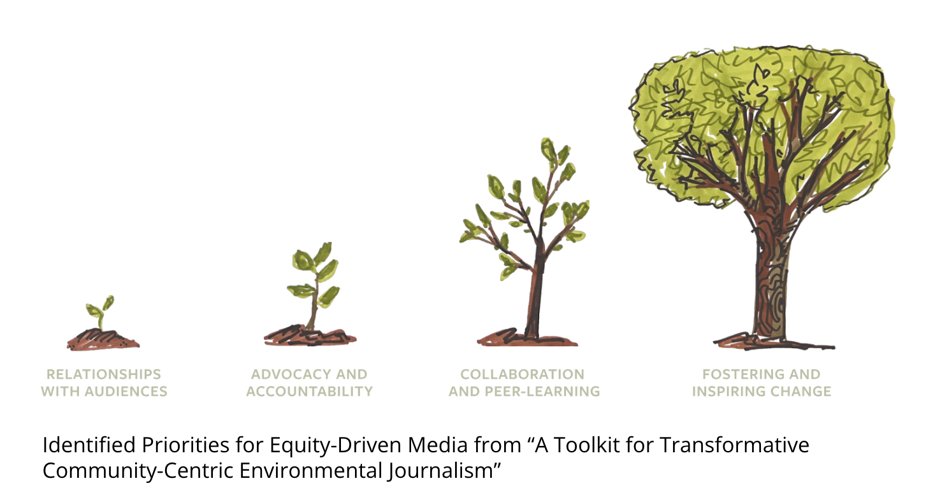
Pictured above are four key priorities for transforming extractive story telling models into equitable community-centered approaches. These priorities emerged from stakeholder interviews and include 1) relationships with audiences, 2) advocacy and accountability, 3) collaboration and peer learning, and 4) fostering and inspiring change. They form the backbone of the toolkit and are organized in a stepwise fashion to help organizations determine which priority best fits both their current capacity and future aspirations. Their illustration as a tree’s growth cycle represents the idea that organizational change is always ongoing.
To get started, organizations identify a priority and then select two or three goals that align with their capacity and current interest. Using both the toolkit and complementary organizational workbook, users can explore strategies to achieving their goals and track their progress in their workbook, while engaging with direct quotes from our collaborators that describe the applicability of these goals to achieving community-based environmental story telling.
Note: This work represents the results of independent research and analysis and does not imply endorsement by the author’s employer.