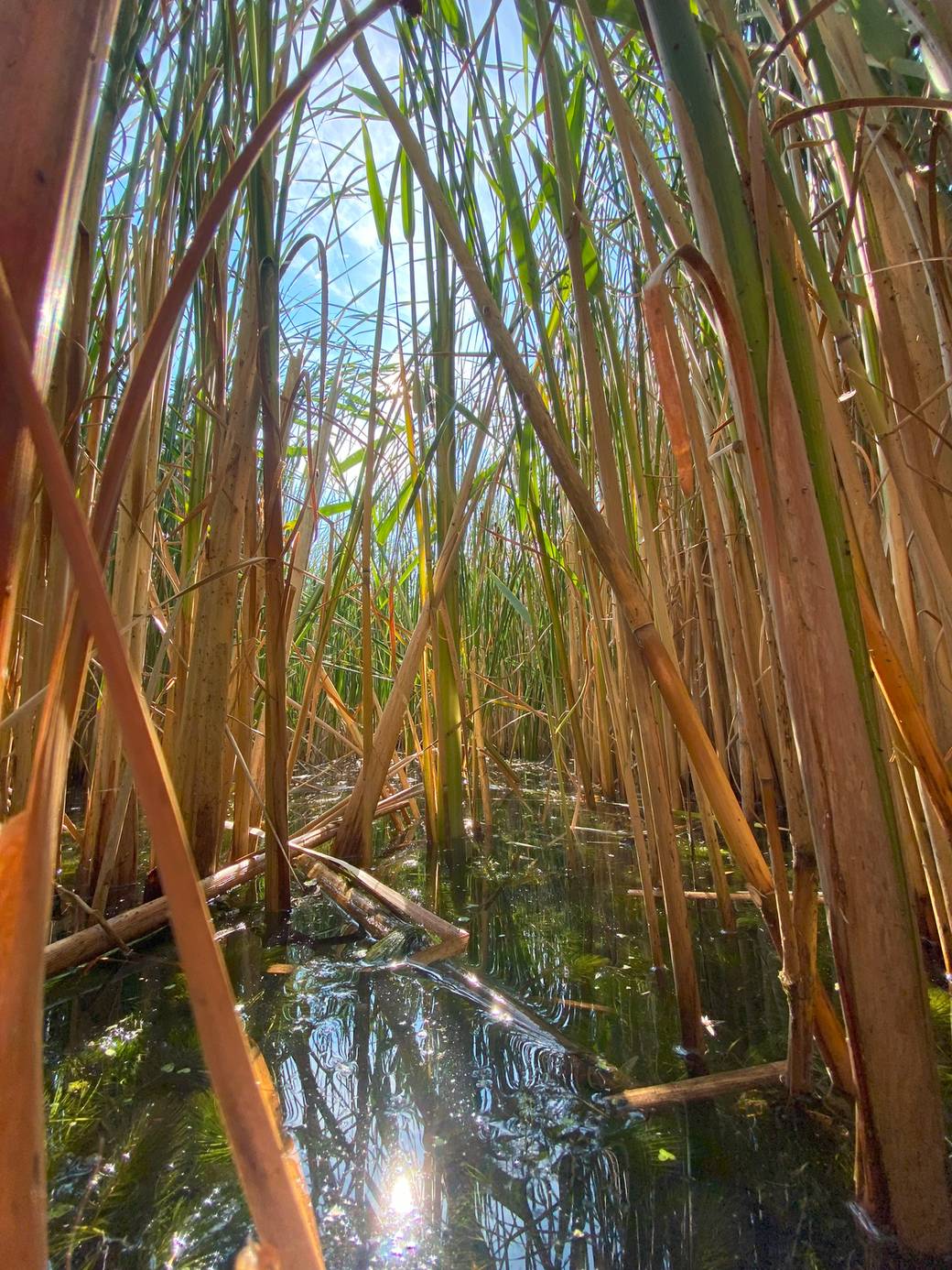
A pervasive problem plaguing both plant and animal biodiversity in wetland ecosystems across many areas of the Great Lakes is the growth and spread of invasive species such as European common reed (Phragmites australis subspecies australis). Phragmites australis can grow up to 4 to 6 meters, comparable to the height of the average male giraffe. Two thirds of its entire biomass is actually located below ground. P. australis has also been identified as a direct threat to 25% of Ontario’s species at risk and has been classified as Canada’s Worst Invasive Plant since the early 2000s. To the benefit of ecosystems all over the province, efforts are underway to control its spread and suppress its growth. To contribute to important science-based guidance for these efforts in southern Ontario, students in the Waterloo Wetland Lab (WWL), spearheaded by Rebecca Rooney at the University of Waterloo, have worked alongside both governmental and non-governmental groups to fill in critical knowledge gaps.
Contributing to long-term monitoring
Mechanical treatment options were largely unsuccessful at suppressing P. australis growth in wetlands in Canada through the 2000s and 2010s, but chemical control options were limited to areas without standing water by federal regulations, leaving P. australis to grow unchecked in Ontario’s open water marshes. In 2016, a pilot project was approved to test the efficacy and safety of the herbicide formula Roundup Custom, which contains the active ingredient glyphosate. This trial took place under an Emergency Use Registration motivated by the documented effects the invasion was having in two important coastal wetlands on the north shore of Lake Erie: the Long Point World Biosphere Reserve and Rondeau Provincial Park. In the years since, the project has successfully treated 1,500 hectares of P. australis through an impressive coalition involving Environment and Climate Change Canada’s Canadian Wildlife Service, the Ontario Ministry of Natural Resources, the Nature Conservancy of Canada, and many other partners. The WWL contributed to monitoring the effects of the herbicide application on the wetland environment, its efficacy in suppressing invasive P. australis, and the recovery of the native plant community following treatment.
Early results were promising in that the helicopter- and ground-based applications of herbicide achieved a persistent 95% reduction in the stem density of invasive P. australis. Additionally, the glyphosate applied never reached concentrations of toxicological concern to aquatic biota and quickly dissipated from the water and sediment in the treated marshes. These data were crucial in building the evidence base that led to an expansion of treatment efforts across the province of Ontario.
However, the initial outcome for native plants was less optimistic. WWL researchers observed reductions in plant community diversity, evenness, and floristic quality in the years immediately following treatment. More alarming, they found the treated marshes were consistently overrun by what they termed “secondary invasions.” Megan Jordan, a former graduate student in the WWL, explains secondary invasions as “the phenomenon where other non-native plants like European frog-bit (Hydrocharis morsus-ranae) and Eurasian milfoil (Myriophyllum spicatum) effectively replace P. australis in the ecosystem.”
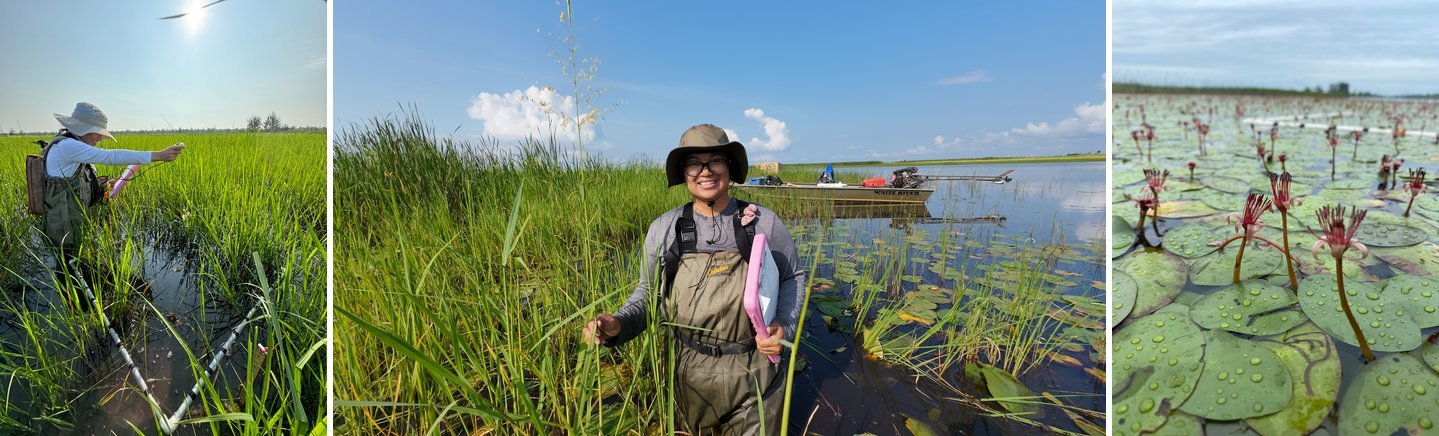
Long-term monitoring after invasive plant suppression activities is not common because of resource constraints and term-limited funding, leaving key uncertainties around the ultimate consequences of treatment for wetlands. Most studies into treatment efficacy only report on plant community changes for one to three years after the treatment. Fortunately, the Emergency Use Registration pilot project committed to a minimum of five years of post-treatment monitoring, as the secondary invasions were not the end of the story.
Within three years of the herbicide application, the WWL found native plant species began replacing those secondary invasions and the plant community diversity and evenness began to recover. This occurred without active revegetation interventions like seeding or planting, but as a part of natural succession in the marshes. By the fifth year after treatment, 78% of the monitoring plots were dominated by native plants and during the seventh and eighth year of monitoring, the plots in treated areas were floristically indistinguishable from reference plots in areas where P. australis had never invaded.
“A major outcome of our monitoring is that it highlights how important it is to support long-term monitoring,” notes Jersey Allyson Fontz, a Ph.D. candidate in the WWL who led parts of this work. “We have so much more to learn after the first couple of years if we want to understand the ultimate outcome for the plants and for the marsh community.”
We have so much more to learn after the first couple of years if we want to understand the ultimate outcome for the plants and for the marsh community.
Testing established techniques in novel ways
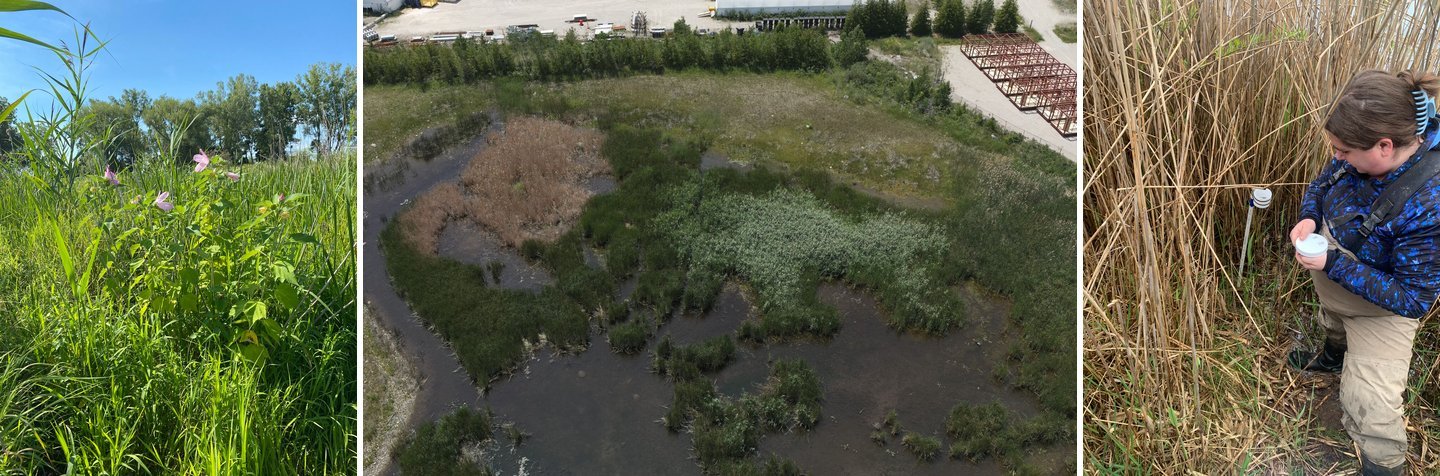
While helicopter-application of herbicide is extremely effective at suppressing P. australis in extensive monocultures, when P. australis occurs in smaller patches interspersed with native plants, this large-scale herbicide application causes collateral damage to neighboring plants because of drift of the pesticide and the large swath width of the helicopters. This can even impact species at risk such as swamp rose-mallow (Hibiscus moscheutos) that grows nearby P. australis.
The Invasive Phragmites Control Center (IPCC), led by Janice Gilbert, is pioneering a more precise herbicide application method with a newly approved imazapyr-based herbicide using drones. This approach has the potential to improve target accuracy by spraying herbicide only on the target invasive species while avoiding surrounding vegetation. Using drones can also minimize disturbance to the marsh associated with moving heavy ground equipment through. In addition, notes former WWL graduate student Grace Lew-Kowal who worked alongside the IPCC, “herbicide applied by spray drone was at least, if not more, effective at suppressing P. australis as helicopter or ground-based application methods with a 99% reduction in live P. australis stems.” Furthermore, with the use of drones, herbicide drift was 96% lower compared to helicopter spraying. This technology for applying herbicide precisely may ultimately enable treatment of P. australis in areas that are too difficult or dangerous to access over the ground but where helicopter application would cause too much damage to native plants.
Biocontrol as a new technique
Broad-spectrum herbicides are by far the most common P. australis treatment method used, but as discussed above, their effect on such a wide range of plants leads to collateral damage for desirable native plants. Moreover, some communities raise concerns about repeated exposure to herbicides. Biocontrol—the use of target-specific live organisms to manage, not eradicate, an invasive species— can offer a gentler alternative. It can also offer cost savings, as the biocontrol organisms can develop self-supporting populations that do not require the same level of resource investment and personnel time that herbicide treatment necessitates. In 2019, the Canadian government approved two European moth species for release as biocontrol agents on invasive P. australis, thanks to more than 20 years of research by the P. australis biocontrol program, led by scientists with the University of Toronto, Agriculture and Agri-Food Canada, CABI in Switzerland, and Ducks Unlimited Canada, among others. The stem-boring caterpillars of these moths feed and mature inside the tall stems of invasive P. australis, harming the plants. Working with this team, WWL researchers were able to measure the effects of these two moth species—Archanara neurica and Lenisa geminipuncta—on P. australis performance at experimental release sites across southern Ontario. Claire Schon, the Ph.D. candidate in the WWL in charge of contributing to the biocontrol work says, “early results from our research are promising. For example, at one site, there was a 26% overall reduction in P. australis canopy height and only 1% of the P. australis stems bore flowers in just two years after the moth releases.” The moth populations are also able to grow and persist through time at release sites as the WWL team even documented their ability to spread and colonize new patches of invasive P. australis as much as 400 meters away. These results provide hope that long-term and sustainable management of P. australis through biocontrol is a viable option.
Hope for the future of invasive species research
Invasive species do not recognize borders or jurisdictional boundaries. Collective action has emerged as a successful partnership model whereby landowners, multiple stakeholders, government agencies, and community groups work collaboratively to coordinate invasive species management, rather than through a series of isolated activities. The collective-action approach benefits from increased efficiency, greater community buy-in, and shared experience. These advances in management techniques and the enhanced understanding of plant community recovery are outcomes of this collective action model and underscore the benefits of broad collaboration in invasive species management. As Rooney notes, “collaboration should be at the forefront of scientific research beyond invasion biology because it is through enduring research partnerships that we make progress to conserve biodiversity.”