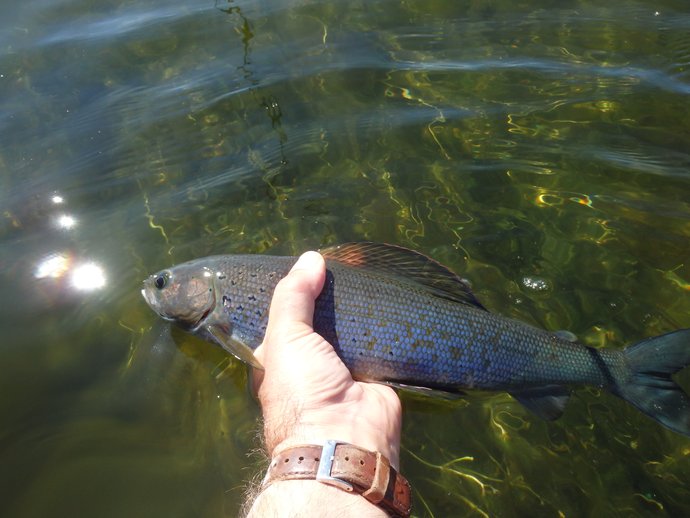
A native fish that disappeared from Michigan nearly a century ago may once again ply the coldwater streams of the state's Lower Peninsula. Arctic grayling, or Nmégos in Anishinaabemowin, is the area’s only native stream salmonid. By the 1930s, they were wiped out due to logging, overfishing, and competition from introduced species.
A coalition of more than 50 partners known as the Michigan Arctic Grayling Initiative (MAGI) hopes to change all that. In 2016, the Little River Band of Ottawa Indians (LRBOI) and the Michigan Department of Natural Resources (MDNR) proposed the initiative. Its aim is to establish self-sustaining populations of grayling within its historical Michigan range. MAGI partners visited Montana to study a successful grayling reintroduction program there, and they tested new technologies on northern Michigan streams to identify the most suitable locations and methods for reintroduction. In 2019, they received fertilized eggs from Alaska and ultimately raised three generations of broodstock.
In May, the MDNR will provide approximately 400,000 grayling eggs from this broodstock to the LRBOI, the Little Traverse Bay Bands of Odawa Indians, and the Grand Traverse Band of Ottawa and Chippewa Indians. These partners will reintroduce the eggs at locations along the North Branch of the Manistee River, the Maple River, and the Boardman-Ottaway River.
“The reintroduction of Nmégos serves to reconnect the Anishinaabe people with their cultural heritage that has been lost for such a long time,” notes Archie Martell, LRBOI Fisheries Division Manager. “I am very excited about this introduction of Nmégos back into Michigan waters and for the opportunity for everyone to interact with this fish soon.”
Taking a cue from successful efforts in Montana, partners will place grayling eggs in streamside incubators to hatch directly into the rivers rather than raising them in hatcheries and then relocating the young fish. This approach will allow the newly hatched fish to imprint on the unique chemical signature of their home river and use it to return there to reproduce. “Without imprinting, Grayling may migrate far from where they are planted, and fail to reproduce in streams and rivers that are best suited for survival,” write Martell and LRBOI Fisheries Biologist Dana Castle in a 2020 stewardship plan. “Grayling need to imprint on their home stream.”
Researchers suspect that previous efforts to reintroduce grayling were unsuccessful in part because the fish were released later in their life cycles and failed to imprint. MAGI partners will closely monitor the hatching and development of the fry, as well as follow up on how they move through these systems as they grow.