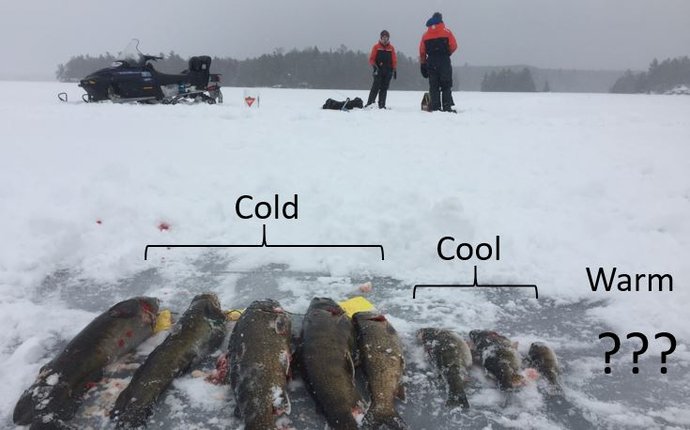
For temperate fishes, winter is a dramatically different environment than all other seasons: temperatures decline to near freezing, light is reduced, and, in some systems, oxygen and prey density also decline. As any ice angler can attest, fishes respond differently to these winter conditions; some remain active, while others become inactive (see image). However, the ecological consequences of differential responses to winter in fish communities remain poorly studied.
Our paper demonstrates how fish habitat use and activity differ from summer to winter and vary among coexisting species. Specifically, using acoustic telemetry, we show that lake trout (Salvelinus namaycush) move nearshore into littoral habitats and remain active throughout the winter. In contrast, smallmouth bass (Micropterus dolmieu), a littoral warm-water species, move to slightly deeper water and dramatically reduce their activity rates, weakening the potential for interspecific competition in this species pair. Activity patterns for lake trout and burbot (Lota lota), two cold-water species, are also shown to diverge throughout the year.
We argue that winter could play a widespread role in promoting coexistence in freshwater fishes. Periods of low temperature, light, and oxygen provide rich opportunities for species to diverge, and these divergent responses to winter appear widespread both across and within thermal guilds. Alarmingly, competition models developed in our study suggest that shorter winters, already arising under a changing climate, threaten this seasonally mediated coexistence. Quantifying how diverse physiological and ecological responses to winter vary across species and populations and shape species interactions from small to large lakes remains a fruitful avenue for future research.