Describe your work.
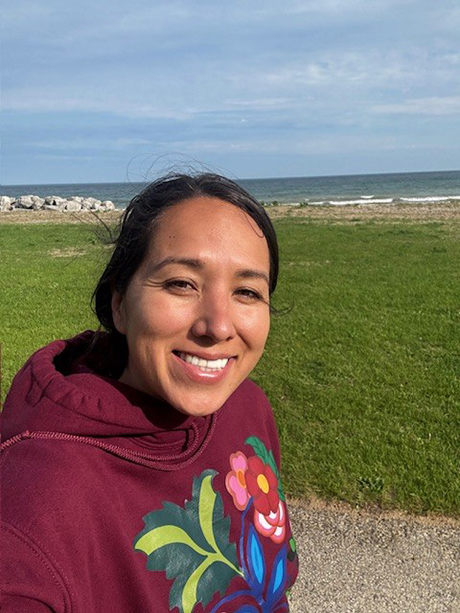
I work with the Great Lakes Fishery Commission as a Great Lakes Indigenous fisheries postdoctoral fellow on a variety of projects and initiatives. These include the Ginebigomeg (sea lamprey) project focused on enhancing the collective understanding of Indigenous relationships with Ginebigomeg and their control. Begun in 2025 and funded by the commission, the project has a large interdisciplinary team led by Dr. Sue Chiblow of the University of Guelph and member of the Garden River First Nation. Another project is titled Connecting Indigenous stewardship across continents: Identifying pathways for equitable fisheries governance in Canada and Uganda. It brings together two First Nation communities along with three Indigenous communities in Uganda. This project was recently funded by the International Development Research Centre and led by the Cross-Cultural Foundation of Uganda. Lastly, I am working alongside Elders with Naugon Associates and other Indigenous leaders across the Great Lakes basin to advance the Inaaknigewin: Giigoonyag, Nibi ge Aki (Anishinaabe Law: Fish, Water and Earth) Initiative, focused on reaffirming and revitalizing Indigenous relationships with fish, water, and the land.
Prior to joining the commission, I lived in Alaska for 10 years, where I spent much of that time working for Tribes and Tribal consortia on various salmon and community-based projects. My dissertation research focused on documenting the breadth and depth of Alaska Native values, knowledge systems, and governance systems pertaining to salmon in order to achieve more equitable and inclusive salmon governance systems. I was able to bridge knowledge systems and perspectives through a case study that also included federal and state agency managers and researchers. My dissertation shed light on key mechanisms for improving salmon management and enhancing Alaska Native inclusion in current fisheries governance systems.
What inspired you to enter this work?
Much of my work is inspired directly by the Indigenous communities I collaborate with. I ground my research in values including but not limited to respect, relationality, relevance, reciprocity, and responsibility. I have a responsibility as an Anishinaabekwe (Anishinaabe woman) not only to the water, but to all of my relations. Through my position at the commission, I am able to fulfill some of these responsibilities by centering relationality and focusing on fish and water with Indigenous leaders, communities, and others.
If you could brief policymakers on one Great Lakes issue that urgently needs attention, what would it be and why?
I would urge policymakers to take action and provide financial support to address the adikameg (whitefish) population declines—with an emphasis on Lake Michigan and Lake Huron—given their significance as a cultural keystone species and their economic importance to many communities across the Great Lakes basin. I would also urge policymakers to protect nibi, our shared waters, as they continue to face threats of diversion, extraction, and commodification that may have devastating impacts on all the life they support. Finally, I would urge policymakers to pursue opportunities to more equitably include Indigenous leadership in Great Lakes fisheries governance.
What is something about yourself that you’d like to share with other IAGLR members?
Upon returning home to the Great Lakes after being gone for several years, my son, husband, and I spend quite a bit of time with our relatives and outdoors in the woods, rivers, and lakes as often as we can. I enjoy outdoor walking and running, attending cultural gatherings, doing yoga, listening to music, dancing, and spending time with loved ones.