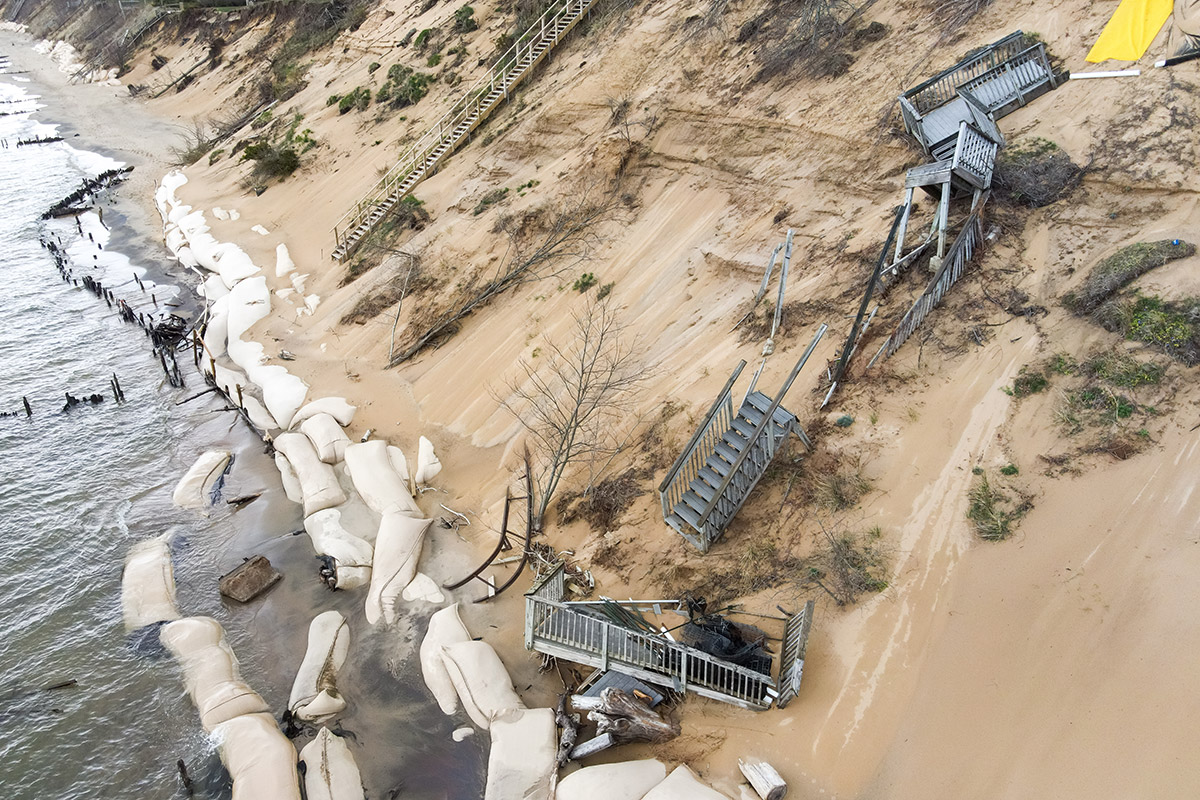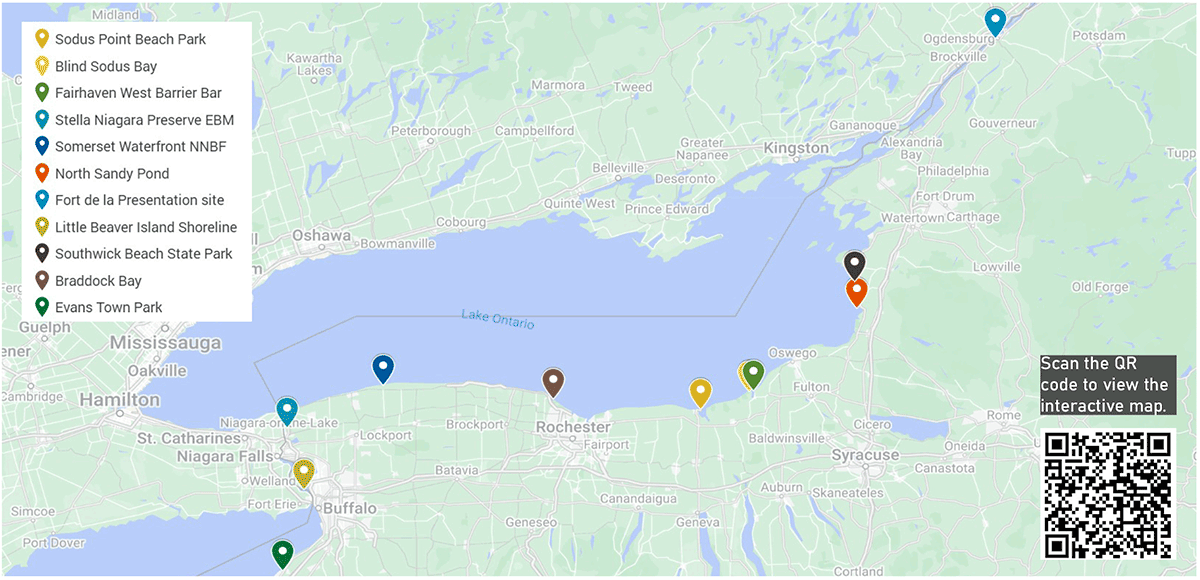
Communities along New York’s Lake Ontario shoreline are increasingly vulnerable to flooding and erosion as climate change drives greater lake-level variability. In response, the state launched the Coastal Lakeshore Economy and Resiliency (CLEAR) initiative in 2019, following rapid funding through the Resiliency and Economic Development Initiative. CLEAR aims to work with communities to identify adaptation strategies, prioritizing landuse approaches and nature-based demonstration projects over reactive shoreline armoring.
This effort reflects a broader policy shift toward long-term resilience, supported by the 2014 Community Risk and Resiliency Act and the Climate Leadership and Community Protection Act. Federal priorities also align, notably through the 2022 Nature-Based Solutions Roadmap. Yet, despite this momentum, a local “adaptation deficit” persists. Shoreline hardening remains the dominant response: 16% of the U.S. Lake Ontario shoreline is classified as “artificial,” and 40.6% is armored across the U.S. and Canada (USACE, 2020; State of the Great Lakes, 2022).
To understand this gap, our research assessed barriers to adaptation using a mixed-methods approach that combined practitioner interviews, document reviews, and participation in public meetings. Using a diagnostic framework by Moser and Ekstrom (2010), we conceptualized adaptation as a process moving through three phases: understanding, planning, and managing. Barriers can emerge at each stage and often compound.
In the understanding phase, communities directly impacted by recent high-water events prioritize flooding, while inland residents often do not. Competing narratives about the causes of flooding further shape how risks are interpreted.
In the planning phase, constraints are structural. Many municipalities operate with limited staff, technical expertise, and time, resulting in reactive approaches. Governance is fragmented, with authority split across local, county, and state actors, and much of the shoreline remains under private ownership. Even where data and tools exists, stakeholders struggle to navigate scattered and sometimes outdated information.
Barriers become most visible during implementation. Nature-based approaches—such as restored beaches, dunes, and living shorelines—are often seen as infeasible. Stakeholders cite high wave energy, steep bluffs, limited parcel sizes, and competing priorities such as maintaining lake views. Uncertainty around siting and design, limited contractor expertise, and complex permitting pathways further complicate adoption. These challenges are reinforced by a strong path dependency on shoreline hardening; rooted in familiarity and established engineering standards, gray infrastructure remains the predictable choice.
Similarly, resilient land use policies—zoning updates, setbacks, and conservation overlays—face persistent hurdles. Local governments hesitate to adopt regulations that might affect property values or reduce tax revenue, particularly in high-value shoreline areas. These challenges are compounded by limited legal and technical capacity and the time-intensive nature of adopting new local laws.
Taken together, our findings suggest the challenge is not simply a lack of awareness or funding. Rather, it reflects a mismatch between how adaptation strategies are promoted and the conditions under which they must be implemented. As new state-led tools and funding streams create opportunities, overcoming these barriers will be critical. Supporting shoreline adaptation in the Great Lakes will depend not just on advancing new ideas, but on making them workable within the realities of local decision-making.