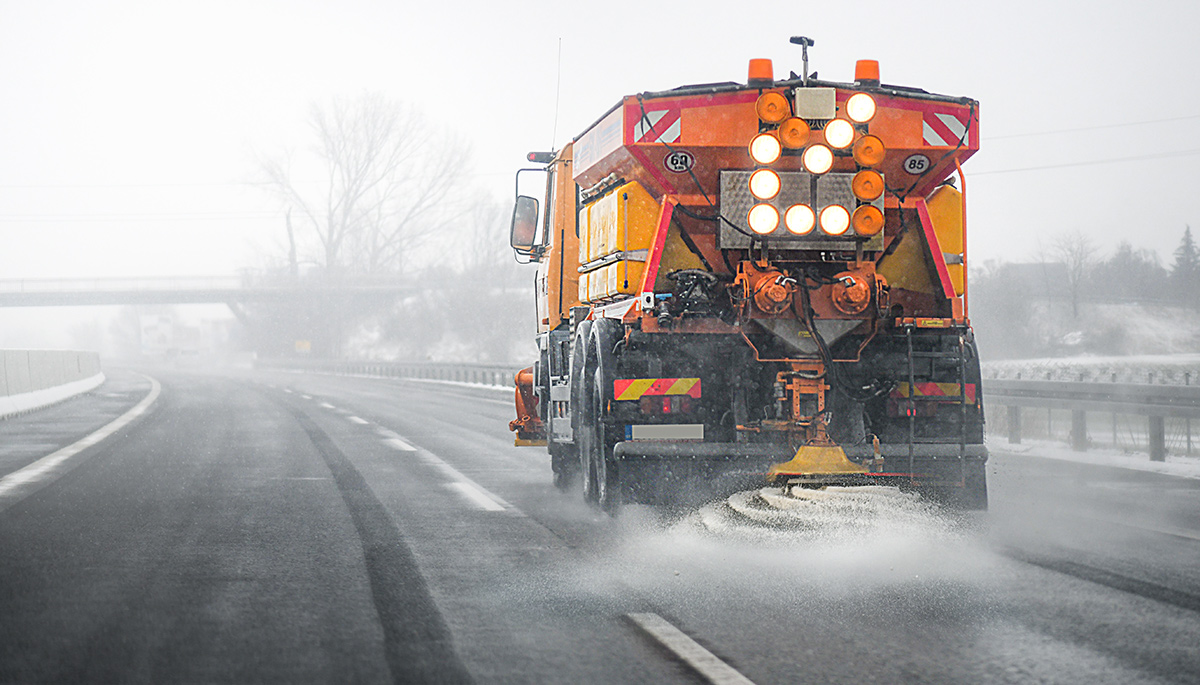
Every winter, road crews, homeowners, and property managers across the Great Lakes basin reach for the same solution they have relied upon since the 1940s: salt. Cheap, effective, and familiar, salt—predominantly sodium chloride (NaCl)—has become the default tool for keeping roads and sidewalks passable through ice and snow. But what happens to all that salt once it washes off our streets and parking lots? It flows into our streams, lakes, soils, and groundwater, and it doesn’t leave.
Salt pollution is now one of the most pervasive and underappreciated water quality threats facing the Great Lakes basin. Chloride, the toxic fraction of NaCl, is rising in freshwater systems across the region, and unlike many other pollutants, there is no natural process that removes it once it enters the water. The cumulative load of chloride from decades of winter road maintenance is reshaping the chemistry of the basin’s freshwaters. For instance, from 1980 to 2020, chloride concentrations in Lake Michigan increased from 9 to 15 mg/L, an annual increase of about 0.125 mg/L. More dramatically, Lake Simcoe in central Ontario is already at an average chloride level of 61 mg/L and is projected to see an increase of 0.7 mg/L chloride per year, reaching an average of 120 mg/L by the 2050s—the Canadian Council of Ministers of the Environment’s (CCME) long-term exposure threshold. Many watersheds are experiencing spikes in chloride that exceed seawater levels (19,400 mg/L). Notably, Newmarket’s Western Creek registered a reading of 26,000 mg/L in February 2025, and Ottawa Riverkeeper’s monitoring of Green’s Creek registered above 20,000 mg/L.
The CCME’s chronic guideline was not designed to protect soft-water ecosystems like those on the Canadian Shield. Research shows that at the low water hardness typical of Muskoka’s lakes, protective chloride thresholds should be as low as 64 mg/L. Some Shield lake species begin showing reproductive failure and increased mortality at concentrations as low as 5 mg/L, well below the CCME's 120 mg/L limit. Most Muskoka lakes haven’t yet reached the CCME’s chronic threshold, but that’s cold comfort when the science shows damage occurring at a fraction of that level. Both the guideline and the pollution are problems.
The threat is even more direct for groundwater. Waterloo, Ontario, for instance, draws most of its drinking water from aquifers in the Paris and Waterloo moraines, and those aquifers are showing elevated chloride from decades of road salt application on the surfaces above. Unlike surface water contamination, groundwater cannot be flushed or filtered by natural processes. What goes in stays in. This also applies to lakes: natural removal in Lake Erie would take about seven to nine years, 25 years in Lake Ontario, and 500 to 600 years in Lake Superior.
Salt pollution is now one of the most pervasive and underappreciated water quality threats facing the Great Lakes basin.
The alternatives market offers little relief. While products like potassium chloride, magnesium chloride, and calcium chloride are marketed as substitutes, research shows they can be even more toxic to aquatic organisms than sodium chloride. Similarly, “natural” products have proven just as harmful. Physical alternatives like sand disrupt aquatic habitat and damage terrestrial ecosystems through extraction. The most promising reductions come not from substitution but from doing things differently: optimized plow timing, anti-icing techniques, adjusted speed limits, and snow tire requirements (that are still not mandatory in Ontario).
None of that matters much without policy that creates real incentives to change, and that’s exactly what we don’t have. In 2001, the Canadian federal government concluded that road salts met the criteria for toxic substances under the Canadian Environmental Protection Act, then opted for a voluntary code of practice rather than regulation. More than 20 years later, salt use has not stopped growing.
At the provincial level, Ontario has water quality objectives and guidelines but no enforceable targets for groundwater quality or water availability. The province’s Safe Drinking Water Act applies only to treated drinking water and not to the protection of the surface or groundwater sources that feed it. Between 2003 and 2019, 24% of monitored groundwater wells showed increasing chloride trends, with no binding framework to respond.
This regulatory gap is not unique to Canada. Across the border, the United States applies over 24.5 million tons of road salt annually, according to the Cary Institute of Ecosystem Studies in New York, with Great Lakes states being the heaviest users.
Moreover, the U.S. EPA’s chloride criteria are less strict than Canada’s: 230 mg/L for chronic and 860 mg/L for acute.The thresholds are not legally enforceable rules, because the criteria only become regulatory once a state adopts them into its own water quality standards under Section 303 of the Clean Water Act.
Some action has happened at the state level, where a handful of states have taken meaningful steps. Minnesota has built out one of the most comprehensive approaches, including a statewide chloride strategy, a Twin Cities metro total maximum daily load (TMDL) study, and chloride management requirements built into municipal separate storm sewer system (MS4) permits. Wisconsin also has developed its own TMDLs and variance programs. The state’s MS4 permit framework requires communities discharging to chloride-impaired waters to include chloride reduction measures in their stormwater management programs, but typically focuses on winter road maintenance rather than removing the chloride during treatment.
When the cost of a lawsuit far outweighs the cost of extra salt, applying more is the rational choice, leaving the Great Lakes’ freshwater reserves increasingly compromised.
Many Great Lakes states look to New Hampshire’s RS 489-C as a single change that could move the needle on private road salt application. New Hampshire passed a law limiting liability for certified applicators from the Green SnowPro Program, recognizing that private contractors over-apply salt because they’re afraid of slip-and-fall lawsuits. Yet outside New Hampshire, most jurisdictions lack comparable policy tools to regulate salt use on private property, and the economic logic of over-salting prevails on both sides of the border. When the cost of a lawsuit far outweighs the cost of extra salt, applying more is the rational choice, leaving the Great Lakes’ freshwater reserves increasingly compromised.
Municipalities throughout the basin are left holding a problem they can’t fully address. On public roads, crews face reputational and legal risk for under-salting; on private property, contractor liability drives over-application. Meanwhile the long-term costs of chloride pollution fall on no one’s ledger. Reforming liability legislation to protect operators who follow best management practices—as New Hampshire does—is one of the most impactful near-term changes available, and one of the most consistently overlooked.
Meanwhile, urban sprawl is expanding the impervious surfaces that need de-icing each winter, climate variability is making freeze-thaw cycles less predictable, and economic pressure keeps salt cheap and attractive.
The Great Lakes hold roughly 20% of the world's surface freshwater. The communities that depend on them deserve water quality standards that reflect that significance. Salt pollution is solvable, but solving it will require enforceable guidelines, liability reform, and a cultural shift toward treating salt as a last resort, not a first response.