Across the Great Lakes basin and beyond, the converging pressures of climate change, biodiversity loss, pollution, and environmental and social injustices call for new ways of working together. Effective science-policy—grounded in cooperation, collaboration, and consensus-based processes—is one such pathway. Among multilateral science-policy platforms, the most recognized include IPCC (climate change), IPBES (biodiversity), and the newly launched ISP-WCP (chemical pollution). Until earlier this year, all Laurentian Great Lakes and African Great Lakes countries participated in these UN-supported platforms through governmental representation and expert contributions. But international science policy can feel remote from local and place-based research and practice. Mobilizing knowledge about platforms such as IPBES can help bridge that gap.
Humans are not only dependent on but a part of Nature, and transformative change is needed to reverse declines in biodiversity, climate, and pollution.
About IPBES
Established in 2012 as a sister platform to IPCC, the Intergovernmental Science-Policy Platform on Biodiversity and Ecosystem Services has become a leading resource for multilateral agreements including the Kunming-Montreal Global Biodiversity Framework. IPBES learned from IPCC's experience about the importance of capacity building and working across plural knowledge systems. After more than a decade and 14 assessments, IPBES has pushed intergovernmental platforms toward more meaningful inclusion of Indigenous knowledge systems, epistemologies, and cosmologies as part of its multievidence-based approach to synthesis.
A key outcome of these assessments is the convergence of knowledge: they establish patterns and processes that Indigenous Peoples and local communities have known about Nature since time immemorial, now confirmed through multiple lines of Western science-based evidence. The message is clear: Humans are not only dependent on but a part of Nature, and transformative change is needed to reverse declines in biodiversity, climate, and pollution (IPBES TfC 2024). Globally, IPBES findings show that Indigenous Peoples steward disproportionate levels of biodiversity in their territories while being disproportionately impacted by environmental degradation (IPBES 2018 Global Assessment). Heightened geopolitical uncertainty is driven by increased environmental uncertainty, given Nature's central role in all businesses (IPBES B&B 2026). Despite these trends, solutions are within reach. Leaning into relational processes—cooperation, consensus building, and collaboration—is needed now more than ever.
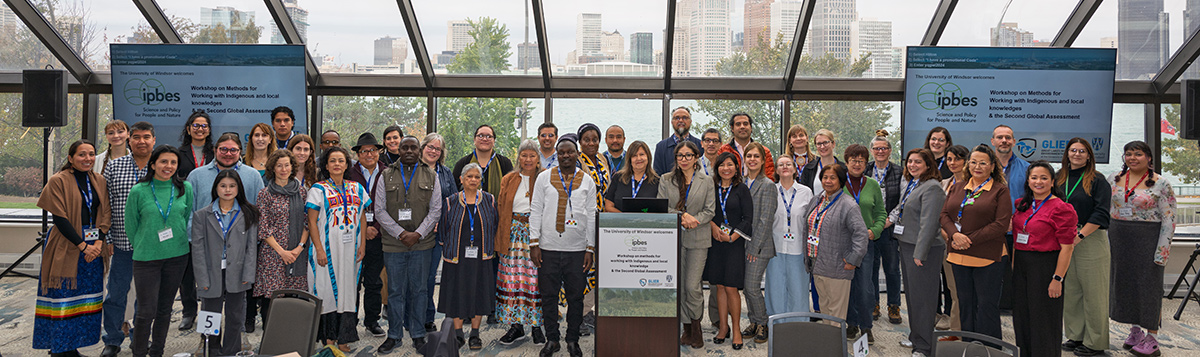
IPBES is more than the reports it produces; it is also a network and a set of processes united by a shared vision for a positive future for Nature and People. After more than a decade of effort, this article connects that global vision to the Great Lakes by sharing the experiences of scholars who have engaged with IPBES, including reflections on a recent workshop in Windsor, Canada (November 2025). In their own voices, diverse IPBES authors and participants from the Laurentian Great Lakes reflect on their experiences and visions for a community of practice to strengthen science-policy interactions locally, regionally, and globally.
On engaging the science-policy interface
Peter Stoett (Professor and Dean of Social Science and Humanities, Ontario Tech University, Co-Chair of the IPBES Invasive Alien Species Assessment): “It is absolutely essential that interdisciplinary approaches to the large-scale problems of our time are fostered through a community of scholars and practitioners. For my own work, it is an opportunity to learn about other disciplines engaged in the assessment, as well as to collaborate with new and interesting and incredibly talented people. On the Great Lakes, most of my work has been based in the policy realm; I’d welcome the opportunity to work more closely with those engaged in the scientific work of understanding the immense challenges the basin faces. I found that IPBES carries some respectable weight when it comes to getting policy attention, though this might be more a reflection of media coverage than genuine science-policy interfacing.”
Participatory processes and diverse knowledge systems
Engaging multiple lines of evidence—not just standard peer-reviewed literature—is central to IPBES assessments. In-person, place-based dialogue workshops are a key participatory mechanism, especially for ethical engagement with Indigenous and local knowledge. Unlike IPCC, IPBES has a dedicated mandate to build capacity and engage diverse knowledge systems, reflected in its Fellows programme for early-career researchers, its work with national governments, and dedicated task forces focused on Indigenous and local knowledge, models, and data.
Kyle Whyte (Professor, University of Michigan, Citizen Potawatomi Nation, IPBES Indigenous & Local Knowledge Task Force Member, and Co-chair of the IPBES ILK Dialogue Workshop in Windsor): “Indigenous Peoples in the region should be able to lead their own institutions that make connections across local conservation practices, governance, research, and law and policy. First Nations and Tribal nations should have programs that encourage community members in a range of Indigenous and scientific knowledge systems and that uplift community members in environmental decision-making so that governance is cooperative and participatory. The governance decisions Indigenous Peoples make should have access to the best information, whether from First Nations or Tribal colleges, or from their being independent Indigenous-led science assessments that deliver policy-relevant knowledge about the environment. First Nations and Tribal governments, then, should have reciprocal relationships with First Nations and Tribal colleges and research institutions. First Nations and Tribal institutions, whether Traditional Knowledge programs, governments, colleges, or research institutions, should be able to send delegates to major policy fora to represent the knowledge, interests, and brilliance of Indigenous Peoples. Policy fora should recognize Indigenous delegates, including them at each relevant level of the policy process. In this way, Indigenous Peoples begin to enjoy the same access to levers of change and education for the sake of environmental protection.”
Abraham Francis (Deer clan from Akwesasne, Policy Analyst, Chiefs of Ontario, and IPBES ILK workshop participant): “Policy is important to me because it can harm communities and is often defined without our voices. They are not passive tools but powerful mechanisms with the potential to exacerbate harms, especially for Indigenous Peoples. I show up and engage as a commitment to harm reduction for my people, ancestors, future generations, and creation. I have always been extremely critical of these global mechanisms. I am firmly situated in the power of local community work to create real change. However, more recently, I have become interested in connecting the local and global, which the Haudenosaunee have been doing for centuries.”
Dawn Martin-Hill (Professor Emerita, McMaster University, IPBES workshop participant): “Enhancing the role of Indigenous knowledge in the science-policy interface is a key objective of our work at Ohneganos Ohnegahdę:gyo at Six Nations of the Grand River. Indigenous knowledge and place-based ecological knowledge must be recognized as central to addressing real-world challenges. However, to be truly impactful, the funding landscape must change so that Indigenous-led conservation, water security, and climate mitigation receive support similar to that of mainstream conservation organizations.”
Building capacity at the science-policy interface
IPBES’s Capacity Building Task Force has delivered a long-standing Fellows programme connecting early career researchers with assessments as authors, providing mentorship and networking. This programme has propelled fellows into other science-policy roles within their own institutions, governments, and multilateral processes.
Sarika Sharma (University of Windsor, early career researcher): “The Windsor IPBES workshop offered excellent insight into the realities and importance of multiscaled policy making and the inclusion of Indigenous and local knowledge voices. It was refreshing to see space being held for the honest, respectful, and vulnerable sharing of these diverse perspectives. And it was also a reminder that policy is created by and meant to adapt with people and communities. For policies to be truly effective, diverse voices need to be part of policy-making processes through relationship and reciprocity. Policies are not perfect, nor are people, but their re-evaluation is not a failure. Instead, these discussions are a natural opportunity for dialogue and connection. They are critical to improving policy relevance, strength, and stature as a common ground for all.”
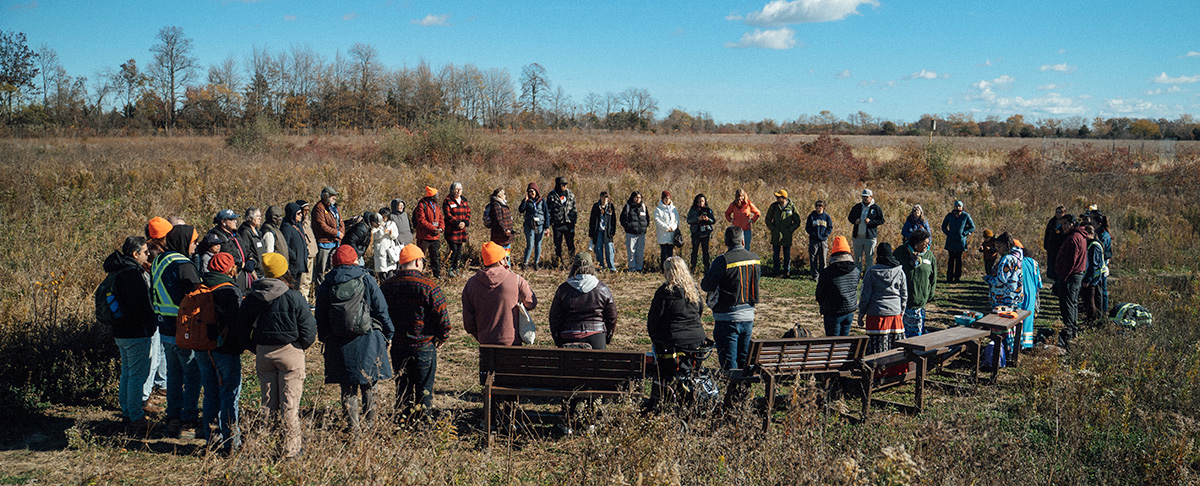
Abraham Francis: “It was wonderful to build community at the IPBES workshop in Windsor through discussions, dinners, and an adventure to Peele Point. For a community of practice, the creation of a fund to support the organizing and meeting of Indigenous Peoples around the Great Lakes is critical—cultivating relationships and translating global messages into collaborative solutions for local contexts. Indigenous Peoples participating in these spaces tend to find themselves over-extended and alone. These spaces offer hope through a knowledgeable and culturally grounded group to care for each other.”
Toward transformative change
Transformative change is defined as “fundamental, systems-wide shifts in views, structures and practices that address the underlying causes of biodiversity loss and nature’s decline” (IPBES 2026). The evidence underpinning assessments emerges from years-long collaboration between scientists, knowledge holders, governments, and organizations. Yet transformative change remains elusive, partly because many still don’t connect global science-policy platforms to on-the-ground actions and regional collaborations across the Great Lakes.
Despite the withdrawal of the United States from UN-affiliated organizations, many U.S. citizens continue contributing to IPBES as independent scholars and practitioners. As IPBES Chair David Obura notes, the departure “harms everybody, including themselves.” He reminds us that we cannot ignore the fact that more than one million species face extinction, nor can we change the reality that the global economy loses up to $25 trillion per year in environmental impacts. Crucially, he points out the missed opportunities of inaction: failing to generate more than $10 trillion in business value and 395 million jobs by 2030.
The mandate of IPBES remains clear: to objectively provide credible science and evidence about biodiversity to all decision-makers for better-informed action. The commitment of the IPBES community to this goal—“science and policy for people and nature”—is unwavering.
Peter Stoett: “When it comes to a community of practice, it’s difficult right now to get people concerned about climate change, but Great Lakes communities will face grave problems ahead. The diminishment of aquifers and rivers will increase pressure on the lakes as commercial water prospects become more enticing. Systems thinking is more important than ever, as are the spiritual ontologies of Indigenous communities around the lakes and their connecting rivers. An effective community of practice would weave all these elements together publicly. The power of media and film should not be overlooked. Getting youth more engaged is a central question; we must improve the role of universities, but it needs to start sooner.”
Kyle Whyte: “The IPBES workshop solidified in my mind that such a system, with feedback loops and direction, is possible, not only at the Great Lakes scale but also at continental and global scales. At one level, this would be done in a way that’s authentic to Indigenous Peoples; but at another level, it’s no different from how nation states, universities, and multilateral institutions have coordinated among each other for some time—they have just excluded Indigenous Peoples from being able to operate in a multi-institutional fashion.”
Nature has taught us that diversity is a strength, and that connections across levels and over time ensure resilient and thriving ecosystems. The same holds for the Great Lakes science-policy-practice network. The diverse outputs of IPBES can strengthen local and regional priorities — but only if people pick them up and use them. To join a growing network of Great Lakes scholars and practitioners connecting IPBES to their own organizations and mandates, reach out. We will be launching a community of practice and further initiatives to ensure that global processes can have local and regional benefits.
Resources
For more information on the regional community of practice, please contact ipbes@uwindsor.ca.