Across the Great Lakes region, a transformation is underway with data centers rapidly becoming part of the landscape to power our digital lives. But as their footprint grows, so do important questions about water, energy, community, and environmental impacts. The issue is whether and how data centers can be developed sustainably in a region defined by one of the world’s most important freshwater systems.
The Great Lakes hold 20% of the world’s surface freshwater. This abundance can be misleading. Less than 1% is renewed each year, and many communities rely on groundwater and local aquifers that are more vulnerable to overuse. These finite and interconnected resources must be managed responsibly for today and tomorrow. The eight Great Lakes states and two Canadian provinces recognized this when they agreed to complementary frameworks: the Great Lakes-St. Lawrence River Basin Water Resources Compact and the Great Lakes-St. Lawrence River Basin Sustainable Water Resources Agreement. Together, these instruments create a binational governance structure where proposals to divert Great Lakes water outside the basin are generally prohibited with minor exceptions. The Compact applies to U.S. states while the Agreement mandates similar restraint across the Canadian provinces of Ontario and Quebec. Any exceptions to the prohibition on diversions require water to be returned after use.
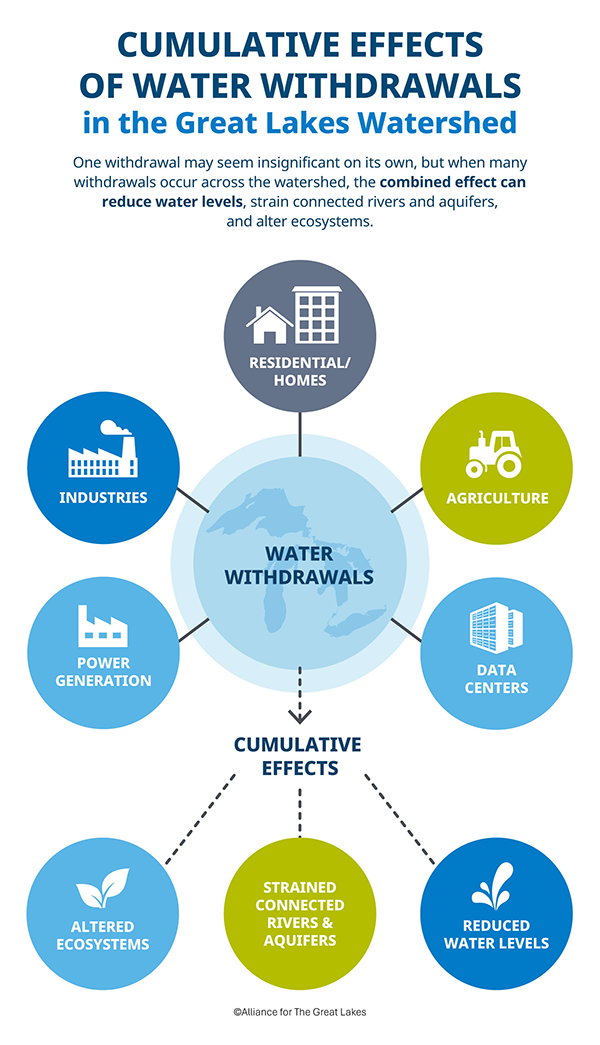 This is where data centers enter the conversation. The Great Lakes region is attractive to data centers because of its resources, relatively cool climates, infrastructure, and tax incentives. The U.S. side of the region now hosts nearly one-fifth of all U.S. data centers, with growth expected to exceed national averages through the end of the decade. But this growth can put pressure on local water systems, especially in small communities that were not designed for large and, at times, sudden withdrawals. For perspective, llinois and Ohio each host around 200 data centers, ranking fourth and fifth nationally in total count, according to Data Center Map. While Canada overall hosts about 285 data centers, located primarily in the provinces of Ontario and Quebec, numbers are not indicative of scale and the localized impact on water resources that individual data centers may have.
Data centers generate enormous heat and must be cooled constantly. Many use water-based cooling systems that can use millions of gallons per day. However, not all the water returns to the system. In evaporative cooling, a significant portion is lost to the atmosphere, effectively removing it from the local watershed. Other ways of cooling data centers are highly energy intensive. The tradeoff is a water-energy nexus:
- Water-based cooling saves energy but consumes vast amounts of water
- Air-based cooling conserves water, but demands signficantly more electricity
Non-renewable energy production itself requires water, so cooling methods that reduce water use onsite may still increase water use offsite at power plants. For example, the Vantage data center in Port Washington, Wisconsin, will reportedly have power needs reaching 3.5 gigawatts. If non-renewable sources are used to meet those needs, its off-site water use could be more than twice the amount of water used by every home, business, and manufacturer in the City of Green Bay. Even before the data center boom, 70% of reported Great Lakes water use in 2024 was associated with generating electrical power, making it the largest Great Lakes water-using sector.
Perhaps the biggest gap we face is the lack of transparency around exactly how much water an individual data center uses. Most data centers connect to public water systems and therefore aren’t required to report water use. While some companies release this information, it’s often aggregated, doesn’t address indirect or off-site water use (including for energy production), and lacks important details needed to assess an individual data center’s water resource impact. This also makes it challenging to evaluate the cumulative effect of expansion across the region.
The issue is whether and how data centers can be developed sustainably in a region defined by one of the world’s most important freshwater systems.
Each level of government has different roles to play when it comes to oversight. At the federal level, the U.S. administration is using executive power to try to fuel growth. The president has issued several executive orders facilitating this expansion—from keeping coal-fired power plants open to trying to restrict states from regulating AI. Now is the time for Congress to step up, use its legislative power on behalf of communities, and enact meaningful regulations that mandate more transparency around water and energy use so that benchmarks for water conservation and efficiency can be established. In Canada, the federal government adopted its Sovereign AI Compute Strategy in 2024 to attract data centers above 100 megawatts. Expansion in Canadian provinces continues as tensions emerge over which level of government has authority to regulate this rapidly expanding industry. An announcement earlier this month of new data centers in British Columbia was met by accusations of a “build-first regulate-later model” and calls for a moratorium on new data centers until stronger regulation and environmental policies are enacted.
Locally, communities can negotiate data center proposals to ensure community benefits, such as green infrastructure and payment for infrastructure improvements. However, state and provincial level frameworks that ensure transparency and provide consistent rules for monitoring water use and preventing pollution are necessary to reduce the regulatory and legal burden on small and under-resourced local governments. Standardized regulations can assist local municipalities to plan for both the initial build out of data centers, as well as ongoing maintenance (including e-waste management), and future decommissioning.
At the state, provincial, and Tribal levels, the most important role will therefore be ensuring sustainable water use and management. In the U.S., states are furiously considering legislation, including everything from energy- and water-use reporting requirements, bans on the use of non-disclosure agreements, study commissions, and repeals of tax incentives, to statewide moratoria. While Canadian provinces have primary responsibility for water management, they have thus far primarily pursued energy-specific proposals to regulate data center expansion. For example, British Columbia has limited data center expansion by limiting access to power altogether, whereas Québec enacted a higher rate for electricity for data center customers. Additionally, the Canadian government has a duty to consult First Nations on numerous activities, including regulatory project approvals. This engagement illustrates the vital role First Nations must play as regulations and future projects are considered. The role and ability of states and provinces to establish regulations that successfully balance rapidly evolving economic development with conservation and protection of water resources and provide for thoughtful planning will be critical in the years ahead.
Resources
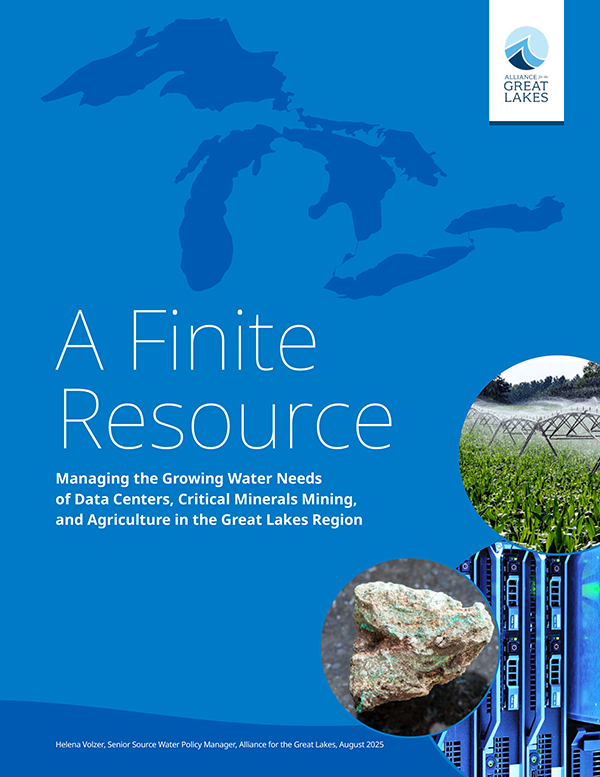
A Finite Resource
The Great Lakes region faces the prospect of water shortages, groundwater conflicts, and contaminated aquifers as demand sharply increases from large water users such as data centers, agriculture, and critical minerals mining. A new Alliance for the Great Lakes report details how access to water in the region will be undermined in the coming years if serious planning, policy, and regulatory actions are not taken.
A Regional Playbook
Data center development is rapidly growing across the Great Lakes region. To help make sense of the impacts, the Alliance also released this guide for residents, concerned citizens, grassroots organizations, and local leaders seeking clear, accessible information. It describes how water is used in data centers and provides checklists to help communities understand potential impacts and ask the right questions at the right time.