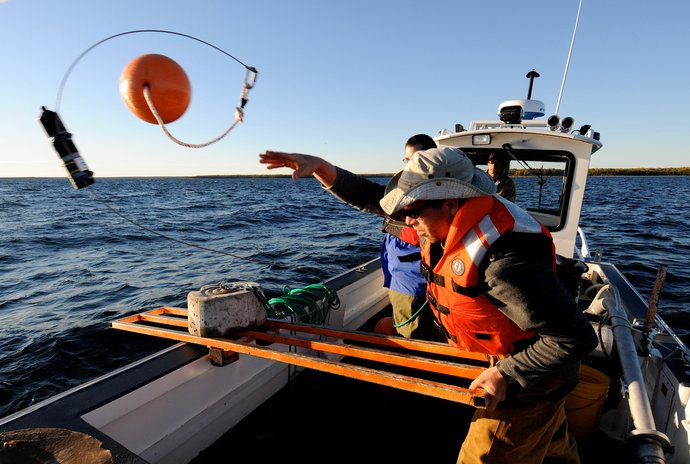
The waters of the Great Lakes basin supported the growth of North America’s industrial heartland throughout the 19th and 20th centuries. Its rivers served as “working rivers for commerce and industrial manufacturing” (Hartig 2010), and pollution was seen as “an acceptable sign of progress” (Adler 2002). The 1948 Detroit River and 1952 Cuyahoga River photos below illustrate this time in our history.
Jonathon Adler paints a compelling picture of this era in his account of the Cuyahoga River. With 20 refineries in the Cleveland area by the mid-1800s, large volumes of the unusable fraction of refined crude were often dumped into the river. He quotes John D. Rockefeller, who owned one of the refineries, as stating, “We used to burn it for fuel in distilling the oil, and thousands and hundreds of thousands of barrels of it floated down the creeks and rivers, and the ground was saturated with it, in the constant effort to get rid of it.”
The river caught fire multiple times between the mid-1800s through 1969. Although not the only river to catch fire in the basin (see Hartig’s Burning Rivers), nor the largest fire on the Cuyahoga (that was the 1952 fire pictured here), the 1969 fire gained national attention from an article in Time magazine and is credited with helping to launch the environmental movement.
Concerns over extensive pollution led to the passage of multiple state, provincial, and federal laws over time. These include the Clean Water Act and the U.S.-Canada Great Lakes Water Quality Agreement in the 1970s, and the Oil Pollution Act of 1990 (OPA 90).
The NEPCO 140 grounding, pictured below, helped to make the case for passage of OPA 90. The U.S. Congress passed the legislation in response to the Exxon Valdez oil spill in 1989 as an amendment to the Clean Water Act of 1972. As stated in a case study by the U.S. Coast Guard, “The need to reduce the affected area should be paramount to all other considerations in a spill such as this. The problems encountered in this spill should clearly motivate both government agencies and private concerns to plan for and provide all that is necessary to be as prepared as possible for an incident of this nature.”
An era of "working rivers"
Detroit River 1948
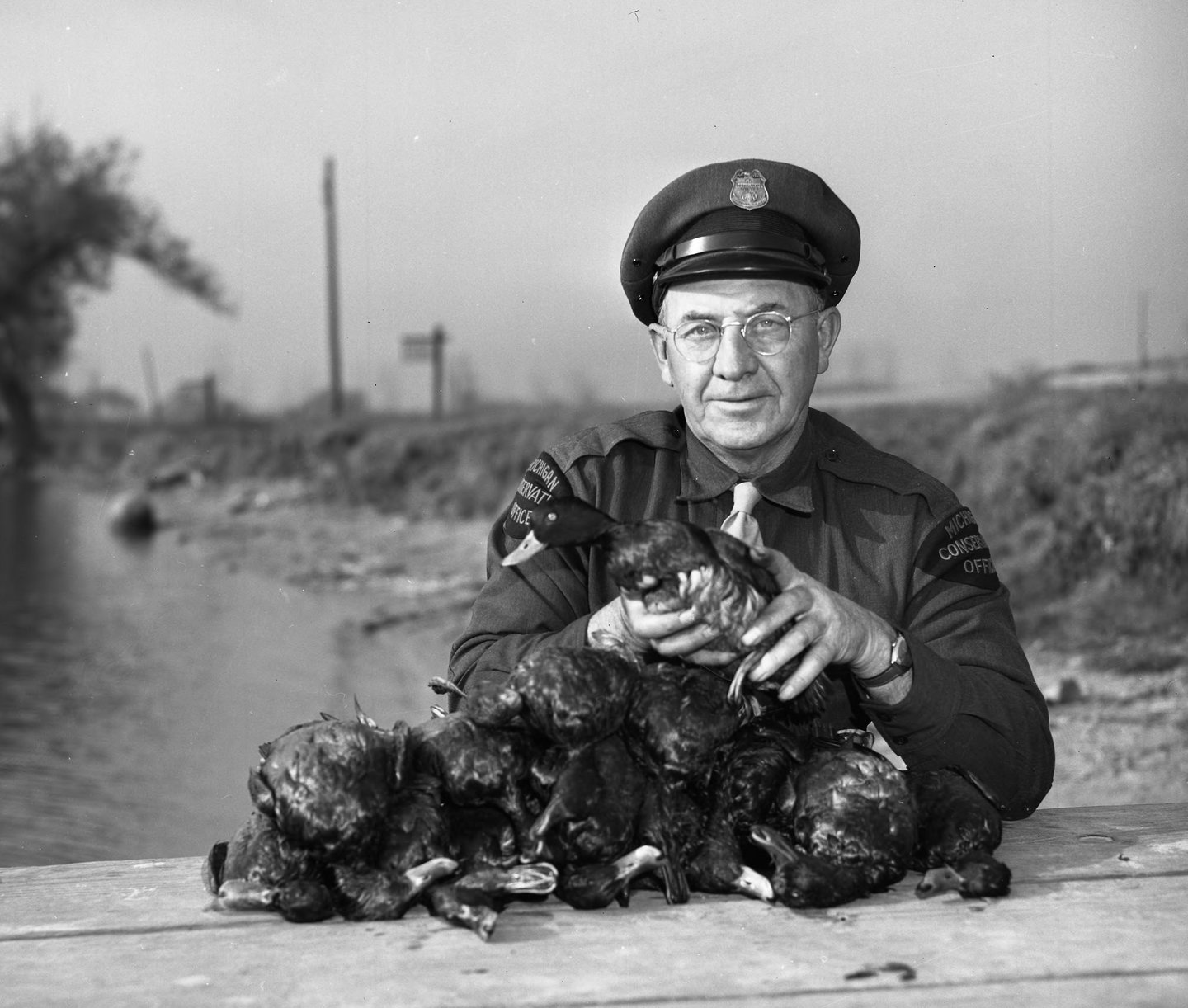
In 1948, much of the river froze over during a particularly cold winter, driving over-wintering birds to spots of open water filled with oil from industries lining the shores. As a result, 11,000 ducks and geese died from the oil pollution (Hartig 2010). A Michigan conservation officer is shown here with oil-soaked ducks from the river.
Cuyahoga River 1952
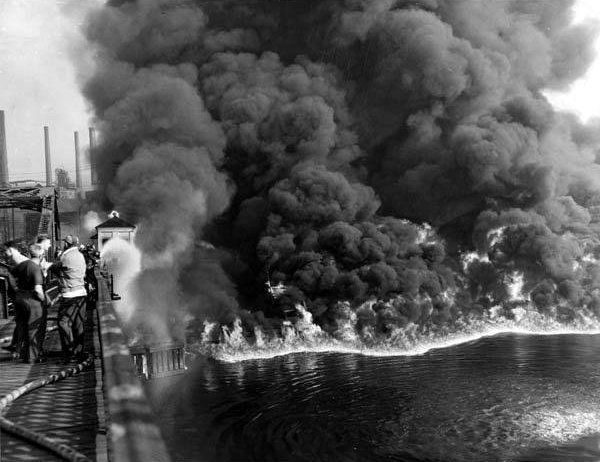
That year saw the largest fire on the Cuyahoga River in Cleveland, Ohio. A two-inch-thick oil slick on the river ignited near a shipyard, resulting in an estimated US$1.5 million of damage to boats, a riverfront office building, and the Jefferson Avenue bridge (Adler 2002).
St. Lawrence River 1976
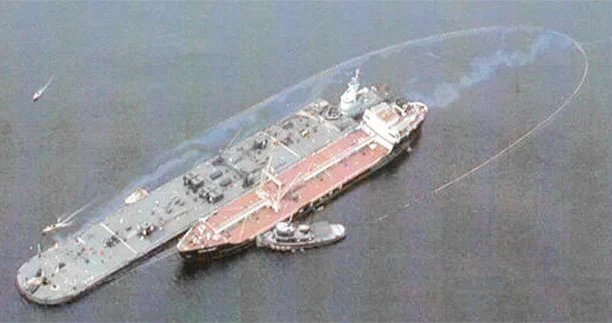
In June 1976, the tug barge NEPCO 140 ran aground in the Upper St. Lawrence River, spilling 300,000 gallons (1,135 m3) of crude oil that spread along 80 miles (130 kilometers) of the river, contaminating shoreline marshes and killing innumerable fish, birds, and wildlife. It is one of the largest oil spills in the United States. The photo shows the barge spilling oil off Mason Point in the Thousand Islands.
OPA 90 holds polluters responsible for cleaning up oil spills and restoring the environment. It fundamentally changed oil spill response, with companies that move or store large volumes of petroleum products improving their measures to prevent oil spills and developing emergency plans that include routine training exercises.
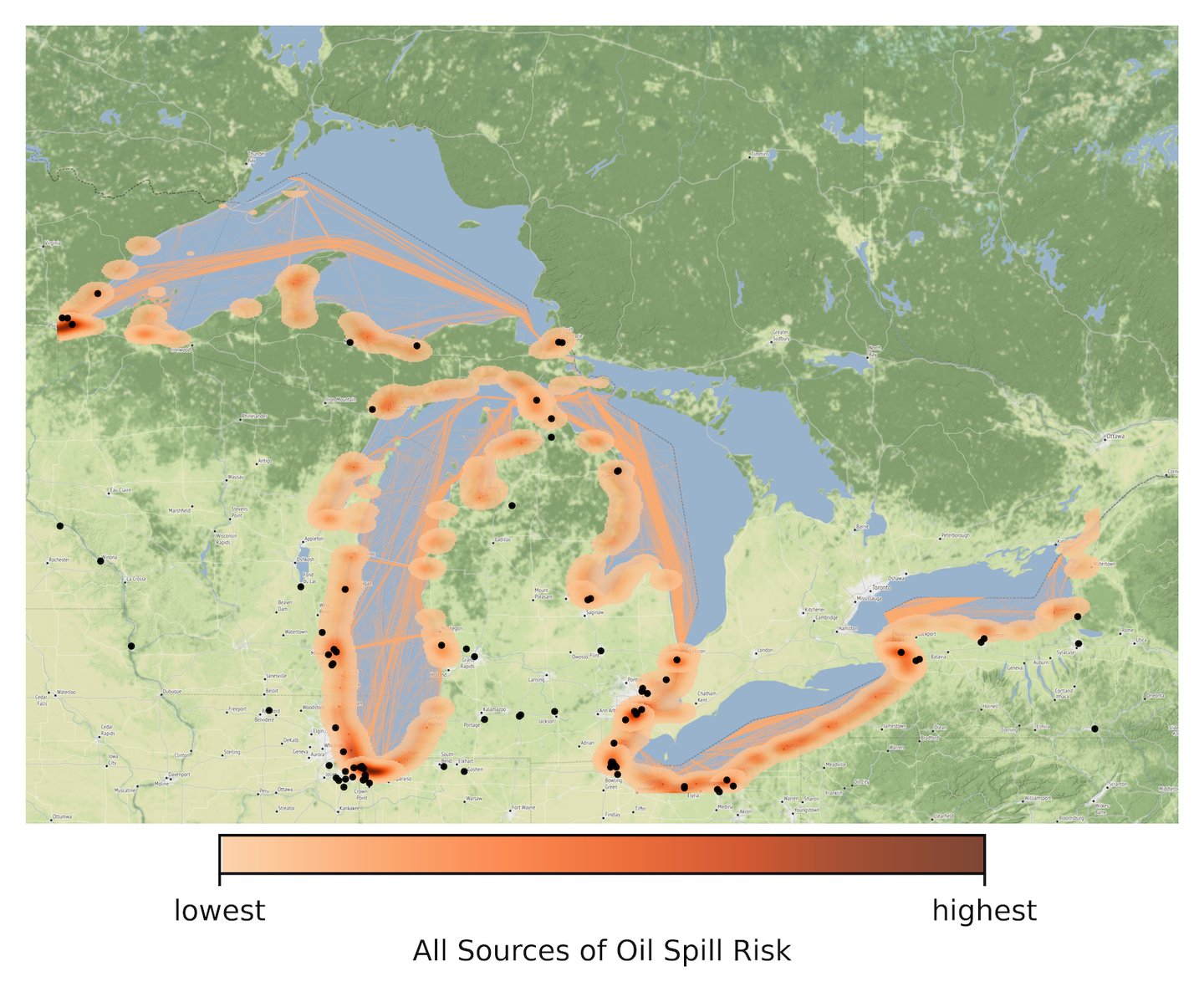
More recently in the Great Lakes, the focus has shifted to understand the risk from spills in inland waters and to develop strategies and tools that will mitigate that risk in freshwater environments.
While inland oil spills typically receive less attention than those in marine environments, they are common, with more than 2,000 on average taking place each year in the continental United States, according to an expert panel report on oil spills (Lee et al., 2015). “Although freshwater spills tend to be smaller volumes than their marine counterparts, they can have a greater potential to pose risks to the environment because of the greater likelihood that they occur within populated areas close to waterbodies with much less dilution and dispersion capacity and involve shorelines that are often immediately adjacent to or directly impacted by the spill.”
There are many practical lessons learned from historical case studies. Oil spill science is a rapidly developing field with many unanswered questions, as the articles in this issue of Lakes Letter attest. Current multi-disciplinary research studies (e.g., toxicology, chemistry, hydrodynamics, genomics, environmental engineering, etc.) and the development of predictive models will improve our understanding of natural recovery, the long-term impacts of oil spills, and the effectiveness and/or detrimental effects of active remedial strategies in freshwater environments. This integrated approach will provide the scientific evidence needed to support site- and time-specific decisions to select the most appropriate oil spill response strategy to apply to protect our waters and its living resources.
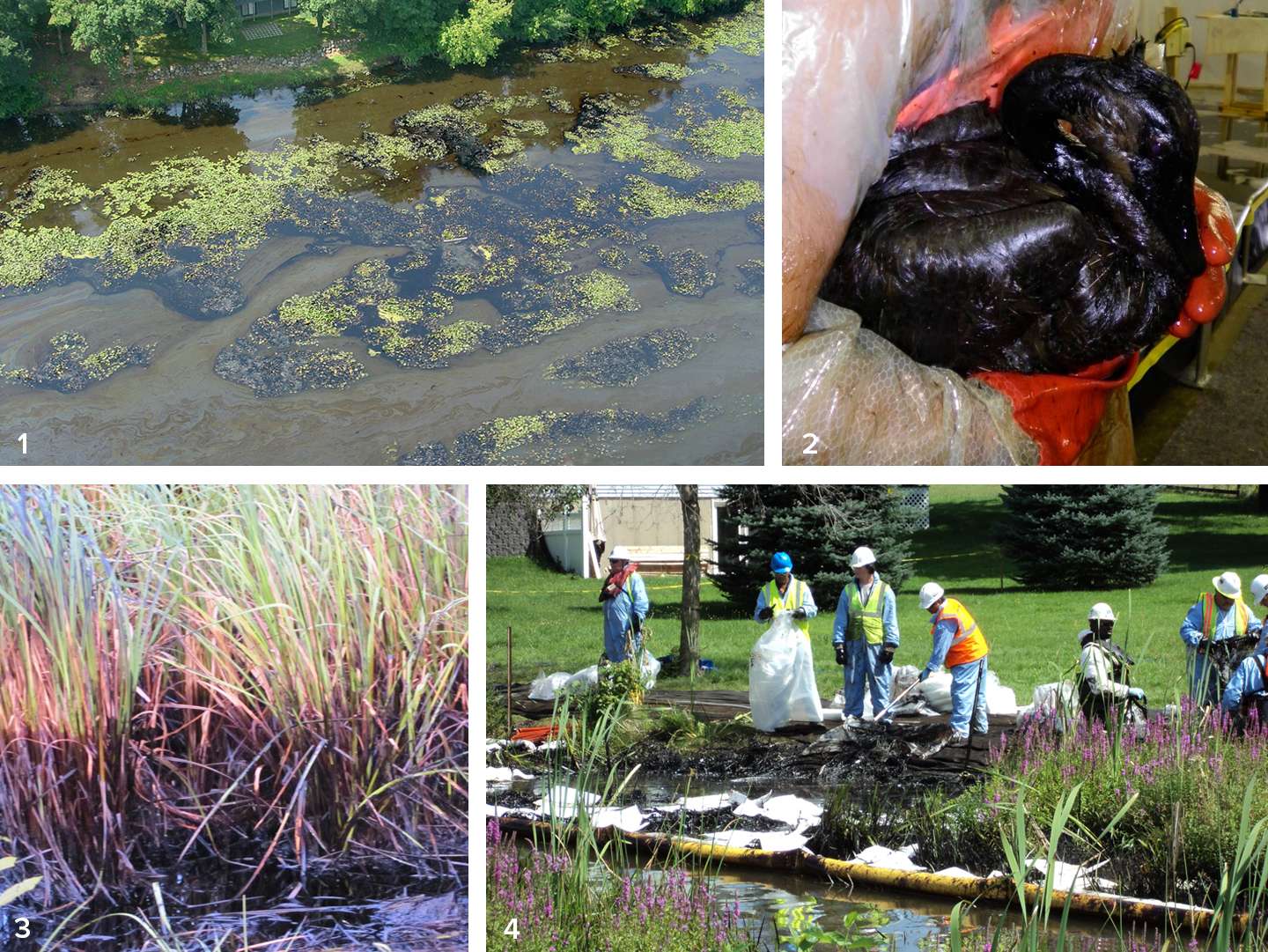
Kalamazoo River 2010
In July 2010, a pipe carrying heavy crude oil ruptured, releasing oil into Talmadge Creek, which feeds into the Kalamazoo River. At least 840,000 gallons (3,180 m3) of crude oil spread along 38 miles (61 kilometers) of this Lake Michigan tributary in southwest Michigan, making this one of the largest inland oil spills in the United States. More than 1,560 acres of shoreline habitat, as well as floodplain and upland areas were affected, injuring birds, mammals, reptiles, and other wildlife. Sections of the river remained closed for several years. The spill cost Enbridge, the company that operates the pipeline, more than US$1.2 billion to clean up. This collection of photos from the Environmental Protection Agency’s album EPA’s Response to the Enbridge Oil Spill in Michigan captures some of the impacts of the spill. The photos show 1) Oiled vegetation upstream of Ceresco Dam; 2) Cleanup crews removing oil and contaminated materials from the Talmadge Creek stream bank near Marshall, Michigan; 3) A volunteer preparing to clean oil from the feathers of a heavily-oiled Canada goose at the Wildlife Rehabilitation Center in Marshall; and, 4) Oil-stained grass in a wetland area of the Kalamazoo River
Smaller spills add up
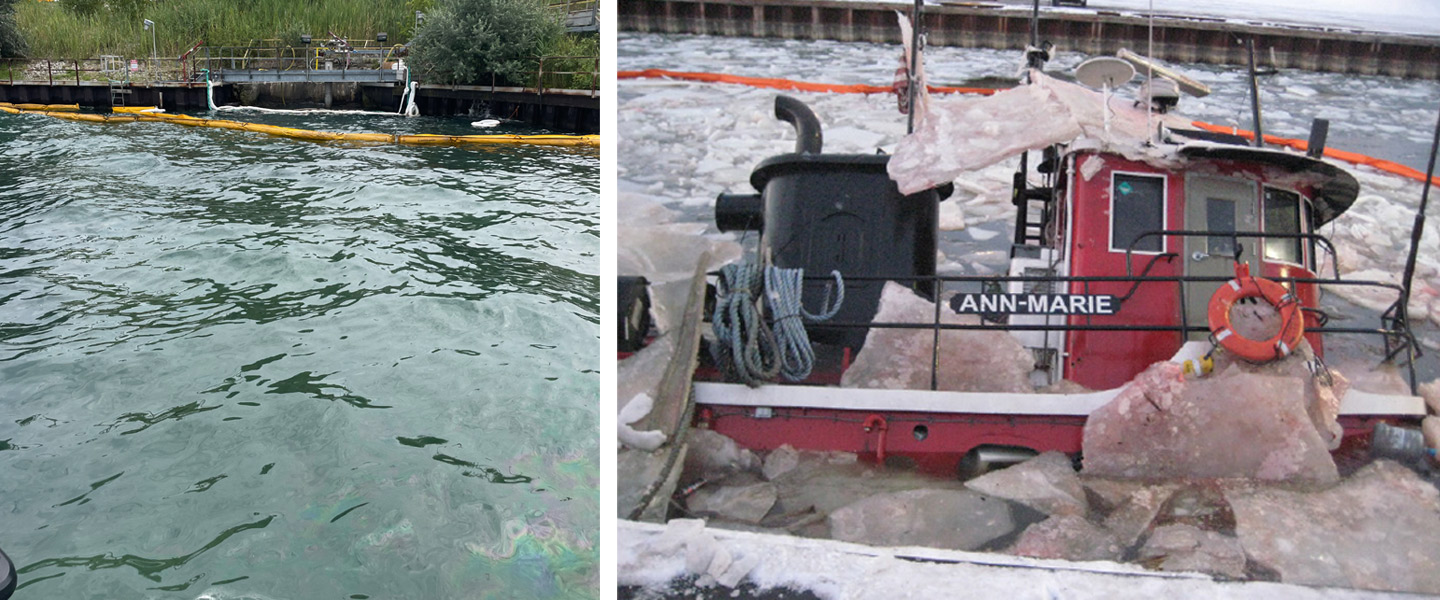
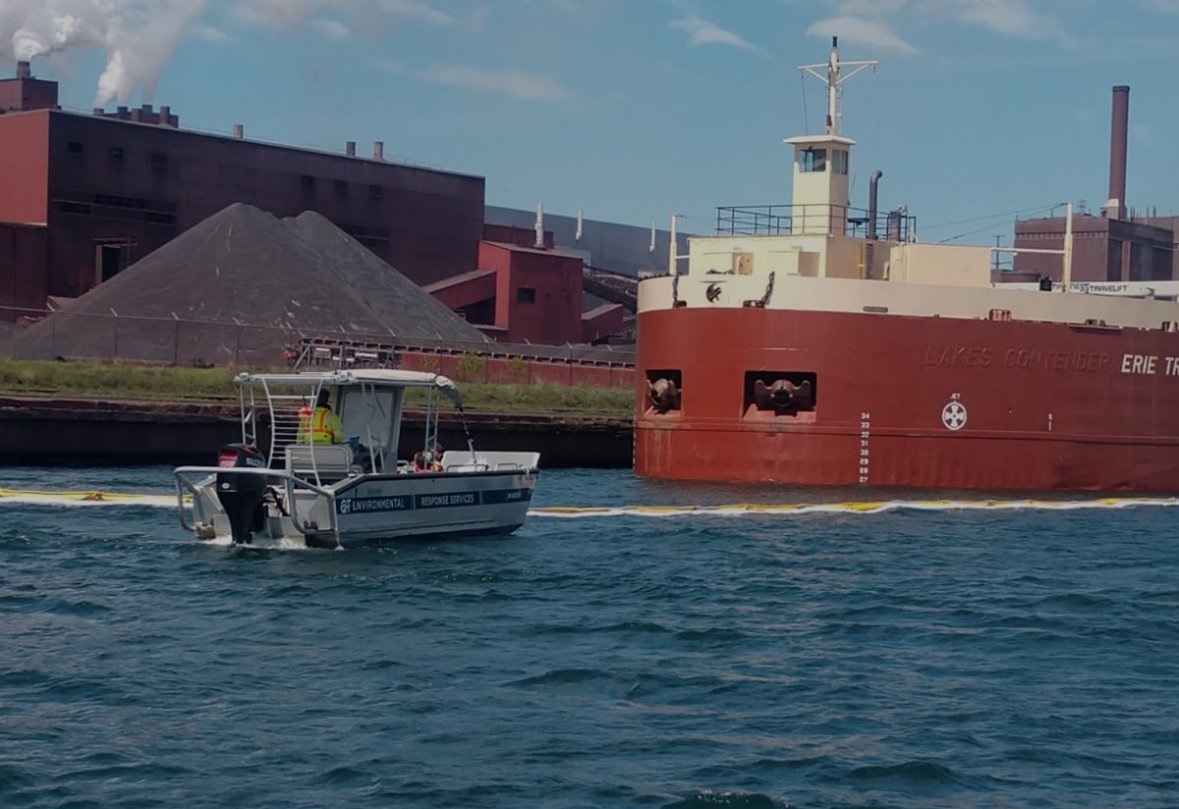
We’ve come a long way since the days when oil pollution was considered an acceptable price to pay for economic progress. As these photos illustrate, small spills still occur in the Great Lakes and can impact the environment, communities, and economies. The photo below right shows the tug Ann-Marie sinking in the Saginaw River in Bay City, Michigan (December 2010), and the other shows the Suncor Energy Sarnia Refinery diesel spill response in the St. Clair River (August 2022). Spills such as these may go unnoticed to all but the community that is directly impacted, and efforts are underway in the Great Lakes to strengthen community preparedness through education and outreach.