How do freshwater lakes contribute to the global carbon cycle? The vast number and size of these lakes has made answering that question a challenge. Different measurement techniques used in onsite studies also make it difficult to compare production values between lakes, or even to create lakewide assessments.
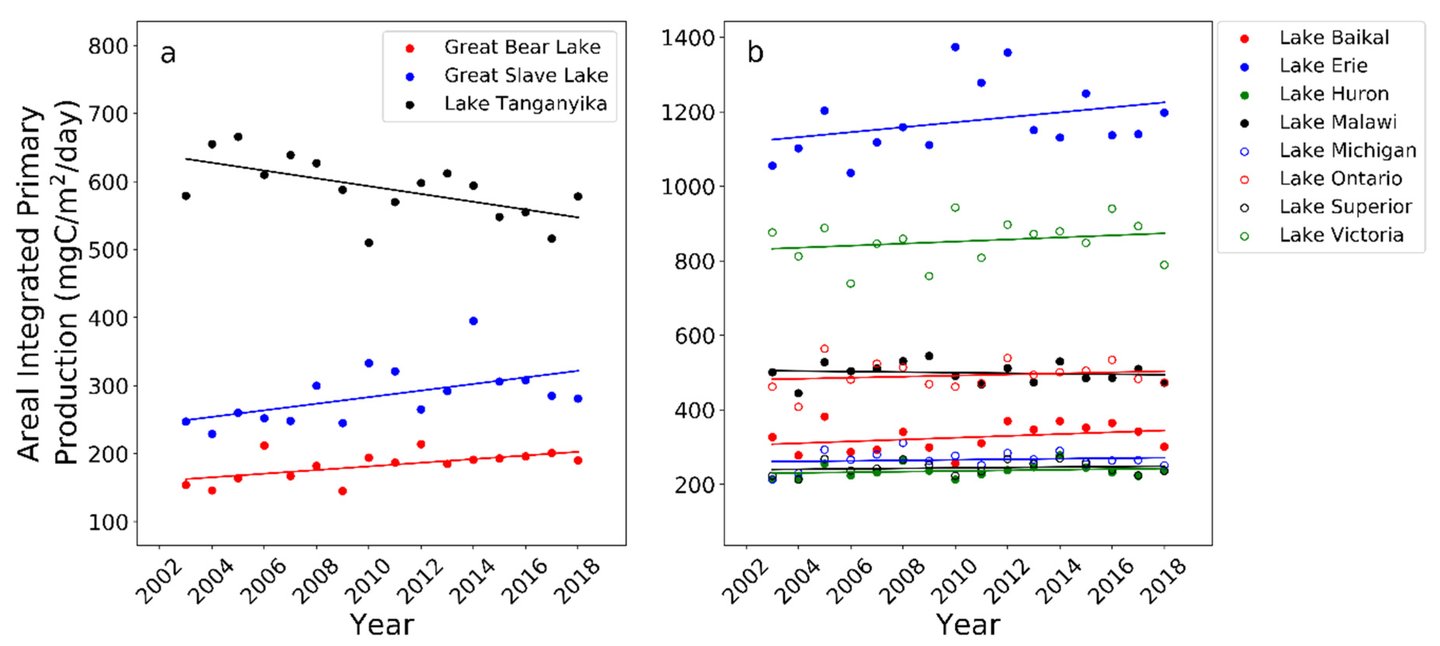
To address these challenges, researchers at Michigan Tech Research Institute (MTRI) turned to the sky. They used data collected from NASA's satellite-based MODIS sensor from 2003 to 2018 to estimate phytoplankton production in 11 of the world's largest lakes: the five Laurentian Great Lakes, three African Great Lakes, Lake Baikal, Great Bear Lake, and Great Slave Lake. MODIS views every point on Earth every one to two days, which resulted in a rich dataset of 137,161 images of the 11 lakes studied.
“Using these data, we were able to compute how much carbon is being fixed from a particular water body over a given year,” says MTRI scientist Gary Fahnenstiel. “This consistent methodology allowed us to compare primary production in the world's largest lakes for the first time ever.”
Their analysis revealed that three lakes showed significant trends in production over the study period. Great Bear and Great Slave lakes exhibited significant increases in production, while Lake Tanganyika experienced a significant decline. These changes appear to be related to climate change, including increasing temperatures and solar radiation and decreasing wind speeds.
The absence of climate change impacts on the other eight lakes may be due to the study's limited time period as well as interactions of other variables. For example, the study period largely misses the early mussel invasion phase in the Laurentian Great Lakes when the greatest production trends would be noted.
The study, reported in Water and at the 2021 Conference on Great Lakes Research, demonstrates how remote sensing primary production or carbon fixation models can be used for the world's large lakes. These results can be used to quantify changes in phytoplankton production, in some cases, due to climate change and anthropogenic forcing. The results also provide insights to better understand the contribution of freshwater lakes to the global carbon cycle dynamics. Researchers hope to expand the study to use other satellite platforms with higher spatial resolution so they can look at smaller lakes in the future.