Aquatic invasive species (AIS) have led to fundamental changes in the structure, function, and composition of Ontario’s aquatic ecosystems. Preventing the arrival of future AIS and controlling the spread of existing AIS are management priorities to protect Ontario’s ecological resources. However, how climate change will affect the vulnerability of Ontario to species invasions remains uncertain. Moreover, as the effects of climate change are increasingly realized over the next several decades, other factors, such as changes in human population density, will also influence AIS arrival and spread.
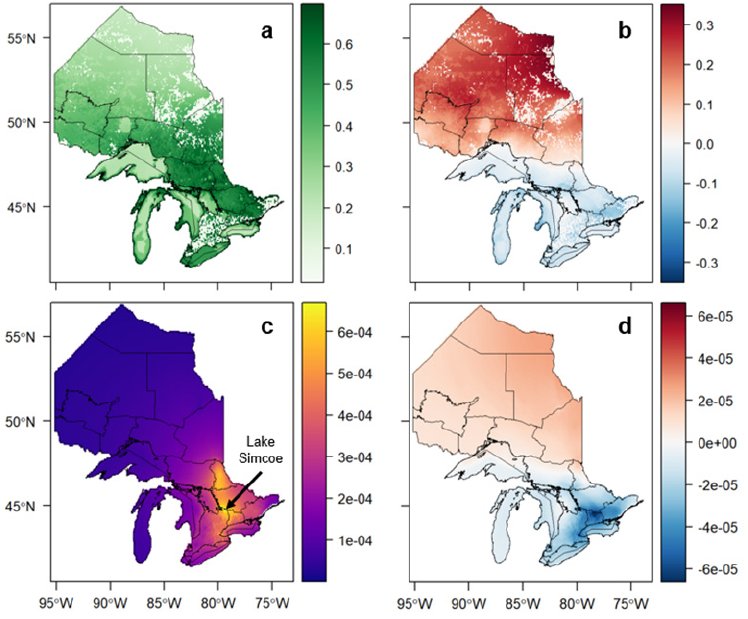
We modeled the vulnerability—potential for arrival, survival, and spread of invasive aquatic invertebrates, plants, and fishes—of Ontario’s aquatic ecosystems under baseline (2018) and future (2041–2070) conditions. The assessment was based on three components: describing the spatial distribution and movement of people associated with human-mediated pathways of propagule delivery; estimating the relative suitability of recipient ecosystems for AIS survival, including changes in climatic conditions over the projection interval; and estimating natural dispersal as a function of habitat suitability.
We found that the locations of greatest pathway activity (i.e., aquarium and water-garden ownership, boat-based fishing, and all recreational boating) were spatially concentrated toward the most populous areas of Ontario. In areas currently supporting the most activity across the projection interval, propagule pressure from these pathways was likely to increase. With projected climate change, habitat suitability was also likely to increase, though not uniformly, and the location and magnitude of increase was less predictable across Ontario. Taken together, the baseline (2018) and future vulnerability of Ontario’s landscapes to AIS showed strong spatial patterning and differed by pathway, indicating that prevention management necessitates a pathway- and species-specific focus.
Copies of the full report are available (tim.johnson@ontario.ca). Authors of the report include Jeff Buckley, Len Hunt, Jenny Rodgers, and Tim Johnson of the Ontario Ministry of Northern Development, Mines, Natural Resources, and Forestry; and Andrew Drake of the Great Lakes Laboratory for Fisheries and Aquatic Sciences, Fisheries and Oceans Canada.