Great Lakes nearshore zones, often defined as areas less than 10 meters deep, play a crucial role in the life history of many native fishes, as they provide nursery habitat for newly hatched fish. Nearshore areas are greatly affected by anthropogenic stressors such as sedimentation, nutrient addition, pollution, and climate change. Despite the importance of nearshore zones to native Great Lakes fishes, very little is known about ecology in this region.
Coregonus species lake whitefish (Coregonus clupeaformis) and cisco (C. artedi) rely heavily on these nearshore areas during several periods of their life history, including spawning, egg incubation, and larval development. Populations of lake whitefish and cisco have fluctuated dramatically throughout the upper Great Lakes since the early 1900s due to overfishing, predation, and changing environment. Since 2011, cisco have resurged in northern Lake Michigan, whereas lake whitefish have declined. Causes of differential recruitment, likely at early life stages, are not known but may include reduced nearshore zooplankton abundance following the dreissenid mussel invasion.
To determine if low food differentially affects young lake whitefish and cisco, I examined gut contents and growth of larval coregonines in relation to prey availability. I hypothesized that larval cisco would have higher prey intake at low prey densities, leading to growth rates surpassing those of larval Lake Whitefish. Tribal and state agencies collected larval fish and zooplankton samples at nearshore sites in 2019 and 2021. Ages were determined via otolith daily growth rings and lengths via imaging software. Zooplankton were enumerated and larval fish identified to species genetically.
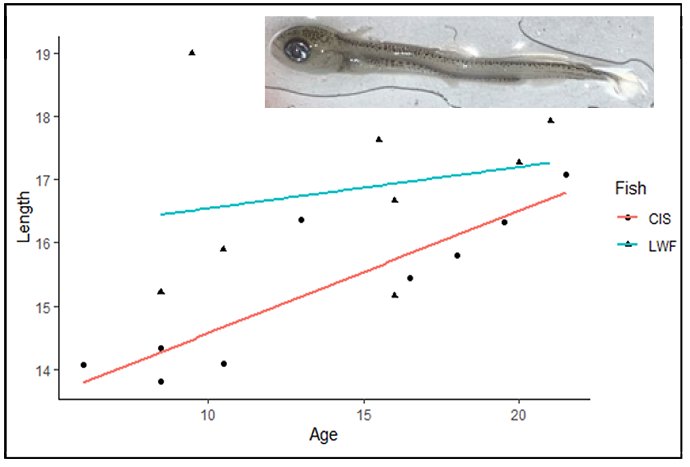
Prey densities were exceptionally low in nearshore waters. Larval growth rates were positively associated with prey density and availability of midge larvae. Larval cisco consumed smaller prey items than larval lake whitefish. Larval cisco started out smaller than larval lake whitefish but grew faster (see figure). Fast larval growth amidst low prey availability could give cisco an advantage over lake whitefish in the northern Lake Michigan-Huron region.