Earlier this year, we conducted a survey to document and share experiences within the Great Lakes research community in response to recent U.S. federal actions. These actions have included the dismantling of diversity, equity, and inclusion (DEI) commitments, the sudden termination of federal employees, and threats to scientific progress through funding cuts and restrictions on international collaboration.
Survey responses reveal deep concern about harm to Great Lakes science—from canceled fieldwork and halted data collection to weakened collaborations. Respondents anticipate the loss of institutional knowledge, interruptions to long-term monitoring, reduced research productivity, and setbacks in addressing challenges such as invasive species, harmful algal blooms, and climate change. “With the layoffs and incentivized early retirements/separations, we have lost institutional knowledge,” wrote one respondent. Another added, “We lost 20 years of monitoring overnight.” Others expressed concern about long-term effects on trust and partnerships: “Partners no longer know if they can rely on us. And frankly, neither do we.”
One respondent reflected on how decades of work are only now beginning to show results. They pointed to the U.S. Geological Survey and U.S. Fish and Wildlife Service’s long-standing efforts to restore native species such as lake trout and cisco, noting that recovery is finally within reach: “We are just at the start of seeing real recovery in many species, and it is sad to see us stop moving forward or go backwards now.”
Beyond scientific setbacks, participants pointed to ripple effects on the workforce and the next generation. Cuts and staff reductions are seen as likely to curtail graduate training, weaken recruitment, reduce diversity in the field, and undermine binational cooperation. Others raised concerns about limits on scientific communication and constraints on how climate change can be discussed. Even if funding is restored in future years, many anticipate lasting impacts on research quality, workforce expertise, and the ability to manage Great Lakes resources. One respondent explained:
"With the limitations on what words can and cannot be used in grant proposals or websites and how climate change can be discussed, it becomes more and more difficult to disseminate information. With the way government and government affiliate employees are being maligned and mistreated, it will be difficult to attract scientists to work for these agencies in the future, especially since new hires have been proven to be disposable and targeted for easy RIFs [reductions in force].
“With a reduction in funding for Great Lakes research, progress will stall. Students will not see environmental science as a possible career avenue. Graduate degree opportunities are already being taken away. Recruitment to this field will become very difficult in the near future if the pattern of deprioritizing, and even demonizing, science continues.”
Responses consistently conveyed uncertainty, instability, and distress. Some individuals bore the brunt of these actions more than others, and the long-term effects remain unclear. With Congress in recess until September, the final 2026 federal budget—and its implications for Great Lakes research—will not be known until after this issue of Lakes Letter goes to press. Early signs show pushback in both the House and Senate against proposed cuts, echoing budget debates we’ve seen in years past.
For now, what is clear is the lived experience shared by those who responded to this survey. While the sample is small and not representative of the entire community, the responses offer valuable insights into how these actions are being felt. They reveal a pervasive sense of professional instability, emotional strain, and disillusionment. Yet they also reflect resilience and commitment—to science, to the Great Lakes, and to one another. As one respondent wrote in solidarity: “I want them to know that their struggle is real, it is not their fault, and they are not alone.”
Impacts on people and organizations
Between mid-May and mid-July, 87 people responded to our survey on recent U.S. federal actions affecting the Great Lakes science community. Of these, 71 live or work in the United States, 14 in Canada, and two in African countries. Six respondents noted that their country of origin was different from where they currently live or work—five now in the U.S. and one in Canada.
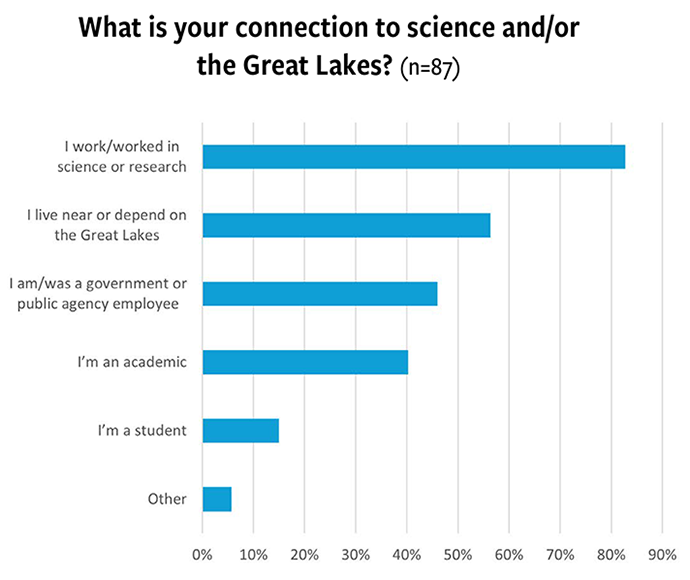 The survey drew heavily from people with direct ties to science. More than four out of five respondents (83%) currently work or have worked in research. Over half said they “live near or depend on the Great Lakes,” underscoring how personal the connection to these waters can be. Respondents also represented a range of roles across the science community: 46% identified as government employees, 40% as academics, and 15% as students (see bar chart).
Their feedback paints a vivid picture of professional and personal upheaval. One respondent shared:
“I’m one of the illegally terminated probationary U.S. federal employees. I worked in Great Lakes research for 15 years. On February 27 at 3:30 p.m., I received an email stating my employment had been terminated and I needed to be out of the building by 5:00. I was later reinstated and placed on administrative leave, and then terminated again.”
The same respondent described the lasting toll:
"I don't think I can describe the effect of knowing any email at any time could be the one that makes me unemployed. The email, when it finally came, was almost a relief because I could get on with it. And there was a lot to do—learning about federal employment law, trying to file for unemployment without any separation paperwork, confusion about health insurance, applying for jobs when science funding is uncertain. I found a new job, but I’ve taken several professional steps backwards in order to continue to work in my field.”
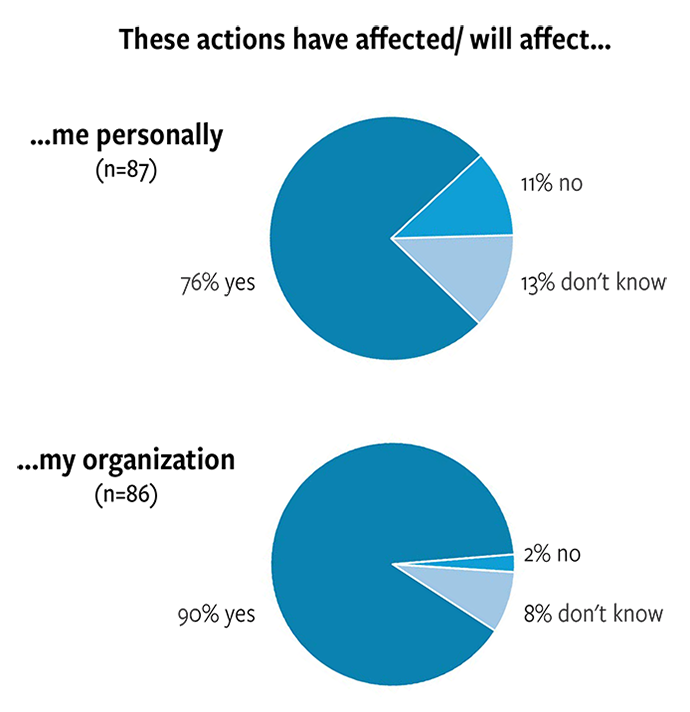
Stories like this reflect a broader reality. Nearly three quarters of respondents said they already have been, or expect to be, personally affected by recent federal actions. An even greater majority (90%) also anticipate impacts on their organizations (see pie charts).
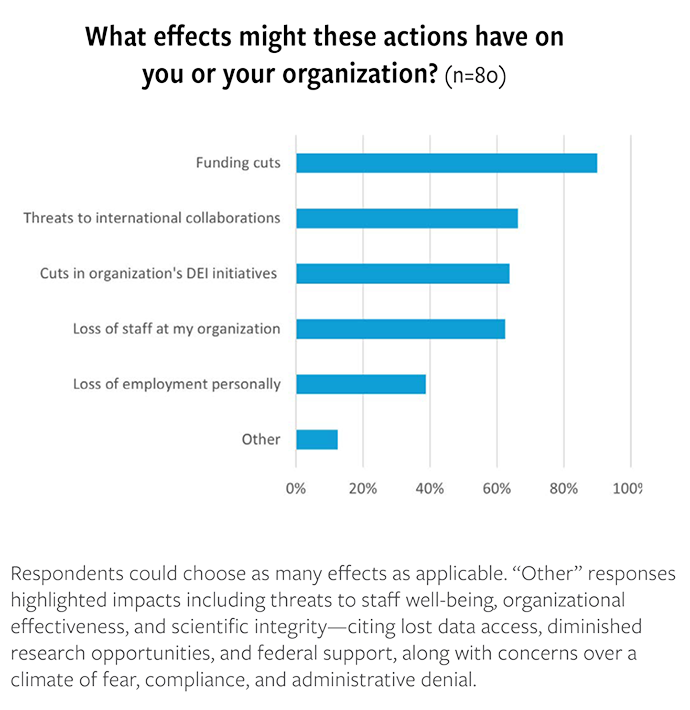
When asked about specific effects, most pointed to funding cuts (90% of respondents). Other top concerns included threats to international collaborations (66%), reductions to DEI initiatives (64%), loss of staff (63%), and the potential for personal job loss (39%) (see bar chart).
In addition, respondents voiced unease about the wider consequences for staff well-being, organizational effectiveness, and scientific integrity. They cited risks such as loss of data access, fewer research opportunities, weakened federal support, and an overall climate of fear and uncertainty.
Career disillusionment and relocation
Recent events have left some respondents questioning their careers altogether. One shared, “I’m seriously considering leaving federal service altogether,” while another admitted, “There is no longer any trust that the work I do will be supported or funded from one year to the next.” Many spoke of career paths—built over decades—suddenly threatened by political shifts rather than guided by public good.
Students also expressed deep uncertainty about their futures in science as federal support shrinks. “As I’m nearing the end of my graduate degree program...the current federal level action is not conducive to the work I am interested in doing,” one noted. Another reflected, “I rely on external funds to successfully conduct quality research… I require a stable occupation come graduation.” Despite personal ties to the Great Lakes, some students are now weighing relocation abroad, where they perceive greater appreciation and opportunity in the environmental field.
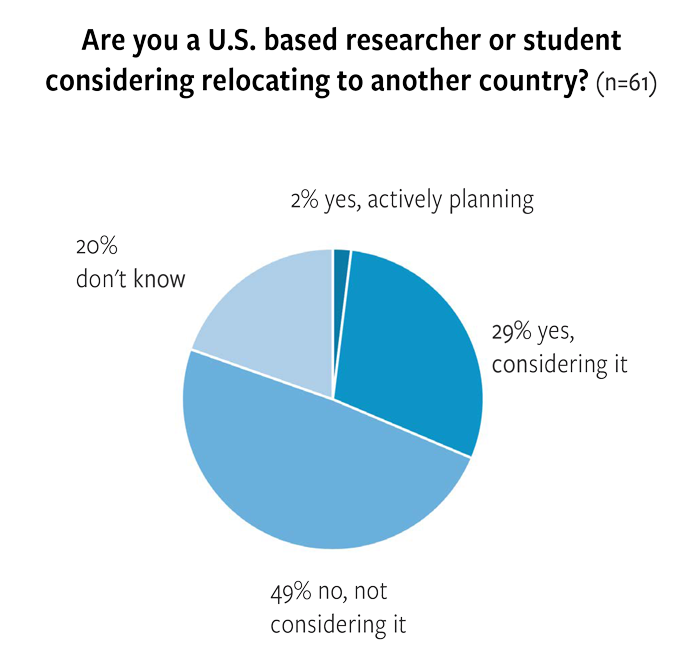 In fact, nearly a third of U.S.-based researchers and students who responded said they are considering or actively planning to move to another country, most often Canada. Nearly half reported they are not considering relocation, while 20% remain unsure (see pie chart).
The motivations for leaving vary. Many pointed to research funding cuts, job instability, and limited opportunities in their fields. Career stage shaped these concerns: early- and mid-career scientists worried about losing momentum, while those nearing retirement sometimes saw relocation as a capstone or as a way to make space for others. Other factors included perceived threats to personal safety, quality of life, and rights for marginalized identities, as well as the promise of greater academic freedom abroad.
At the same time, relocation is not easy. Respondents cited strong family ties, reluctance to restart careers, and limited openings outside the U.S. For some, moving remains a contingency plan if job loss occurs; for others, it is more a distant aspiration than an active pursuit.
DEI under attack
The rollback of DEI programs was particularly painful for some respondents. “I feel betrayed,” wrote one federal employee. “We were told this agency valued inclusion. Now it’s as if that work never mattered.” The sudden reversals have left staff feeling expendable and cynical, especially those who championed or built such programs in good faith.
John Berges, professor in the Department of Biological Sciences and the School of Freshwater Sciences at the University of Wisconsin–Milwaukee, described the impact firsthand:
“I was a PI and mentor for two major diversity programs, one for minority students in STEM, and one for students with disabilities in STEM. Both programs were terminated with no reasonable explanation. This was terrible for me and the mentors and devastating and confusing for the students. The funding loss is bad enough. Silence is worse. There’s been almost no institutional acknowledgement, and little public recognition. The local press seems disinterested.”
Another respondent, whose work focuses on science communication—“the kind of work that’s been smeared as ‘woke’ DEI and a ‘waste of time,’ despite consistently positive outcomes”—was not allowed to present at IAGLR’s annual conference for fear of drawing unwanted scrutiny that could jeopardize their team’s funding or employment.
For many, the loss of these programs directly undermines recruitment and retention of diverse scientific talent. As Berges reflected:
“Much of what we do depends on the goodwill and the generosity of a few really good/special people. We’ve simply trashed them. A message has been sent and received, and recovery will not be easy.”
Emotional and mental toll
Threaded through many responses is the weight of the personal toll. Scientists and students described sleepless nights, anxiety, and sadness. “I didn’t sign up for politics—I signed up to protect water,” wrote one. Another confided, “I cry at my desk. I’ve never felt so helpless in my career.”
The psychological impact appears especially acute for younger and more vulnerable professionals, who spoke of exhaustion, declining morale, and fear for the future. “It’s been stressful for both myself and my friends… many job opportunities in the public sector and indirectly in the private sector are being lost,” wrote one student. Others expressed frustration at being told their work amounted to “wasteful tax dollars,” even as they faced the prospect of losing entire careers.
While some remain determined—“We’re still here, still showing up, even when it’s hard”—the prevailing tone is one of heartbreak and depletion.
“A number of colleagues have had actual bona-fide mental breakdowns and needed to take stress leave (well, those who weren’t fired outright). I’ve been feeling utterly sick and horrible since January watching my whole field and all of my friends in it be harmed maliciously by the administration’s actions.”
Even among students and early-career researchers who remain passionate, the erosion of jobs, funding, and community has taken a lasting emotional toll—compounded by uncertainty over partners’ and colleagues’ futures.
What scientists want you to know
When asked what they wish others understood, respondents emphasized that the impacts of federal actions are human and societal—not merely technical or economic. The dismantling of research infrastructure, marginalization of expertise, and erosion of trust affect not only careers, but also public health, environmental quality, and scientific progress. Several themes emerged:
- Personal and professional trauma
Many described the demoralization of watching careers dismantled. “It was the destruction of a decade of leadership and vision to develop a high performing and efficient laboratory...it demoralized the remaining employees, especially the portrayal of them as wasteful and fraudulent.” Another added:
“Being in this unstable and unpredictable environment makes it hard to get work done and is stressful…the existential dread I experience daily makes me want to find a different job.”
- Misunderstood value and public perception
Respondents wished the public better understood the commitment and value of federal scientists.
“I wish the public understood the hardworking nature of federal employees who are working on Great Lakes issues...the value of federal funding for protecting the Great Lakes and the countless benefits they provide.” Another stressed: “We aren’t their enemy...we go to work every day just like them and work hard to try to make a positive difference.”
- Nature of careers
Scientific careers are highly specialized and losing them means more than simply finding a new job.
“When you’re a research specialist in environmental science, there is no ‘finding another job’ like there is in the corporate world...firing and defunding us en masse throughout the U.S. is resulting in hundreds of thousands of brilliant scientists and public servants losing their life’s work. It is cruel and it is torturous.”
- Impacts beyond jobs
Respondents stressed that these losses threaten public safety and well-being. “This isn’t just people getting fired, we are losing our entire careers and being told our work is wasteful..the services we provide are benefiting and protecting (the public)—even if they don’t realize it.”
- Illegality and disregard for process
Several alleged illegal or unethical actions. “These illegal actions are able to happen and cause harm before they are questioned in court.” Abrupt grant terminations are described as “equivalent to a business suddenly breaking its contract without cause.”
- Disempowerment and lack of support
Respondents often felt abandoned. “You are alone in your troubles. There is no coordinated response...to these collective and unjustified administrative actions.”
- Long-term consequences
Respondents feared that recovery may prove impossible “There’s incredible long-term value in the science being done...recovering may not be possible due to the loss of datasets and trust.”
What now?
We asked respondents what justice and support would look like—and how organizations like IAGLR could help.
Justice and support
Many defined justice as public accountability, calling for apologies from leaders, hearings, and explanations for decisions. Yet symbolic actions are not enough. Respondents most urgently called for concrete measures: reinstating unlawfully fired employees, unfreezing grants, restoring programs, and rehiring staff. One respondent summed it up: “Justice would look like the reinstatement of unlawfully fired federal employees, the unfreezing of previously allocated federal funding, and the restoration of programs that serve all communities in the Great Lakes region.”
Respondents emphasized that early career researchers, in particular, were seen as needing emergency or bridge funding, health benefits, and stable career pathways.
Respondents also called for the need for reliable funding from a variety of sources to buffer against federal instability. In addition, they pointed to the importance of sustained access to federal datasets and tools, strong international collaborations, and mentoring networks.
Advocacy emerges as essential. Respondents called for lobbying elected officials, elevating the economic and public-health benefits of Great Lakes research. They advocated for collective resistance tools—legal recourse, society-wide campaigns, and unified messaging—to elevate the profile of science within civic and political discourse.
The role of associations
Respondents are clear about the role an organization like IAGLR could—and should—play. They want the association to be a forceful advocate for funding and policy, leveraging its regional presence and partnerships to lobby for binational and multilateral initiatives and rally support at state and federal levels. Communication is also critical: regularly publicizing scientific achievements and personal stories, broadening outreach beyond environmental outcomes to economic and social benefits.
"Help gain public awareness and support for federal data as we depend on having large, robust, authoritative datasets that we can trust for long-term quality. The public depend on these data even if they don't realize how they use them.”
In addition, direct support was highlighted, from mutual-aid funds and conference scholarships to peer networking and resource-sharing platforms, especially to bolster community among early career and marginalized researchers. Respondents urged IAGLR to continue championing equity and inclusion: “Continue to advocate for the value of science, particularly inclusive science, ecosystem preservation, and climate justice.”
A look to the future
Looking forward, respondents imagine a future where political and institutional transformation accompanies lasting scientific resilience. They envision new leadership more supportive of science, regulatory safeguards to prevent abrupt “meat‑cleaver” defunding, and strengthened congressional and judicial protections that stabilize research continuity. They want regional unity among Great Lakes states to transcend division and elevate the scientific agenda. In parallel, they seek community healing and rebuilding—a kind of “Reconstruction” phase where funding is diversified, institutions make amends, and the scientific community rebuilds with empathy, civility, and inclusivity.
“When all of this is over...I want scientists and their communities to be able to get to work picking up the pieces and rebuilding as best we can,” states a respondent. “We’ll need everyone’s help to recover from what—and who—we lost.” Throughout, they urge recognition of science as a foundation of public welfare, transparency, ecosystem stewardship, and civic health.
In short, respondents need both immediate relief and long-term transformation: restored funding, public accountability, strategic advocacy, community-based support, and institutional reform that honors the value and resilience of Great Lakes science and the researchers who sustain it.
A university professor's perspective
“When most people hear about grant terminations, it’s just meaningless numbers to them (especially those who think this is somehow ‘cutting out fraud, waste, and abuse’). What I wish people understood is (1) we are being punished despite following EVERY rule and honoring our commitments to other people; (2) most of the grants being terminated aren’t ‘radical’ or ‘woke,’ at least not in any way that ordinary people would understand these terms; (3) when grants are terminated in this way, it has a huge human cost, disrupting lives and causing good people to suffer needlessly; (4) the way that DOGE is terminating these grants is completely unprofessional. They didn’t think through any of the administrative details, and terminating grants abruptly is equivalent to a business suddenly breaking its contract without cause—most Americans would never tolerate the way this has been handled.
On a personal level, I wish people had some sense of how much of my last three weeks has been a struggle to (1) understand the implications of the termination, when even our NSF program officers aren’t sure how all of this works; (2) take care of our people—I have vulnerable graduate assistants, and I’ve put in many hours trying to ensure that we honor our commitments to them.
On the flip side, people should understand that there are heroes out there right now: neighborhood groups and institutions stepping up to the plate to help.”
May 19, 2025