The Sea Lamprey Control Program in the United States comprises approximately 85 full-time and 25 seasonal employees. The program was disrupted earlier this year due to the loss of U.S. Fish and Wildlife Service staff and a federal hiring freeze. This initially impacted the USFWS’s ability to begin the 2025 field season as planned. Fortunately, elected officials throughout the basin worked hard to ensure that the critical work of controlling invasive sea lamprey populations was safeguarded.
As outlined in a recent study (Marcy-Quay et al., 2025), delays in lampricide applications can yield serious consequences for the Great Lakes. Sea lampreys are most vulnerable in their larval stage, where they are concentrated in stream sediments. Without a fully staffed control program, their populations could rebound and threaten both the fishery and the regional economy.
Although the Sea Lamprey Control Program had a late start in preparing for the field season, the program successfully began at the end of April. Currently, control agents are in the midst of a busy field season with plans to treat approximately 120 Great Lakes tributaries. Despite earlier challenges, the long-standing partnership between the Great Lakes Fishery Commission, USFWS, Fisheries and Oceans Canada, and the U.S. Army Corps of Engineers remains strong. The integrated control program, focused on lampricide treatments and physical barriers, continues to suppress sea lamprey populations by about 90% in most areas of the Great Lakes.
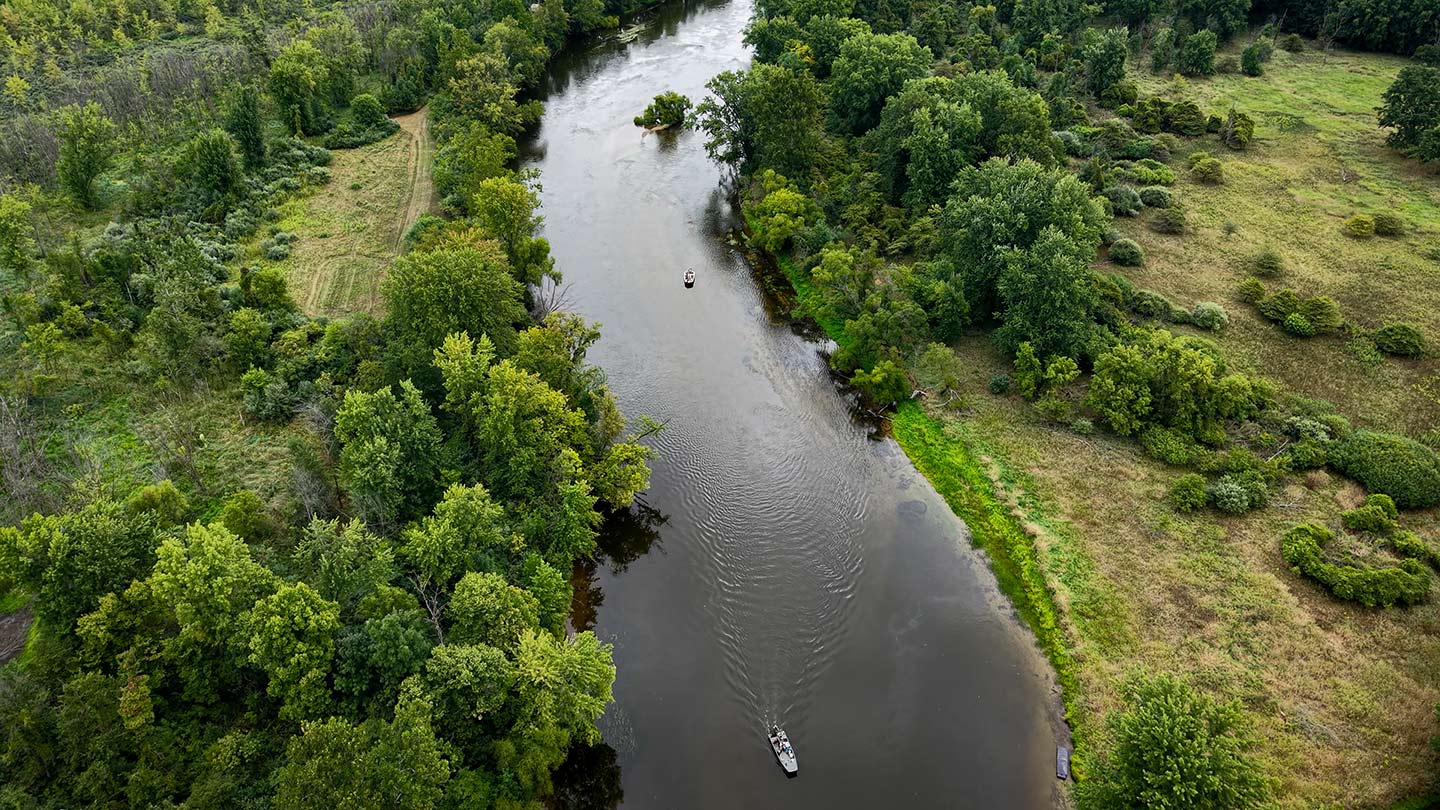
Background photo: Control agents applying secondary treatments by boat, targeting tributaries and backwater areas that the main stem treatment does not reach.
Sampling lampricide concentrations
Control agents setting up automatic water samplers programmed to collect river samples every hour during lampricide treatment. The samples are analyzed to measure lampricide concentrations, which inform managers of the treatment efficacy.
Feed checks
Control agents perform “feed checks,” which is the act of measuring the amount of lampricide applied during treatment.
Sea lamprey larval assessment
A control agent uses a backpack electrofishing unit to sample the streambed for larval sea lamprey, pictured at left.
Lampricide applications
A lampricide application from a state-of-the-art spray boat, used to apply granular lampricide to lentic areas where a typical treatment setup is not feasible.
Photos by Zak Allan, Great Lakes Fishery Commission.