Since 2016, the Lake Champlain Research Institute at SUNY Plattsburgh has operated a data buoy that records temperatures from the lake’s surface down to its bottom at 50 meters depth. Using these data, graduate student Miranda Rummell is investigating the lake’s thermal structure and how storm events alter it.
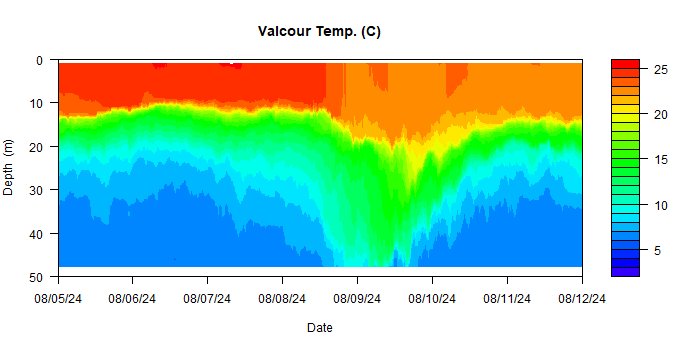
Rummell’s work is revealing several noteworthy patterns. Not all storms are alike; they vary both in intensity and their impact on the water column. Some storms mainly perturb surface waters, while others have deeper impacts (pun intended). To capture this variability, we have developed a five-tier storm intensity classification for Lake Champlain events. The strongest storms can displace warm surface water to depths exceeding 45 meters. Disturbances are a natural part of lake dynamics, and studying them is crucial for understanding potential impacts on the ecosystem, especially in a deep, northern temperate lake that has not yet adapted to such perturbations.
Chasing storms with Miranda Rummell
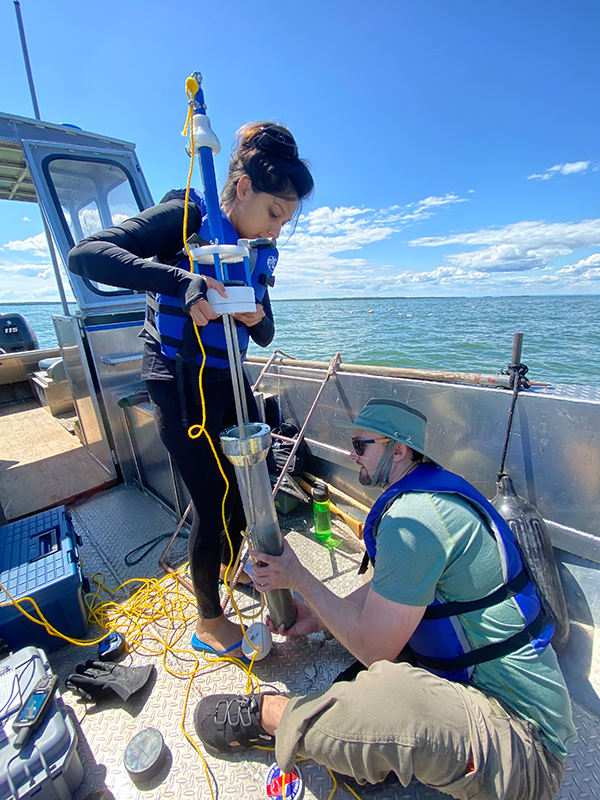
Growing up with the Great Lakes in my backyard, I always felt a pull toward the water and everything in it. When I joined the plankton project in June 2024, I expected boat trips and routine plankton counts. But I never imagined that I’d become fascinated by the hidden storms beneath Lake Champlain’s surface.
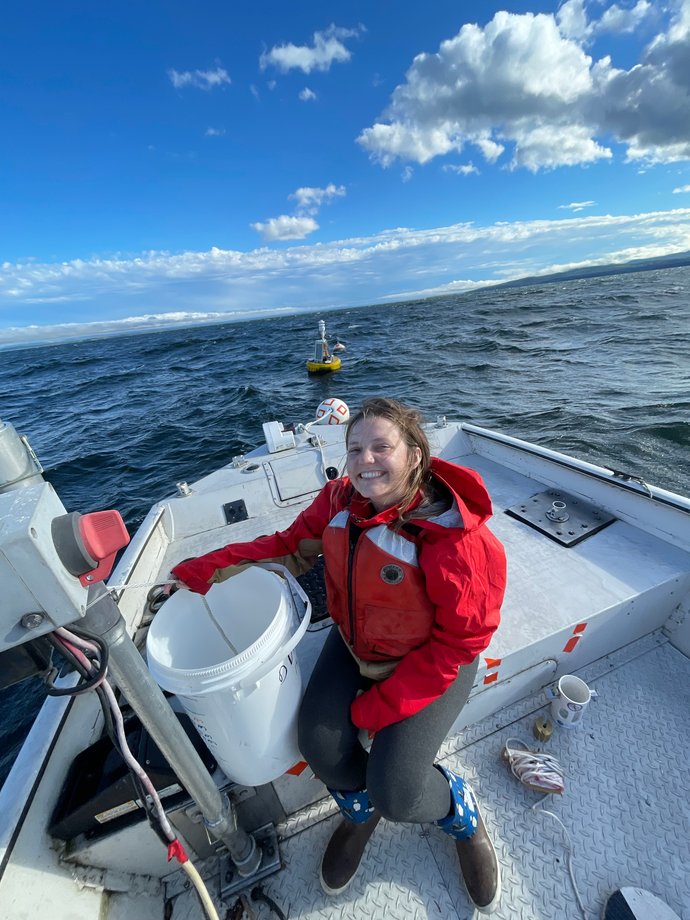
The project’s plankton sampling had started in 2022 with funding from the Great Lakes Fishery Commission. When I joined the project, I spent the first couple months identifying zooplankton and phytoplankton from past collections. Upon seeing stark differences in species abundance and vertical distribution across the samples, I knew I needed to find an explanation and set out to analyze the Valcour buoy’s temperature data in RStudio. I discovered that the storms recorded since the buoy was first deployed in 2016 behaved differently from one another. Classifying these events became a priority to guide our fall 2025 sampling schedule.
That analysis led to even more questions: How does wind translate its energy into the water column? How do these physical forces shape the plankton communities we’re studying? My goal now is to raise awareness among scientists that large, deep, temperate freshwater lakes remain understudied, especially regarding storm impacts on aquatic life. I also want to emphasize the importance of taking a vertical profile within a few hours when sampling due to rapid changes in stratified conditions. This is important because thermal disturbances can lag behind the wind, meaning a storm may be happening underwater while the surface looks perfectly calm.
Uncovering unknown processes in Lake Champlain and connecting those physical events with the plankton samples we’ve collected has been exhilarating. And there’s still so much more to explore beyond temperature, including currents, nutrients, and dissolved oxygen. This has been a rewarding opportunity to answer questions while finding new ones. And now, I can proudly say that I am a storm chaser.