Working arrangements have been fundamentally transformed during the COVID-19 pandemic. These new arrangements have the potential to affect trust-based social networks foundational to collaborative resource management and transboundary governance. The governance structure for Great Lakes fisheries has weathered the storm associated with two years of remote working conditions; but it is unknown how long trust-based relationships can persevere without refreshed commitment to in-person engagement.
A recent survey of fishery professionals throughout the Great Lakes network provided insights into how trust-based relationships have been affected during the pandemic. Eighty three percent of fishery managers and scientists surveyed (n=117) indicated that virtual engagement was effective for maintaining well-established relationships during the pandemic; however, 76.7% of respondents indicated in-person engagement to be more effective than virtual engagement for building and maintaining trust. Only 26.5% of respondents were able to establish trust as part of new relationships through virtual engagement, and only 7.7% of respondents strongly agreed with this sentiment.
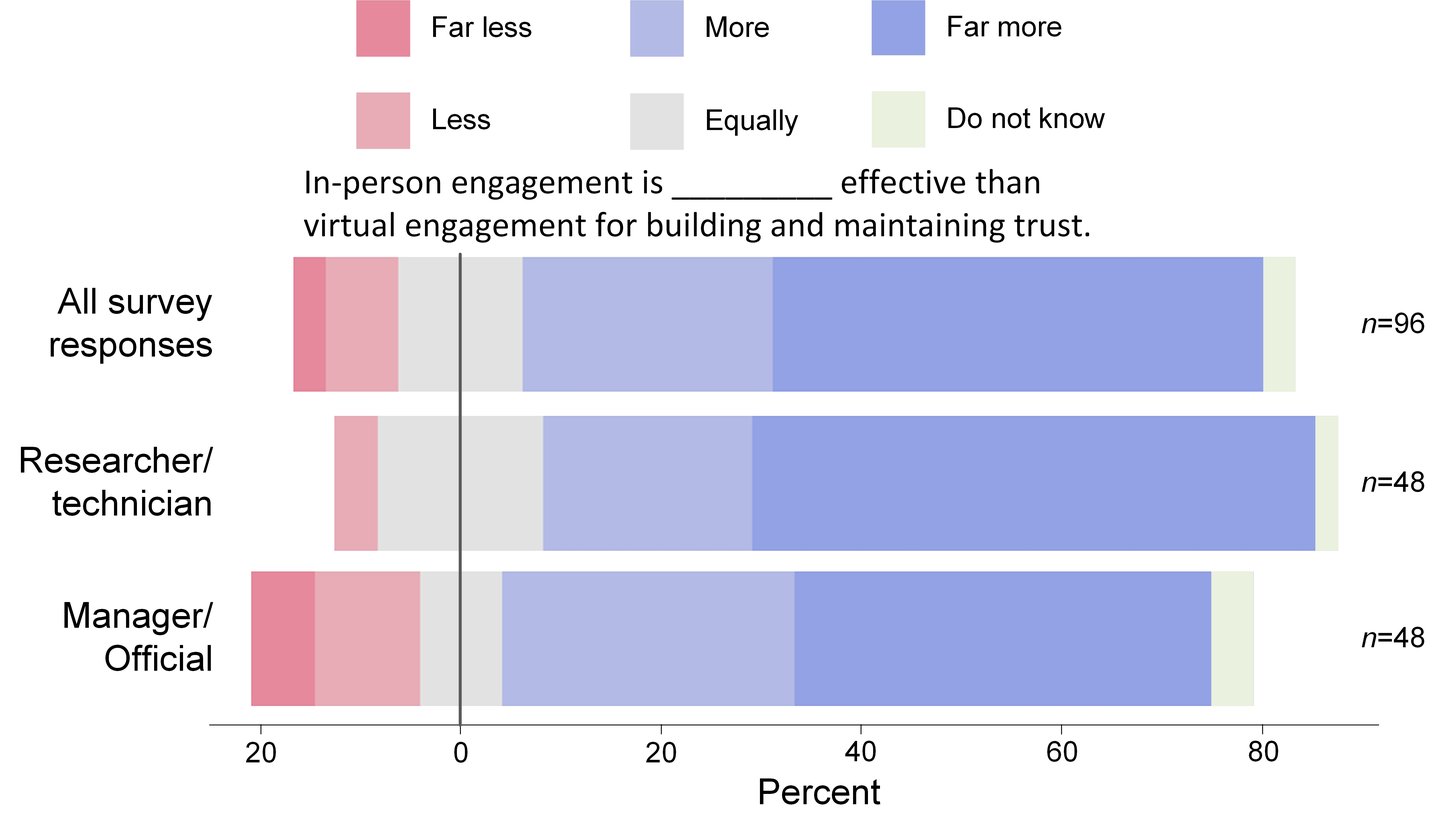
A literature synthesis revealed threats and opportunities to resource management as a post-pandemic new normal emerges. Despite shortcomings, virtual engagement presents opportunities such as nurturing of well-established long-term relationships; short-term trust maintenance; peer-peer coordination; knowledge dissemination; and potentially enhancing diversity, equity, and inclusion.
Governments are urged to prioritize informal interactions and communications fostered by in-person meetings while also recognizing the importance of virtual meetings to conduct business in a cost-effective manner. Without renewed commitment to in-person engagement, pre-pandemic trust-based relationships foundational to cooperative, multinational resource management are under threat.
For a further discussion of survey results, please see the article in the Journal of Environmental Management. Authors include A.M. Muir, J.R. Bernhardt, N.W. Boucher, C. Cvitanovic, J.M. Dettmers, M. Gaden, J.L.M. Hinderer, B. Locke, K.F. Robinson, M.J. Siefkes, N. Young, and S.J. Cooke.