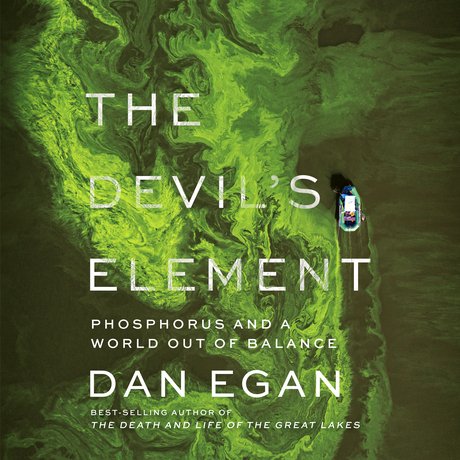
In The Devil’s Element, Dan Egan traces humanity’s love-hate relationship with the 15th element in the periodic table, phosphorus (P). One of six macroelements required for life (CHONPS), P is an essential building block of life (nucleic acids) and its energy currency (adenosine triphosphate). Life can neither take shape nor fire up its engine without P.
Unlike elements CHONS, P is neither abundant on Earth’s surface (CHO) nor biologically fixable (CNS). Consequently, availability of P is mostly regulated by Earth’s slow rock cycle and often limits growth. Egan examines the dual role of P as a boon and curse: critically needed as fertilizer for our ever-intensifying agriculture and a pollutant degrading water quality and habitat downstream. Too little P limits plant growth at the base of aquatic food webs, whereas too much P fuels excessive plant growth (eutrophication) often triggering the formation of harmful algal blooms and bottom water hypoxia.
Geologic and anthropogenic forces have created a paradox of scarcity and excess P across our modern world. There are only two sources of bioavailable P (phosphate, PO4): minable phosphate-rich rocks (mostly in Western Sahara) and onshore deposits of guano (marine bird poop). With human activity having doubled the flow of P in the environment relative to the pre-industrial baseline, the latter is now all but exhausted, and the former is in precipitous decline. Indeed, Earth’s P reserves are projected to last only about 100 years, endangering global food security. At the same time, excessive P from agricultural and sewage runoff is degrading water quality and endangering aquatic and human health.
How we manage the “devil’s element” will reshape our civilization’s future just as fossil fuels have. Egan elegantly states the problem of a world in serious P-imbalance given current unsustainable agricultural and animal waste disposal practices, but does not provide concrete solutions for the required balancing act: having enough P to grow our food while maintaining healthier ecosystems downstream. That is now up to us.