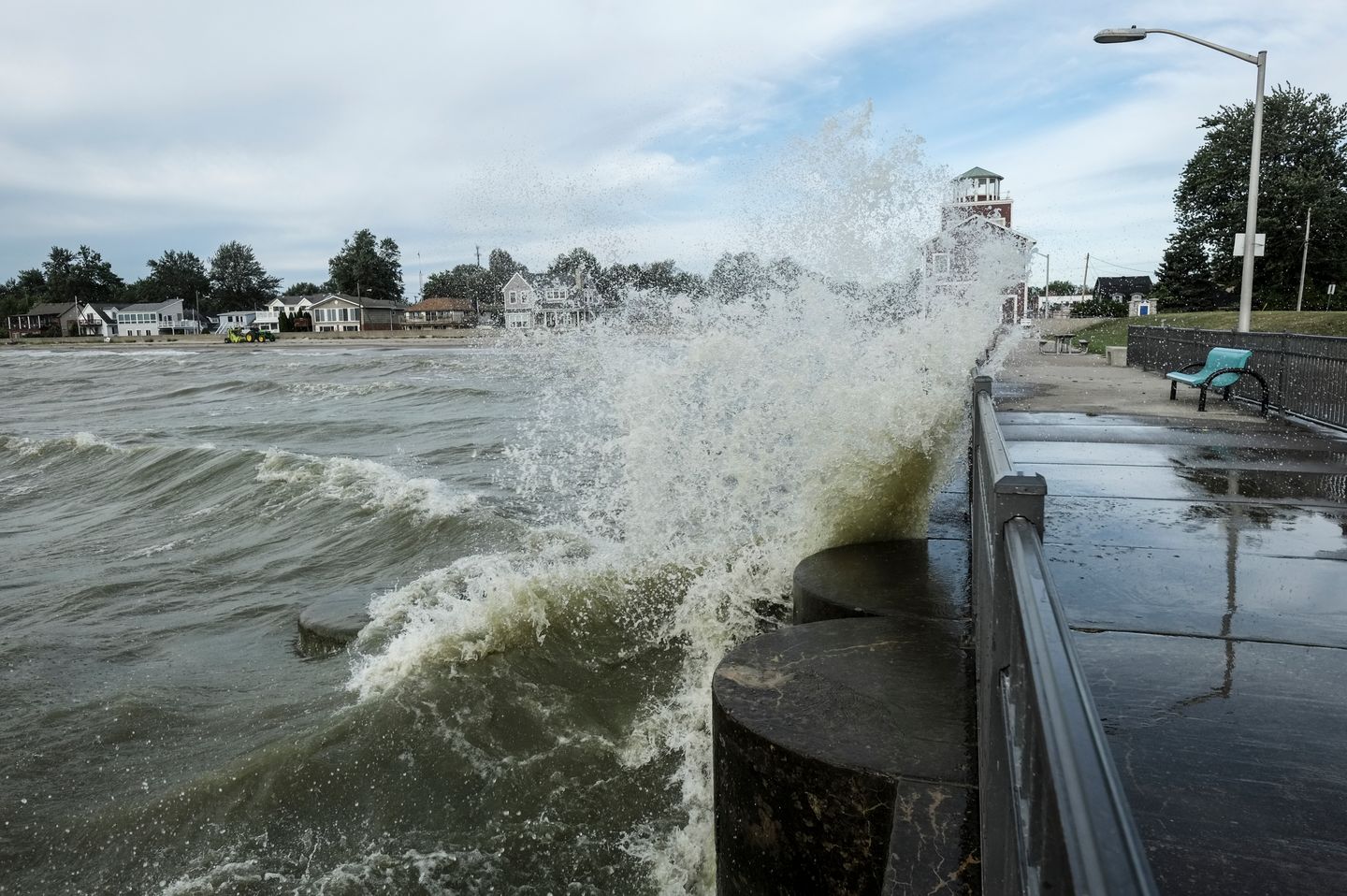
The terms storm surge and seiche are frequently used interchangeably, especially in the press and on social media following large surge events. While these phenomena are related, they are distinct. This is not just a matter of semantics; if you consider the equations of motion that determine the behavior of water in a lake, the dynamical balances that describe these phenomena are fundamentally different. While this may seem like splitting hairs to some, these should not be used interchangeably, any more than a fisheries biologist would use Cisco and Siscowet interchangeably. So how do we define these two phenomena?
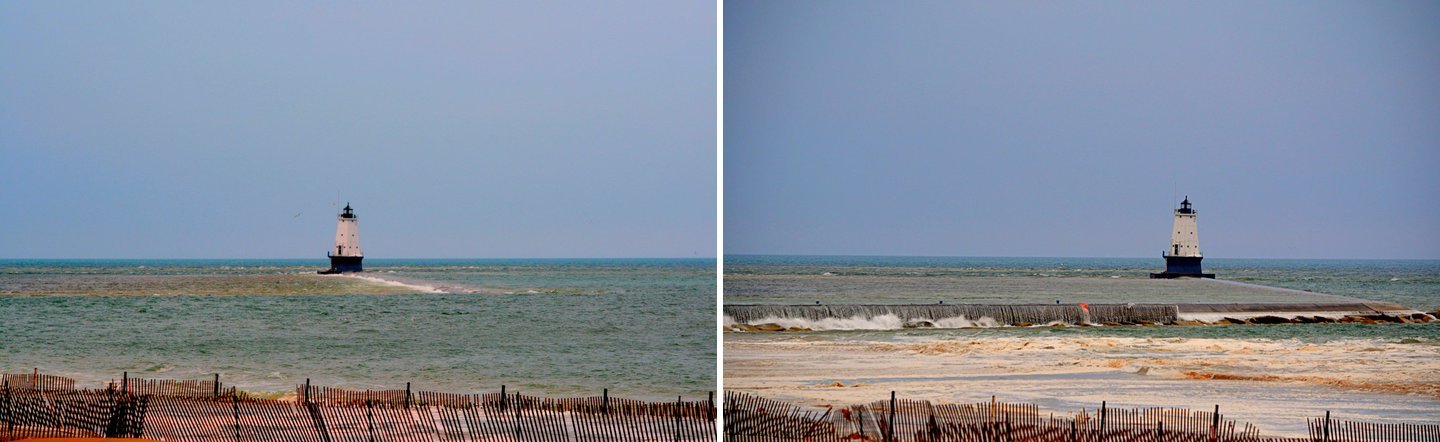
A storm surge is a response of a lake to external atmospheric forcing; typically a strong wind along the axis of a lake, pushing water to one end, or a large difference in atmospheric pressure across the lake, causing one end of the lake to get deeper and the other shallower (there can also be setup due to incident breaking waves, which we won’t consider here). For the wind-driven response, the size of the difference is inversely proportional to lake depth, so wind-driven storm surges are larger in shallower lakes; hence shallow Erie being the home of the most dramatic, damaging, and deadly surges. The response to atmospheric pressure gradients is often referred to as the inverse barometer effect, where the atmosphere pushes down harder on one end of the lake than the other, causing the high-pressure end to be shallow and the low-pressure end to be deep relative to the unforced case. The relative importance of these varies between the lakes; Lake Erie is dominated by wind forcing; the response in deep Lake Superior is dominated by atmospheric pressure gradients.
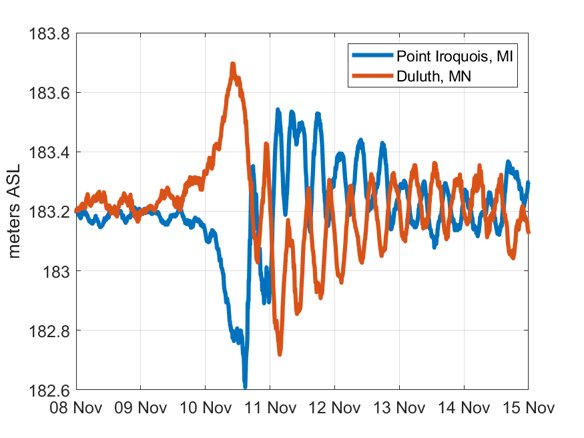
In contrast, a seiche is the oscillatory response of a lake that results from that forcing. (Lakes in seismically active regions, such as Crater or Tahoe, can have seiches set off by seismic activity; that’s not such a big deal in the Laurentian Great Lakes.) Once the external forcing is removed, the lake relaxes back toward its equilibrium state (i.e., a level surface), but overshoots, resulting in a reversal of which side of the lake is highest. This process of relaxation and overshoot results a periodic sloshing back and forth, first formally called a seiche by Forel in 1890 based on observations of Lake Geneva. This process continues until another wind event occurs or the energy associated with the seiche is dissipated by bottom friction. The exact same dynamics govern coffee sloshing back and forth in your coffee cup, or water sloshing back and forth in a bathtub; only the scales are different.
By analogy, storm surge can be thought of as a guitar string being pulled to one side by a guitarist’s finger; once the force is released, the string will oscillate back and forth with no external forces applied, analogous to the seiche. A fundamental feature of both a vibrating guitar string and a seiche is that the period (or, equivalently, frequency) of the resulting oscillation is a function of the geometry of the scenario, but independent of the forcing. No matter how hard the wind blows, the period of a seiche will always be a function of the length and depth of a lake. Likewise, the frequency of a plucked guitar string is a function of the characteristics of the string (specifically, tension, linear density, and length), not how hard it is plucked. For Superior, the primary seiche period is about eight hours; for Erie, about 16. Both the guitar string and a seiching lake will also have higher frequency oscillations, often referred to as harmonics, but most of the energy is typically in the lowest, fundamental frequency.
When there are high water levels in, say, Buffalo or Toledo, it is almost always due to the initial storm surge; any resulting high water level 16 hours later because of the subsequent seiching behavior typically results in much smaller water level displacements, as energy is dissipated from the system. While high water levels pose the obvious threat of coastal flooding, low water levels can cause problems too. During a strong storm surge event on Lake Erie in December 2022, water levels near the Davis-Besse Nuclear Power plant near Toledo became low enough that there was concern that the cooling water intakes could be exposed, nearly leading to a shutdown of the plant. The threat to coastal communities from these displacements of water is real, regardless what word we use for them, but as limnologists, it is worth noting that there are two distinct processes that we should be careful to distinguish between.