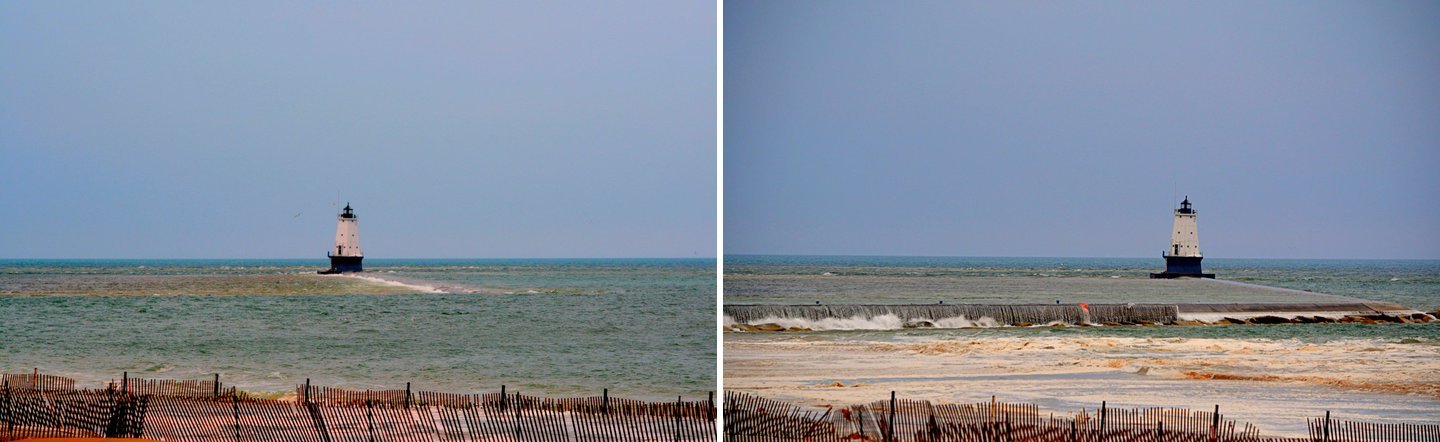
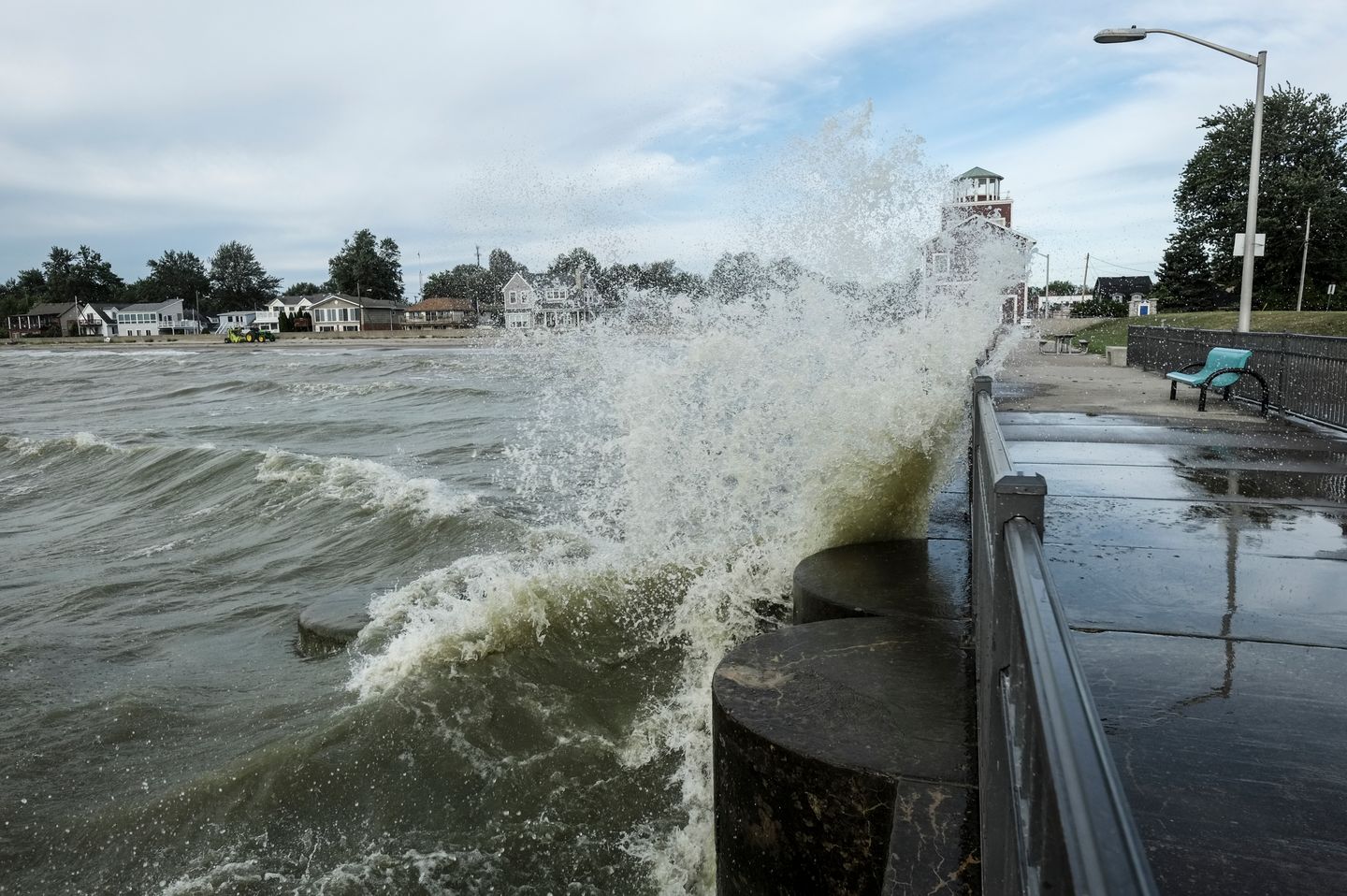
Meteotsunamis have always been there, but it wasn’t until recently that their place amongst the different types of Great Lakes waves was recognized. The term is a combination of meteorological and tsunami and aptly fits both their wave characteristics and mechanism by which they are generated. Technically speaking, meteotsunamis are long waves with periods between roughly two minutes and two hours, which in the wave spectrum is situated between the more commonly observed wind waves and the large, standing waves known as seiche.
However, unlike seismic tsunami waves, which are generated by earthquakes or landslides, meteotsunamis are initiated by a few specific combinations of atmospheric conditions. The most recognizable forms of these weather conditions are what we would call thunderstorms (mesoscale convective systems) or squall lines, but generally speaking, they are any fast-moving system that has a sharp change in air pressure, and at times, wind speed. A key ingredient comes in the speed at which these atmospheric conditions move over the Great Lakes, wherein if the storm propagation speed is close to the underlying (water) wave speed, a resonance is achieved, and the atmosphere can efficiently transfer its energy into the lake below. This process results in the generation, growth, and sustainment of the meteotsunami wave in the lake. However, it is only as the wave reaches shore, where depths decrease dramatically and wave shoaling occurs, where the wave can be amplified to a level that becomes hazardous to the public.
The first Great Lakes meteotsunami appropriately attributed as such occurred on May 27, 2012, in Lake Erie. This event swept swimmers into the lake, swamped marinas, and capsized boats nearshore, and it also served as the commencement of meteotsunami research within the Great Lakes. From that point forward, several notable historical events were then reclassified as meteotsunamis, with perhaps the most famous case having occurred in Chicago in 1954 when eight people were killed. Over time, our understanding of meteotsunami generation and occurrence matured, and the Great Lakes community joined a growing international scientific field that was starting to recognize meteotsunamis as a global phenomenon. In the Great Lakes, it has been determined that many meteotsunamis occur each year; however, most go unnoticed, as hazardous episodes only occur every few years at best. Yet, in recent years, we have also seen that even small, benign meteotsunamis can play integral roles in sediment resuspension, contaminant transport, and coastal hydrology.
Even if rare, meteotsunamis can pose a risk to beachgoers and property owners along the Great Lakes, just like the more commonly recognized wind waves and seiches. However, unlike these types of waves, no forecast exists for meteotsunamis. Researchers have been working on developing meteotsunami forecasts for the past several years, and while there has been success in recreating specific events, operational forecast systems are still unable to provide advance warning of their formation. In part, this is because weather forecast models struggle to predict thunderstorm characteristics.
However, a recent Lake Michigan event revealed that all is not lost. In 2018, a meteotsunami was created by an atmospheric gravity wave, or essentially a large air pressure disturbance that rolled over the lake. It just so happens that these type of weather conditions are better predicted by existing weather forecast models. While they may only be a fraction of the types of weather systems that create meteotsunamis in the Great Lakes, it has become the first sign that a forecasting system may be within reach.