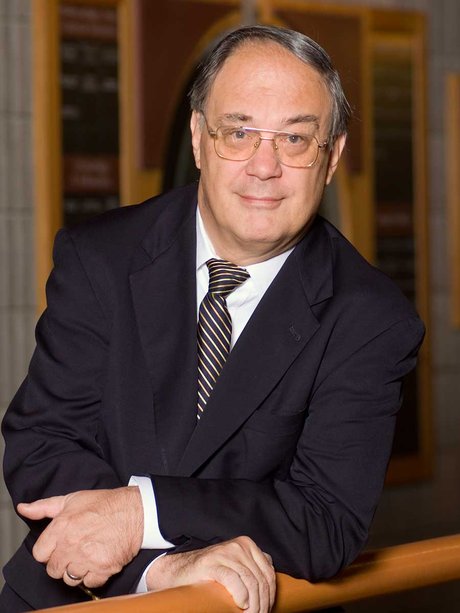
The Great Lakes lost a prominent scholar and great scientist and mentor with the passing of Ronald A. Hites on January 5, 2024. Hites was a distinguished professor emeritus at Indiana University with a joint appointment in the Environmental Sciences program of the O’Neill School of Public and Environmental Affairs and in the Department of Chemistry from 1979 until 2020, when he retired after a 51-year scientific career.
A member of the International Association for Great Lakes Research since 1981, Hites served on the IAGLR Board of Directors from 2006 through 2010, including for a year as president beginning in 2008. He was an associate editor for the Journal of Great Lakes Research (JGLR) from 2018 through 2024. In 2016, he received IAGLR’s highest honor, the Lifetime Achievement Award.
“Ron was a leader in Great Lakes contaminant research for decades,” notes JGLR Editor Bob Hecky. “JGLR was fortunate to have him serve as associate editor right up to the time of his passing. IAGLR and JGLR will miss him greatly.”
Hites made seminal contributions to the Great Lakes community and the discipline of environmental organic chemistry in North America and worldwide. He pioneered new methods of measuring trace levels of (potentially) toxic persistent organic pollutants in the environment based on gas chromatographic mass spectrometry. Much of his research focused on the application of these advanced methods to environmental forensics studies of organic pollution in the air of the Great Lakes region. His research investigated the sources, fates, and effects of trace levels of persistent organic pollutants in the environment. Detailed accounts of his contributions, impact, and mentorship can be found in the peer-reviewed literature. These include a 2015 article titled “The Journey of Ronald A. Hites,” published in Environmental Science and Technology, where he served as an associate editor from 1990 to 2018.
Hites and his research group conducted the U.S. portion of the Great Lakes Integrated Atmospheric Deposition Network (IADN) from 1994 through 2020 for the U.S. Environmental Protection Agency (EPA). In so doing, he established IADN as the world’s leading research and monitoring atmospheric program for organic pollutants. IADN is now led by EPA and Indiana University. Hites’ research activity provided world-leading scientific understanding and policy choices on the role of the atmosphere in contaminating the North American Great Lakes and, by extension, locations worldwide.
Hites' peers and the research community refer to him as the “father of environmental chemistry” as he is widely recognized as the father of modern environmental mass spectrometry—technology that he advanced and applied throughout his career.
Hites also earned a reputation as a “chemical comedian” due to his witty, playful nature, notes long-time colleague and former IAGLR President Robert Letcher. His good humor endeared him to many, including the numerous students he supervised over the years.
“Ron was always very approachable and gregarious, in part due to his comedic banter,” Letcher recalls. “When I first met Ron during my Ph.D. days, it was intimidating to meet such a giant of environmental science. However, my anxiety melted away with his disarming charm. When he realized that I was from Canada, he immediately quipped, ‘You’re from Canada, eh? You know, I am one quarter Canadian.’”
Hites fell in love with science after an enjoyable science class with a great teacher in a Detroit elementary school (Hites 2015). He went on to get his B.A. in 1964 from Oakland University in Michigan. He then attended Massachusetts Institute of Technology (MIT), where he studied organic analytical chemistry, earning his Ph.D. in 1968. He went on to a postdoctoral fellowship at the U.S. Department of Agriculture before returning to MIT as a staff researcher in 1969 to work on the Viking project, which landed a mass spectrometer on Mars in 1976.
With the dawning environmental movement and formation of the EPA, Hites realized that mass spectrometry could be useful for analyzing environmental pollutants. He started with a simple project, studying water taken once a week from the Charles River in front of MIT. Analyses showed the presence of polycyclic aromatic hydrocarbons, and Hites published these results in Science in 1972. This research to identify and quantify previously unsuspected pollutants in environmental samples was immediately recognized as novel and significant.
Hites joined the MIT faculty as an assistant professor of chemistry in 1972. He remained until 1979, when he joined Indiana University as a professor in the School of Public and Environmental Affairs and the Chemistry Department. He was appointed Distinguished Professor of Public and Environmental Affairs in 1989 and a Distinguished Professor of Chemistry in 1997. He supervised the research of about 90 graduate students and postdocs.
Hites was a fellow of the American Chemical Society, the Society of Environmental Toxicology and Chemistry, and the American Association for the Advancement of Science. He received the 1993 Founders Award from the Society of Environmental Toxicology and Chemistry and the 1991 Award for Creative Advances in Environmental Science and Technology from the American Chemical Society. In 1988, Hites spearheaded the creation of the Journal of the American Society for Mass Spectrometry while serving as president of that society. The Ron Hites Award is given annually for the best paper in that journal. Indiana University recognized his contributions with the Bicentennial Medal in 2020. In 2022, the O’Neill School created the Ron Hites Prize in Environmental Science, which recognizes individuals who have made significant contributions toward solving complex environmental problems.