Scientists are constantly identifying chemicals that have the potential to impact the environment, but it can be hard to know when and how to share information about contaminants of emerging concern (CECs) with those whose health or livelihoods may be negatively affected by them. While CECs may have been manufactured for decades, like legacy contaminants such as PCBs and heavy metals, only recently have they been determined to be—or have the potential to be—persistent, bioaccumulative, and toxic, thus warranting further investigation.
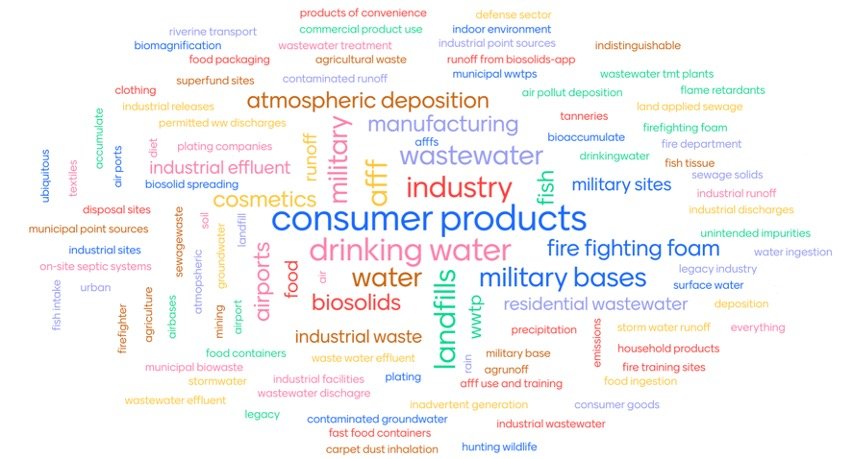
Pharmaceuticals and personal care products, microplastics, and bisphenol A have all been a focus in recent years, but the latest family of CECs to grab the headlines is per- and polyfluoroalkyl substances (PFAS). From The New York Times to Last Week Tonight with John Oliver, the number of news sources covering this issue has skyrocketed. In this article, the term PFAS represents a group of 10,000+ manufactured per- and polyfluoroalkyl substances and their related compounds. PFAS were created to make people’s lives more convenient, as they are resistant to water, oil, stains, and heat. PFAS have been widely used in clothing, kitchenware, food packaging, cosmetics, carpets, paints, and firefighting foams, and they are ubiquitous in the environment. The Centers for Disease Control and Prevention reports PFAS to be present in the blood of at least 97% of Americans. While the mechanism of PFAS toxicity remains under study, epidemiological evidence suggests PFAS are associated with negative health outcomes including risk of cardiovascular and thyroid issues, suppression of immune response, decreased infant birth weights, and cancer.
In the Laurentian Great Lakes, PFAS have been detected at concerning levels in drinking water and fish. As millions in the United States, Canada, and First and Tribal nations benefit from the Great Lakes and connecting waterways, PFAS are a major cause for concern. Similar to other CECs, socioeconomic issues related to the exposure and mitigation of PFAS can be significant and wide-ranging. Marginalized and lower-income communities often bear a disproportionate pollution burden, and though it is not clear that PFAS exposure varies directly with economic status, costs associated with treating individuals affected by PFAS-related health problems or environmental remediation may be a significant burden for low-income households. Racial and ethnic minority groups with traditional cultural practices related to fishing, or communities dependent on fishing for sustenance, may also be disproportionally affected by PFAS exposure from fish consumption due to bioaccumulation potential. Further, PFAS contamination can affect the agricultural economy and the farming community by contaminating the soil and water used for irrigation.
A community-specific approach to engagement is critical to address CECs, as exposure reduction measures designed for one community may not be suitable for others. Through a Great Lakes-wide scoping effort, Illinois-Indiana Sea Grant (IISG) helped identify pressing research questions related to PFAS exposure and mitigation. Manufacturers of PFAS, workers exposed to PFAS-filled products (e.g., firefighters), and those who live near major sources of PFAS (e.g., airports) were identified as some of the communities who are at high risk from exposure to PFAS but relatively well-aware of the potential risks. On the other hand, anglers and seafood consumers (particularly from tribal and subsistence communities), residents in rural areas served by municipal water and well water, and lower income households were identified as some of the communities who are at high risk from exposure to PFAS but least aware of the risks. Effectively addressing the socioeconomic impacts of PFAS requires effort from environmental toxicologists and epidemiologists, various levels of the government, and industry.
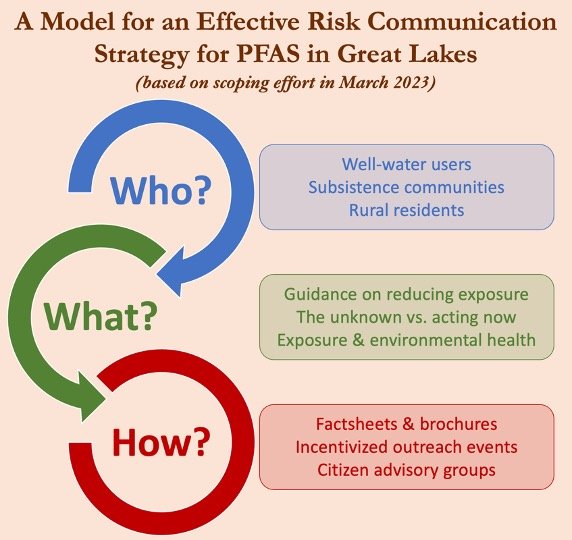
A key need that emerges with new CECs is early communication with those experiencing exposure. The evolving scientific understanding of PFAS demands that caution be exercised during risk communication. However, it is important to increase awareness and address concerns in vulnerable communities early on. What information needs to be communicated and how it needs to be communicated are key elements of an effective risk communication strategy. From the scoping effort in March 2023, IISG suggests a model for an effective risk communication strategy for PFAS in Great Lakes (see figure). Further, with support from the National Sea Grant Office and NOAA, IISG is supporting four research projects to fill information gaps in this area. Specifically, researchers will assess best practices in communicating PFAS-risks with recreational anglers in Chicago, Illinois, and Benton Harbor, Michigan; evaluate PFAS messaging to the public, with special emphasis on Latino populations in Wisconsin; develop an online risk assessment tool to help residents of Michigan, New York, and Pennsylvania gain a better understanding of PFAS exposure; and assess and compare PFAS-related state laws and regulations in the Great Lakes and Lake Champlain regions to explore policy challenges. Socioeconomic aspects of CEC mitigation will also be featured during a session at IAGLR's Conference on Great Lakes Research this May.