Conceptual drawing of the horizontal mooring and glider path against a convective background. Red dots represent thermistors, yellow dots represent flotation devices, and blue dots represent pressure sensors.
To study new phenomena, sometimes we need to reconsider either how we use traditional technologies or how we interpret the data they provide.
Take, for example, the study of springtime convective processes in Lake Superior. Convection can occur when a water column is below its temperature of maximum density (about 4° C) and sunlight heats the near-surface water causing it to become denser and sink to the bottom. This movement displaces deep water toward the surface and provides a pathway for water column constituents to travel from the lake’s surface to its bottom in just a few hours in even the deepest parts of the lake. The ecological significance of this circulation has been explored in shallow lakes (e.g., Yang et al. 2017), but is poorly understood in deeper lakes like Superior. Recent work (Austin 2019) suggests convective cells dominate the circulation of Lake Superior for two to three months of the year, a significant portion, indicating the need for exploration of deep lake convective processes.
One challenge in studying these processes is that we’re not that good at measuring the relatively narrow widths of convective cells. Most traditional observational techniques, such as CTD profiling or single-point moorings, assume that horizontal variability occurs on scales much larger than does vertical variability. In most cases, this is a reasonable assumption as vertical structure is driven by water column light penetration and density stratification. However, recent results suggest springtime convective cells have lateral scales on the order of just tens to hundreds of meters, making traditional approaches unviable. We are meeting this challenge with two new approaches: first, an innovative way to interpret data collected in a traditional fashion; second, a new design for a platform on which to deploy standard instrumentation.
Interpreting data in a new way
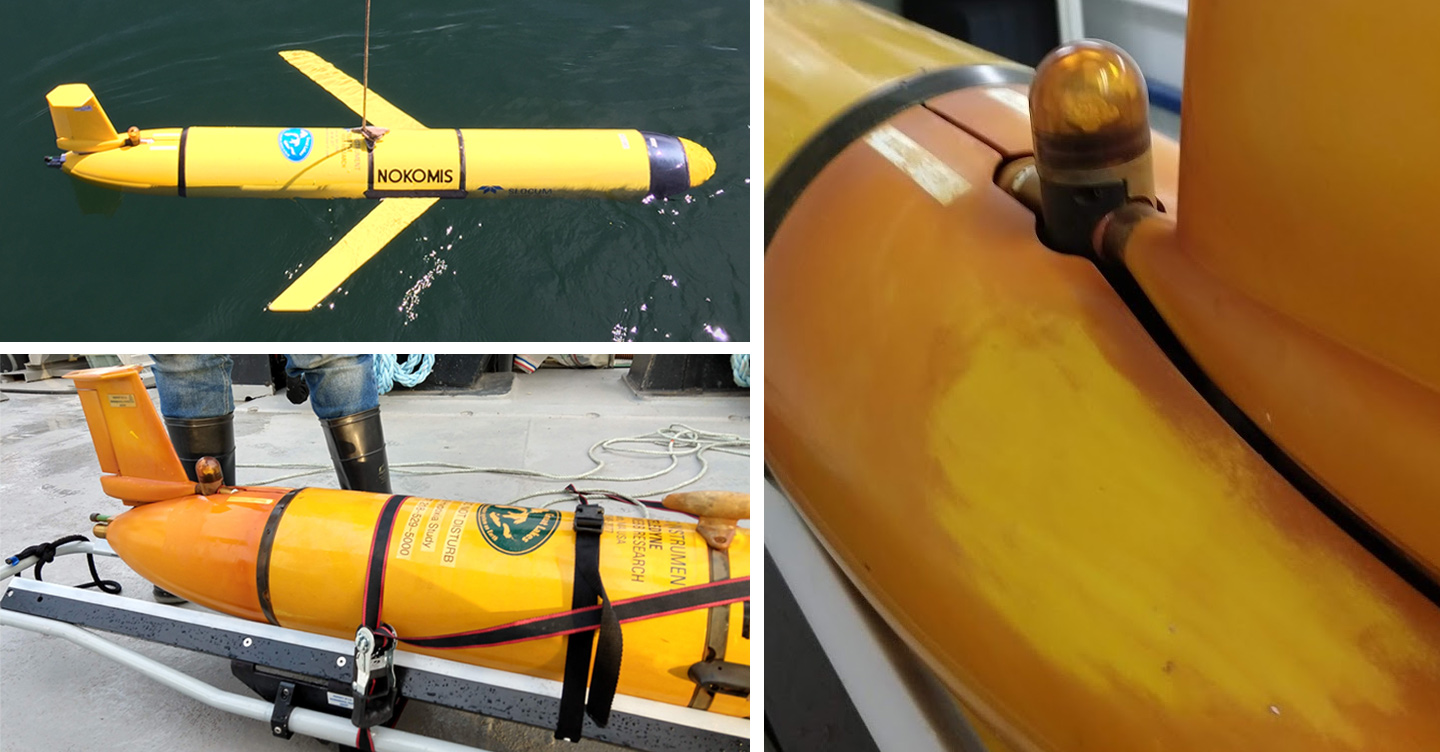
Autonomous gliders are becoming a mainstay of oceanographic research, and are starting to be used more frequently in large lake research. A usual way to interpret data collected along the gentle slope (1:2) of a typical glider’s path is as a representation of a vertical profile, as would be collected by a CTD profiler. Yet for fairly narrow convective cells, variability along the glide path also may reflect lateral variability. Such may be the case for data collected during springtime convection, and estimates of the abundance of anomalously warm regions have allowed us to place some preliminary constraints on the size of convective plumes and cells.
Standard tech, new design
To further address the issue of variability on very short lateral scales, we recently designed, built, deployed, and recovered a large “horizontal mooring” with support from the National Science Foundation. This mooring allowed us to deploy a two-dimensional array of precision thermistors. The platform is large, standing 150 meters tall, and the instrumented portion spans a width of 180 meters. It carries 48 RBR TR-SOLO thermistors and seven pressure sensors used to verify orientation of the mooring as currents displace it. This mooring was accompanied by several auxiliary platforms including a meteorology buoy and a current profiler. The data collected are allowing us to study the development of individual convective cells. This is a great example of how a traditional technology, like off-the-shelf thermistors, deployed in an innovative fashion allows us to ask (and answer!) questions that we otherwise might not be able to address. Insights from this research will provide us with a greater understanding of how the convective processes of the largest of the Great Lakes behaves for several months of each year.
"