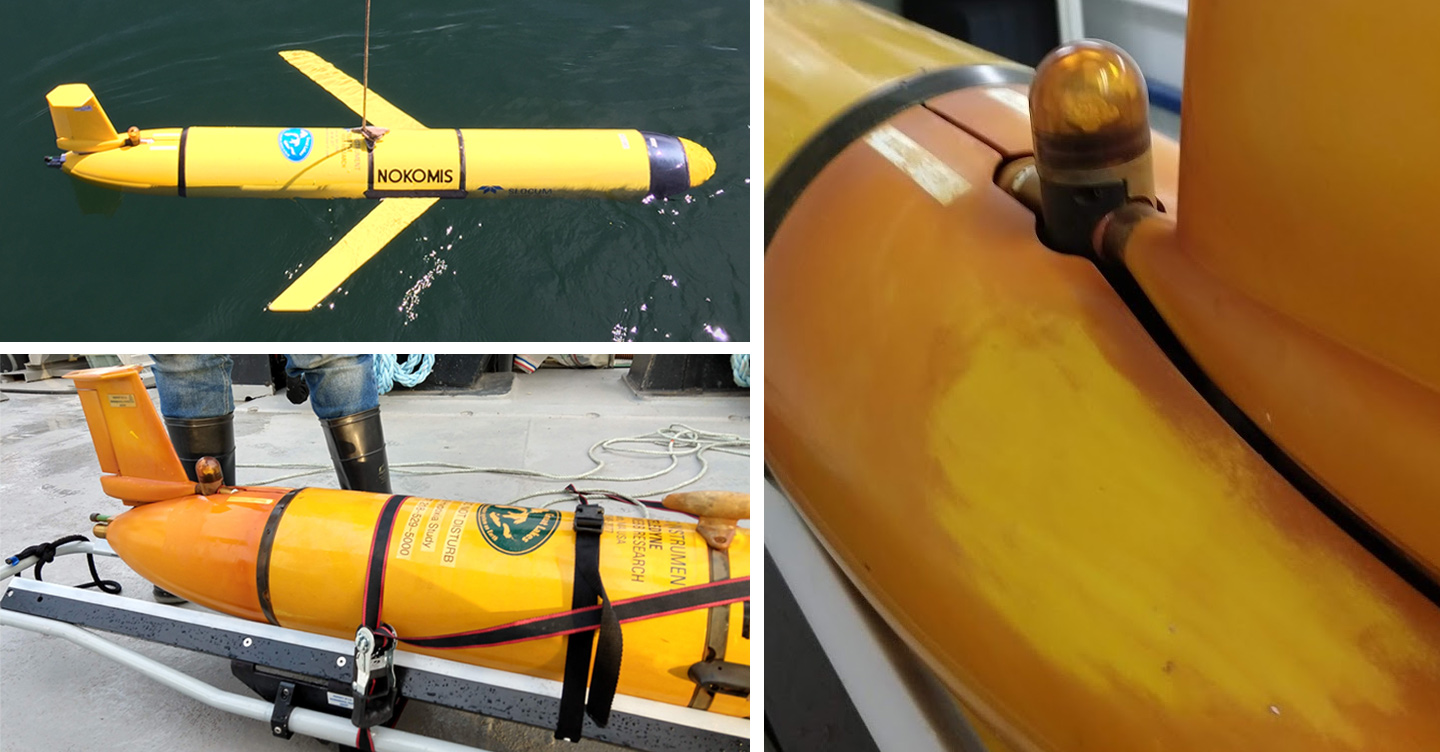
In late August 2019, two underwater robots zigzagged beneath the surface of western Lake Erie to test new technology that autonomously monitors and measures in near real time the toxicity of Great Lakes harmful algal blooms (HABs). This was the second year in which the National Oceanic and Atmospheric Administration (NOAA) tested these robots and the first year that two were sent out at the same time. These field trials are part of an ongoing collaboration between NOAA, the Monterey Bay Aquarium Research Institute (MBARI), and the Cooperative Institute for Great Lakes Research (CIGLR). Project researchers tested these underwater vehicles to see how well they worked in a shallow, turbid, freshwater system and to see what tweaks were needed to make them part of NOAA’s efforts to forecast, monitor, and understand HABs in the Great Lakes.
HABs develop when excess nutrients from fertilizers, sewers, and water treatment plants wash into the Great Lakes causing algae to grow out of control. Continuous monitoring of them is important because the toxins they produce can contaminate drinking water and pose a risk to people and animals.
“The ability to measure algal toxins on the fly using autonomous vehicles will be a game changer for researchers and resource managers,” says Chris Scholin, president and CEO of MBARI. “Lake Erie and Monterey Bay are the only places in the world where this has been attempted.”
The robots, known as long-range autonomous underwater vehicles (LRAUVs), each had a unique mission that helped scientists study the HABs. The first robot, named Tethys, searched for patches of algae that might be toxic to determine how far each discovered bloom extended and where it was most concentrated. The other robot, Makai, carried a third-generation Environmental Sample Processor (3G ESP) known as a “lab in a can” to measure levels of microcystin, a liver toxin produced by the cyanobacteria that commonly comprise Lake Erie HABs. Whenever Tethys found bloom patches likely to have high microcystin concentrations, it informed an operations team, which sent Makai to measure toxin levels in that area.
LRAUVs collect high-quality data efficiently, cost-effectively, day and night, and in all weather conditions. They can provide more detail about how far a bloom has spread and how fast a bloom is moving than can traditional sampling from a boat. This information can also help complete satellite data gaps, which often result from cloud cover in the Great Lakes region. In addition, onboard 3G ESPs can measure algal toxin levels in near real time, a process that otherwise takes overnight to complete. These features help drinking and recreational water managers stay ahead of treatment plans and keep water safe. Once fully operational, these underwater robots will give NOAA the ability to detect, monitor, and map HABs and their toxicity on a 24/7 basis.
“We are always looking for ways to improve our understanding of harmful algal blooms in the Great Lakes, and having the ability to continuously detect and report on these blooms would be a big boost to our efforts,” says Debbie Lee, director of NOAA’s Great Lakes Environmental Research Laboratory. “Harmful algal blooms have a big impact on Great Lakes residents, and, by teaming up with MBARI to advance technological innovations of these LRAUVs, we’re working to protect lives here in the Great Lakes and beyond.”
To read more about this project and Great Lakes HABs, check out the full article on NOAA’s Oceanic and Atmospheric Research website.