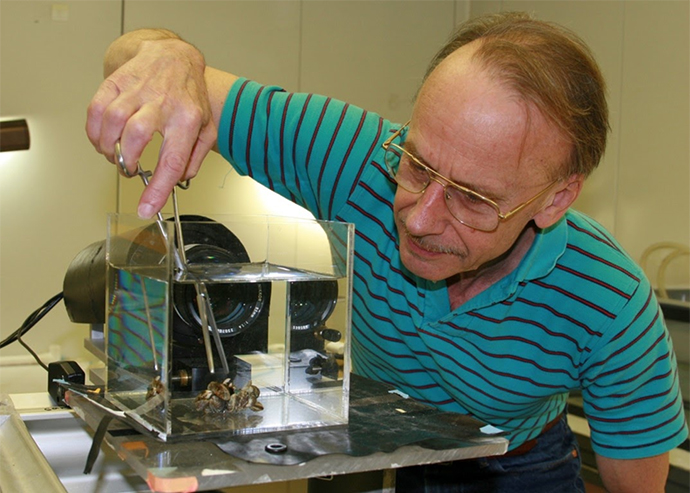
I am a professor of civil and environmental engineering at Michigan Technological University (Michigan Tech), located in Houghton on the Keweenaw Peninsula of Michigan’s Upper Peninsula. I teach courses in sustainable engineering, environmental chemistry, and meteorology. My research deals with transport and transformation of legacy and emerging pollutants in the Great Lakes region.
My Pandemic Story
The pandemic has affected my work in causing me to work from home for both teaching and research. I learned that Michigan Tech would be going to online teaching Wednesday of spring break. I had until the following Monday to inform my students how the course would function for the remaining seven weeks of the semester. Luckily, the course I was teaching was conducive to an online format, but, not surprisingly, I was not prepared for online teaching. I had to increase my online presence in the learning management system, learn how to hold synchronous and asynchronous class meetings, conduct online assessment, run student group meetings using Zoom breakout rooms, work in Google Docs and Sheets for classwork, and more, in a short time frame.
Through those weeks, it became clear to me that I needed additional training in online teaching. At the end of the spring semester, Michigan Tech required all faculty to obtain certification to teach online, and so I obtained the Quality Matters (QM) certification by taking their seven mini courses in May and June. Taking the QM certification courses did increase my confidence in online teaching. The biggest challenge for me in this pandemic has been delivering courses online that are of similar quality as face-to-face courses. The litmus test for success in dealing with the challenge will be the start of fall term, when I am required to deliver courses both face-to-face and online.
Michigan Tech is hosting the IAGLR conference May 17–21, 2021. Noel Urban, also a faculty member at Michigan Tech, and I are co-chairing the event, and so the conference has been on my mind a lot lately. If it occurs in person, it will be the largest conference ever hosted by Michigan Tech. We have held numerous planning meetings this summer, and I have been amazed at the outpouring of interest and help with the preparations. We will not know whether the conference will be held face-to-face or online until January, so we are preparing contingencies for both cases. IAGLR 2020 Virtual was outstanding, and I would personally like to thank President Ed Verhamme (an alumnus of our environmental engineering program, I am proud to mention) and the IAGLR staff for the key roles that they played in making IAGLR 2020 Virtual a reality. I admit that we hope that IAGLR 2021 can be held face-to-face, as we would very much like the IAGLR community to see and experience the natural beauty and rich history of the Keweenaw Peninsula in person.
A look to the future
During this time of upheaval, how can we as a research community emerge stronger than before? The seemingly contradictory answer to this question is that standing together in solidarity means, quite literally, standing apart. Social (aka physical) distancing remains the most effective means to stop the pandemic. Given the distances across and between great lake basins, and as IAGLR 2020 Virtual so aptly demonstrated, the IAGLR community is already adept at standing apart in solidarity. Looking forward to seeing you at IAGLR 2021, whether it be in person or virtually!