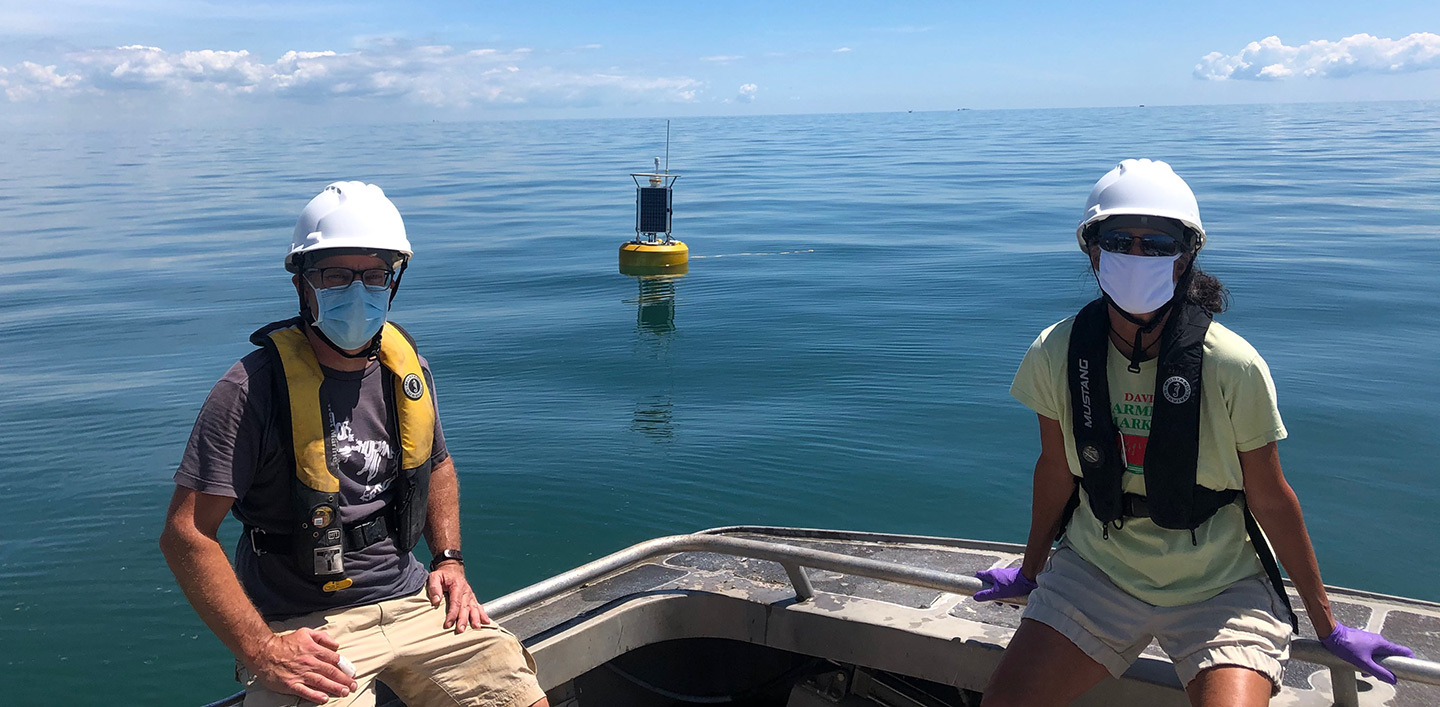
I use remote sensing data to look at different water quality issues. My most recent focus was on the cyanobacterial and harmful algal blooms that recur annually in Lake Erie and in South Florida. We can use the data captured by the sensors to distinguish different in-water constituents like pigments, sediment, and colored dissolved organic matter. Now I am part of a project that tracks mercury in the San Francisco Estuary using proxies that we can detect with remote sensing instruments.
My Pandemic Story
My work was largely unaffected by the pandemic, because my research is primarily computer based! I had my laptop and a Wi-Fi connection and was able to work from home without a lot of fuss. I was teaching one class in the spring, an introductory oceanography class, and migrated it online for my students.
However, just because I can easily work from home doesn’t mean that this time has been easy. The realities of ongoing societal-level uncertainty driving multiple layers of stress, worry for both loved ones and students, looking for a new job, and managing a changing household situation have a big impact. My oldest child moved home so she wasn’t isolated in an apartment while she worked remotely. My next two, college age students, were abruptly dislocated (one from a study abroad program in Scotland).
In total, seven of us needed space and quiet to be able to continue to work and finish the school year. It is not an easy situation, but we are incredibly privileged to live in an area where we have the space in our house and the means to support our family. That privilege has also served to highlight the incredibly high level of inequality and financial disparity in our country and society—for families, scientists, and persons of color. This inequality has been both a source of further concern and a call to action for me personally and for my family.
There have been some wonderful personal benefits during this time as well. I did get a new position with a principal investigator (PI) who is already proving to be an excellent mentor. My previous PI remains a part of my professional success, and my network grows! And at home, my partner has been taking over the cooking, and household tasks are more evenly distributed. We have been able to complete some projects as well. I know that this is very much a cliché, but it is true, and one way to help cope with the stress of the pandemic. I have also begun to find ways that I can help enact real change in our society. I am hopeful that change can occur and be real.
A look to the future
I think that one of the most important impacts of the pandemic was to pull back the curtain on the realities of our lives. Scientists are people—with interests, relationships, and responsibilities outside of their scientific research. As a community, we need to be better at recognizing and valuing those things. We need to work to change the expectation of research as a priority for which everything else is sacrificed. For example, we should focus on increased access to conferences, a normalization of the challenges of childcare or eldercare, and attention to race and gender issues.
I use remote sensing data to look at different water quality issues. My most recent focus was on the cyanobacterial and harmful algal blooms that recur annually in Lake Erie and in South Florida. We can use the data captured by the sensors to distinguish different in-water constituents like pigments, sediment, and colored dissolved organic matter. Now I am part of a project that tracks mercury in the San Francisco Estuary using proxies that we can detect with remote sensing instruments.