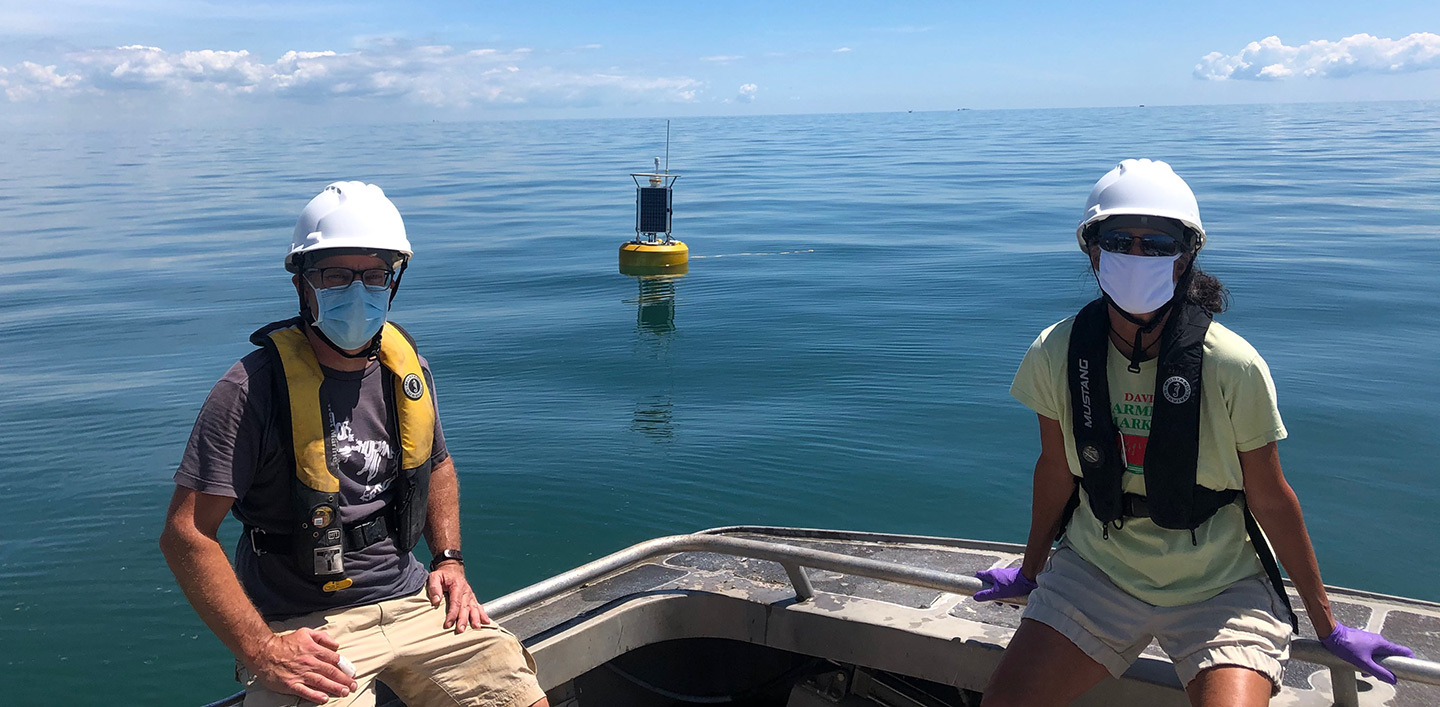
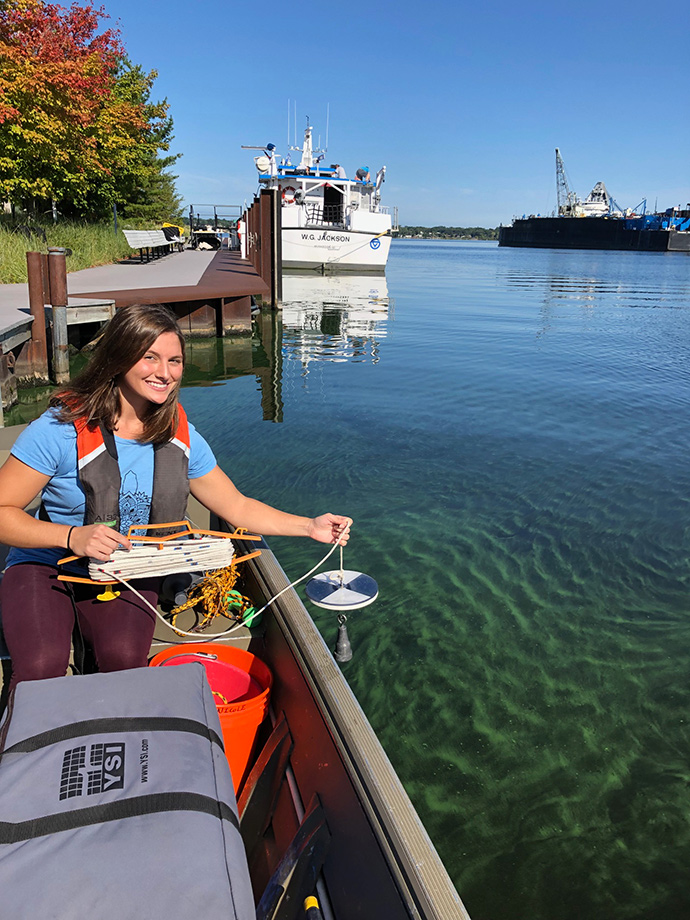
 My master’s thesis research focused on the harmful algal bloom (HAB) impairment in Muskegon Lake (Muskegon, MI), a Great Lakes Area of Concern. The first objective was to gain a historical understanding of the trends of HABs on Muskegon Lake (2003–2019) both in terms of abundance and composition. The second objective was to determine how the anomalous weather patterns of 2019, a very cool and wet year, affected the phytoplankton community and HABs in Muskegon Lake.
My Pandemic Story
When campus officially closed in March, we were told it was a temporary measure. I hadn’t any idea I would only return to campus one more time to clear my desk months later.
One of the most challenging realizations for me was that my graduate school career would not conclude with months of me working hard alongside my peers as we rallied to finish our theses, but rather with me trying to focus at an impromptu desk in my living room, alone. It was a struggle to maintain efficiency, and I began working long days finishing up data analysis and tackling the writing portion of what would turn out to be a 200-page thesis.
While the seemingly constant distractions of the news, my cats, and the other members of my household (who were also trying to figure out how to work from home) made it difficult to maintain a strong work ethic, I can’t help but feel lucky that all of the work that needed to be done to finish my thesis could be done remotely. With all the time in the world and no reason to leave my home, it actually made for a timely opportunity to focus on writing and preparing for my defense. I found that the most important thing to maintaining sanity and productivity was to follow a strict schedule, not work for too long at a time, and take the weekends off. With the amount of time saved from not commuting to campus or the lab and the conclusion of classes, I was able to pick up old hobbies, tend to my plants, read more, make puzzles, go birding and hiking in the mornings before working, watch shows I’d earmarked, frequent the beach, and spend time with my family.
In realizing all of the things that I, and many others, have lost during the course of the pandemic—the energy of the campus environment, the ability to go out with friends, celebrations for concluding our graduate school journey—I found that I actually gained things as well. For the first time since beginning my academic endeavors, I had time. Whereas my days used to be filled with driving to and from campus and the lab, completing class requirements, performing field and lab work, going to the gym, engaging in social activities, and more, they were now filled with seemingly endless amounts of time. At first, it was daunting and overwhelming, but it also provided endless opportunities to appreciate the world around me, and I believe I am a more adaptive, flexible, and self-sufficient person for it.
A look to the future
To me, one of the most important and obvious things to emerge from the pandemic is the realization that scientists have the ability to pull together and work hard to fast-track necessary research for the common good, all while facing criticism, mistrust, and disbelief from the public. There has long been a movement to try to better connect the scientific community to the community it serves, and I believe we have made progress in that regard and can use the momentum to tackle challenges like climate change. I think the key is collaborative efforts and a united front.