For many in the Great Lakes region, “up north” means fresh-caught, local fish. The fisheries supporting this pastime are deeply woven throughout the region’s culture. Towns along the lakes have built their livelihoods on commercial fishing. Leland, in the pinky of Michigan’s mitt-shaped lower peninsula, even has a district named Fishtown along the mouth of the Leland River that feeds into Lake Michigan. The original fishing shanties along the river are still standing, most now filled with small shops and businesses. Thousands of tourists from Michigan and the broader region visit Fishtown to enjoy the area’s rich history and, of course, the excellent fish it has produced for years.

One of the most emblematic of the Great Lakes fisheries focuses on lake whitefish (Coregonus clupeaformis), a large silvery fish that is known to be one of the best tasting of the region. This is not a new revelation; Indigenous Peoples have been harvesting lake whitefish since time immemorial, and it still plays a key role in their cultures. Lake whitefish’s taste and abundance have solidified it as a key pillar in the region’s US$5.1 billion fishing industry.
Despite their seemingly steady availability, lake whitefish are not an infinite resource. This is evident from the fishery’s collapse in the 1950s, when the populations dwindled to unfishable numbers after the sea lamprey invasion. Thanks to the implementation of sea lamprey control, populations bounced back. Harvest regulations, continued monitoring, and invasive species control allowed the fishery to regain some stability. Continued co-management and collaboration between tribal and state agencies have been crucial in setting and maintaining harvest quotas. However, history seems to be repeating itself, with Great Lakes ecosystems being reshaped by new invasive species, like the round goby and dreissenid mussel species. Due to changes in the food web caused by these seemingly ubiquitous invaders, lake whitefish abundance has been declining since the early 2000s, with recent estimates causing alarm among fishers and managers alike. Understanding how fish populations are changing in response to these shifts is crucial for determining what can be done to restore them. Much of the data used to make abundance estimates comes from commercial fishers, so lowering harvest limits results in less data to make confident estimates.
This is where a genetic tool called close-kin mark-recapture (CKMR) can come in. Part of an expanding toolset of molecular techniques that help us learn more about wild populations, CKMR provides estimates of abundance using the frequency of related pairs of individuals to infer the size of a population. If considered in a human context, CKMR would operate on the idea that it is more likely to randomly find two related people in a small, rural community than in a massive city. The same logic can be applied to populations of lake whitefish and samples collected by fishers and management agencies. The number of relationships discovered within a sample can therefore provide the basis for estimating the size of a population. We’re developing such a CKMR model for Great Lakes lake whitefish in collaboration with U.S. Geological Survey researcher Benjamin Marcy-Quay and with funding support from the Great Lakes Fishery Trust.
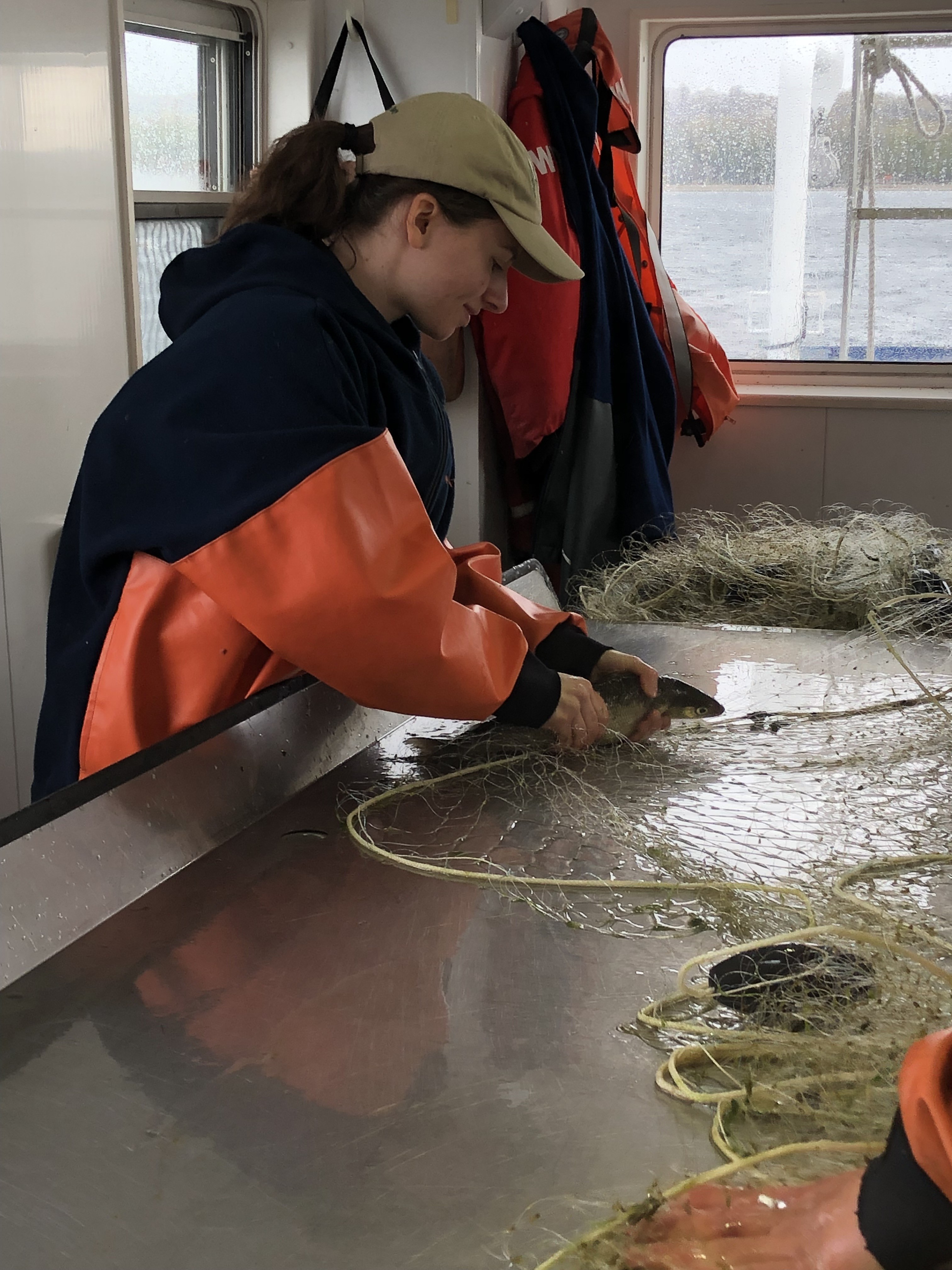
To find related fish, we can examine regions of the genome that are particularly well-suited for determining familial relationships. We have been developing a carefully tailored tool that targets certain locations in the lake whitefish genome that allow us to determine whether sampled fish are either parent and child or half siblings. With Lake Michigan lake whitefish samples collected by the Michigan Department of Natural Resources and Grand Traverse Band of Ottawa and Chippewa Indians over the past two decades, we can use the CKMR tool to estimate population sizes from those years for comparison to current abundance estimation approaches. Discovery of half siblings also reveals the survival of fish over the years, as the shared parent must have survived between the births of the siblings.
Lake whitefish are divided into geographically defined units within the Great Lakes and managed separately. However, recent genetic analyses have confirmed what managers have long suspected; the fish themselves are unaware of the boundaries we have drawn for them. We have been able to better estimate where population borders lie thanks to patterns of genetic similarity, but with changing food availability, these boundaries may be changing. Knowing the source of fish we are analyzing is crucial to understanding what we are estimating; if we count fish that are not members of the study population, there is a risk of overestimating population size and thus setting harvest limits too high. With the genetic regions we are targeting with the CKMR analysis, we will be able to determine which unit each fish came from to help characterize the status of the fishery in each corner of Lake Michigan.
It is impossible to know the exact number of lake whitefish in Lake Michigan at any given time, but we can get close estimates of reality with tools like CKMR. Being able to properly assess the total number of fish can help managers set informed harvest limits and potentially take other measures to preserve or restore populations. Considering continued environmental changes and species invasions, CKMR offers a way to ensure our actions are effective. Continued economic success of places like Fishtown that make up the rich cultural tapestry of the Great Lakes region hinge on success of healthy fisheries. Tools like CKMR help us to preserve not only the fishery itself, but the legacy of towns that have been built around the fishery for generations.