It is an exciting moment for Great Lakes research, one that calls for thoughtful and responsible strategizing. The Great Lakes research and management community is gaining new power to apply advanced algorithms, data integration strategies, and cloud-scale infrastructure that can fundamentally enhance our ability to study, manage, and protect these complex inland seas. This progress is driven by both scientific curiosity and a commitment to ethical stewardship of the environment and the technologies we embrace.
Fueled by collaboration and the generous support of partners such as the National Oceanic and Atmospheric Administration (NOAA) and the Great Lakes Observing System (GLOS), the Cooperative Institute for Great Lakes Research (CIGLR) is launching the Great Lakes AI Lab as a regional hub for collaboration across the Great Lakes science community. Rather than replacing established science, this initiative unlocks our community’s collective potential to build smarter, faster tools for managing the colossal streams of data produced by monitoring and modeling efforts across the world’s largest freshwater system.
The Vision: Taming the data deluge
The Great Lakes generate vast amounts of information every day from satellites, buoys, remote sensors, and advanced computer models. Artificial intelligence (AI) and machine learning (ML) offer essential tools for managing this data deluge. These are methods that allow computers to detect patterns and make predictions from very large datasets, helping scientists uncover insights that would otherwise remain hidden.
Our vision, which took shape after the 2024 CIGLR summit titled “Mapping Out How Machine Learning and Artificial Intelligence Will Change Great Lakes Observations, Modeling, and Forecasting,” is to build a collaborative, open-source framework. Think of it like a shared digital workbench where researchers across the region can train, test, and deploy AI approaches. This framework moves beyond disconnected data and models. By integrating them for systemwide optimization, we can improve forecasting and make observing networks more adaptive and effective.
"The arrival of ML and AI represents a fundamental shift, not just a new set of tools. Rather than reacting to change, our community must decide how to use this technology with focus and intention."
The arrival of ML and AI represents a fundamental shift, not just a new set of tools. Rather than reacting to change, our community must decide how to use this technology with focus and intention. To maintain the high standards of accuracy and reproducibility that the Great Lakes demand, domain expertise must remain in the driver’s seat. We are not simply training algorithms on numbers; we are embedding them in decades of scientific understanding and process knowledge. Realizing this vision depends on continued investment in our local experts, who form the human accountability layer for these powerful tools. This commitment is essential for moving toward systemic understanding and higher-order connectivity. It allows us to apply smarter, more holistic methods for assessing the interconnected Great Lakes system and to ask and answer more complex questions than ever before.
AI in Action: Extremes and efficiency
The power of this technology lies in its ability to address some of the region’s most pressing challenges.
- Predicting water level extremes. Water levels on the Great Lakes fluctuate dramatically, from record lows to flood-inducing highs. Our data-driven approach identifies subtle, long-term patterns to provide probabilistic forecasts on subseasonal to annual timescales. One key example is our NOAA-funded effort, supported by the Bipartisan Infrastructure Law, to provide the U.S. Army Corps of Engineers with advanced tools that extend the probabilistic water level forecast horizon beyond six months. This capability helps communities across the basin prepare and adapt to changing conditions.
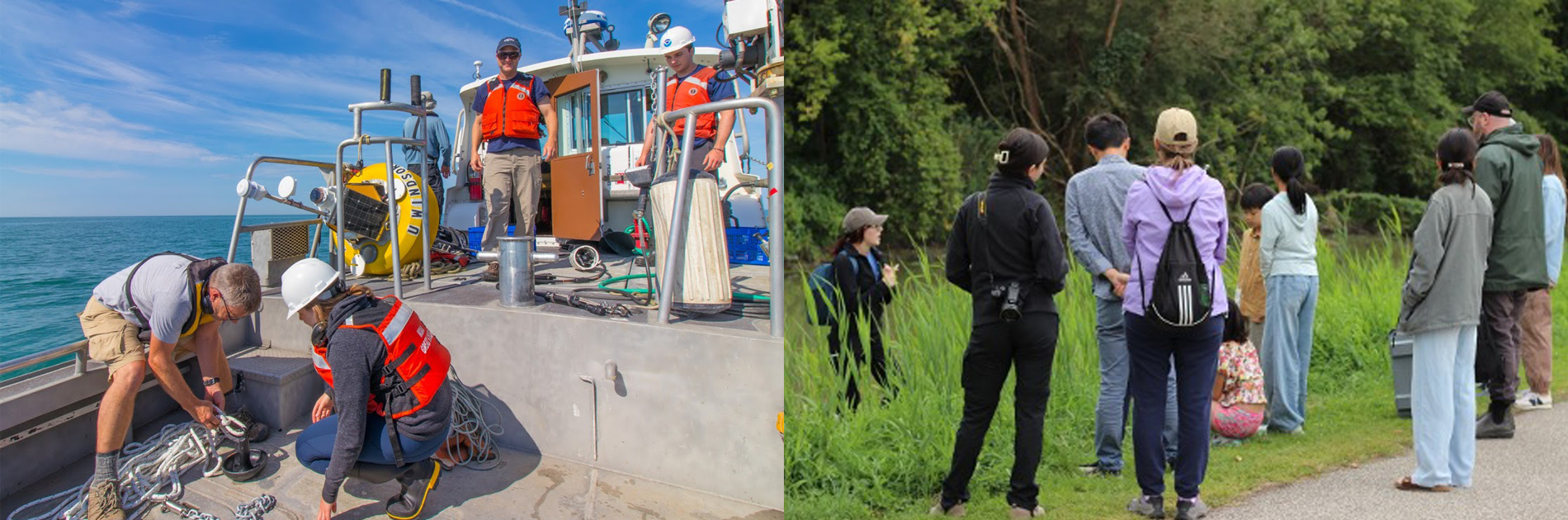
- Designing Smarter Observing Networks. Each year, considerable resources go toward deploying sensors and buoys across the lakes. Data-driven methods help us evaluate whether we are measuring the right things in the right places. By blending model forecasts with sensor data, ML algorithms can test different observing strategies and highlight where new instruments or vessel missions would have the greatest impact. This work, supported through NOAA’s Synthesis, Observation, and Response program and GLOS, is being advanced through CIGLR summer fellowships that develop algorithms to guide future monitoring efforts.
The adjacent possible: What comes next
The applications we are developing today are only the beginning. As we master our current tools, new and unexpected breakthroughs will follow. Each success opens doors to new scientific territories, expanding what we can understand and predict.
This growing collaborative enterprise, made possible by NOAA and our regional partners, represents national-scale investment in the Great Lakes research community. It strengthens our collective capacity to support coastal resilience and environmental stewardship.
We are just beginning to chart this digital frontier. We invite colleagues across the Great Lakes community to collaborate, experiment, and help us harness the potential of AI. To get involved, connect with our collaboration hub on GitHub and contribute to the effort. We look forward to forging this path together.
To learn more, please see “Mapping Out How Machine Learning and Artificial Intelligence Will Change Great Lakes Observations, Modeling, and Forecasting in the Coming Decade.”