Begin by finding photos or specimens of the species to work from. If you have access to an aquarium, you can work from live species. Many aquariums have live digital feeds that allow you to watch the fishes! Preserved specimens in a lab or museum are also an option, as are your own photos or fair use photos on the internet. I prefer a drawing paper that is heavyweight. For this drawing, I’m using 80 lb. acid-free paper and a collection of pencils noted below. Since I’m currently self-isolated due to the global COVID-19 pandemic, and since art supplies are low, I recently discovered that a cut piece of brown paper bag works great for drawing.
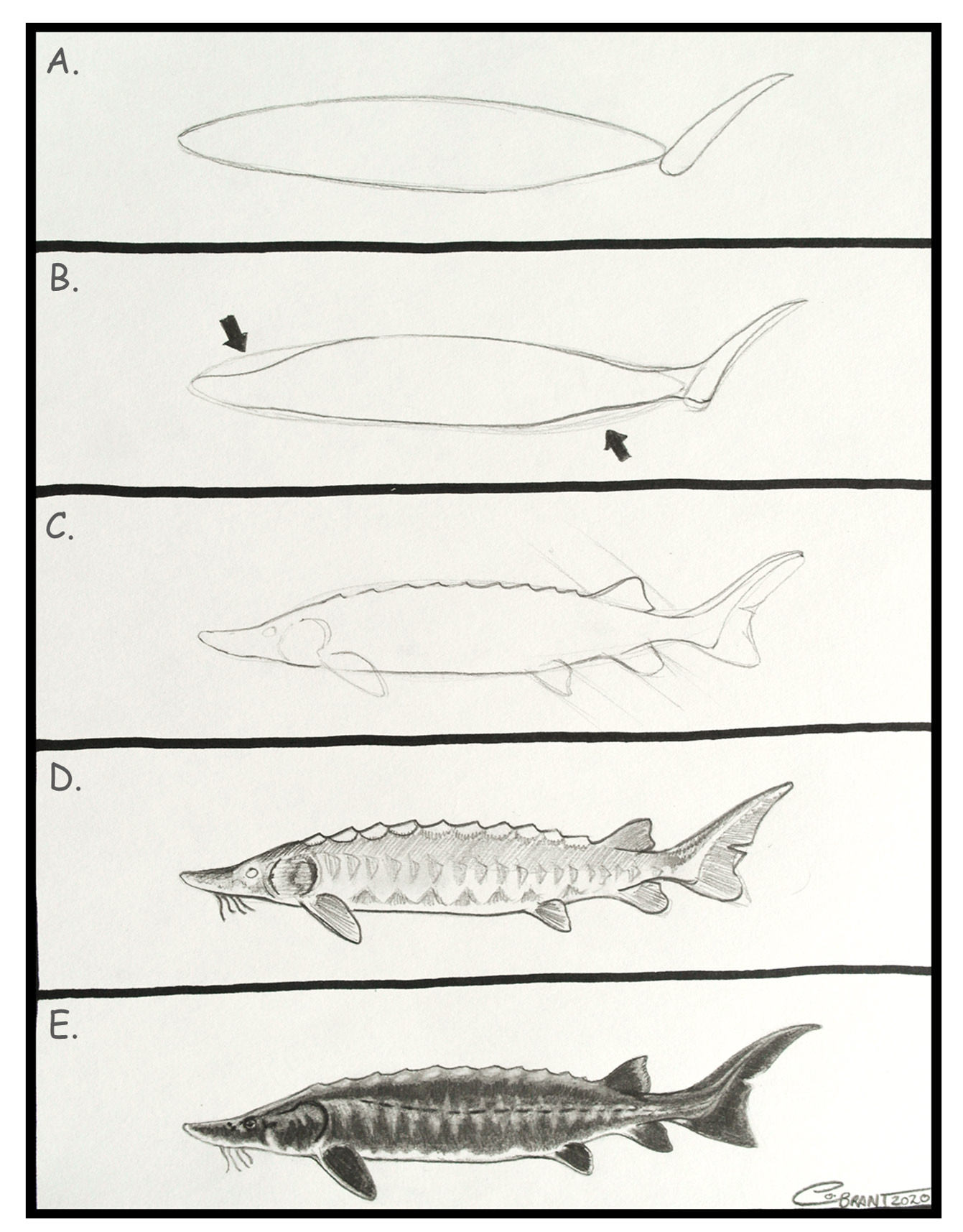
A. Start by sketching two main shapes. Sturgeon are torpedo-shaped with a sickle-shaped tail and a unique snout that looks like the side of a shoe.
B. Adjust your shapes based on the shape of a sturgeon. You will be erasing a lot at this stage as you work out the general body outline. A #2 or 2H pencil is best.
C. While looking at references, continue to refine the outline of your sturgeon. Add the fins, gills, and the eye. Pay special attention to the fins’ locations on the body, their shapes, and their proportions to one another.
D. At this stage, make sure you are happy with the outline and fins. You can bold the outline with a softer graphite pencil like a 2B once you decide you like it. On big projects, I sometimes spend days adjusting things at this stage. Keep checking reference photos, and, while using softer pencils, shade in rough shapes and features like scutes, gills, or shadows. This is a good time to practice a technique called hatching that entails rapidly scratching closely spaced parallel lines to create tonal or shading effects.
E. Now it’s time for details and blending. At this point I like to use softer pencils, 2B–4B, and a blending stump (a tightly rolled piece of tissue works). I’m left-handed, so I like to work from right to left to minimize smudging (it happens anyway). Continue to sketch and blend, paying attention to lighter versus darker areas on the fish. Often the fins of a lake sturgeon appear dark with light edges. Scutes along the back can be shaded lighter while the mid-body region can be shaded dark to give the appearance of light shining down on the fish. Don’t forget the four barbells (whiskers) on the snout! I often leave the belly white or lightly shaded. Have fun, and don’t be afraid to add your own style!