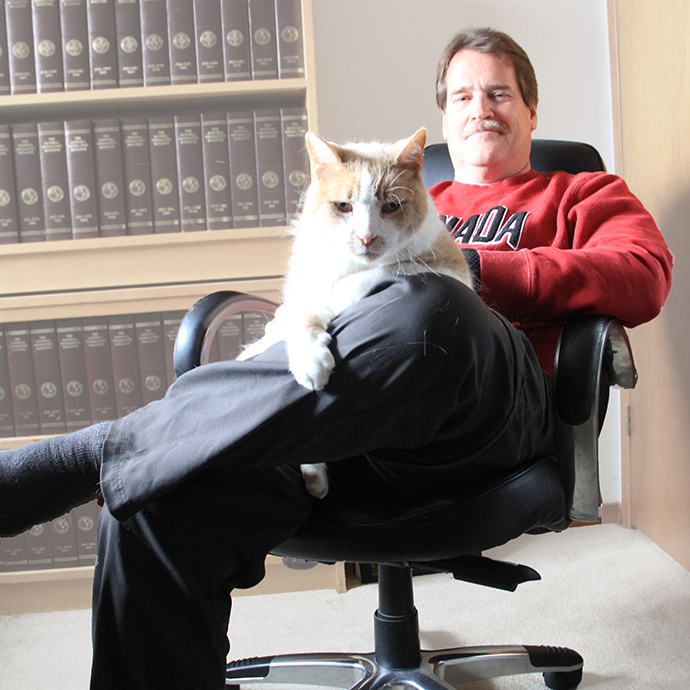
My dissertation research has largely dealt with the invasion and establishment of nonnative bivalves in small stream (<30m wide) ecosystems. I have documented population densities and assessed the impacts of bivalve invaders (dreissenid and cyrenid) on native, benthic macroinvertebrate communities throughout the Great lakes and southeastern United States. My research has included natural history surveys in Michigan, Ohio, Georgia, and Puerto Rico. Additionally, I have conducted enclosed mesocosm experiments through several Great Lakes tributaries. I also co-manage Dr. Donna Kashian’s lab.
Describe your creative pursuit.
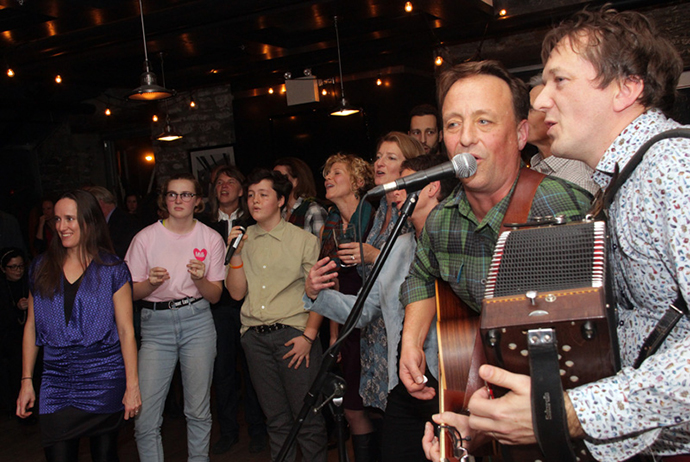
Music has always been an important part of my life. My dad played music, and there was always a guitar around the house when I was growing up. I was drawn to my dad’s guitar and started playing before I was big enough to properly hold it, and when I was old enough, my parents gave me an electric guitar of my own. Shortly before that, I also received a skateboard. These two instruments have provided a lifelong lens through which I view the world.
Skateboarding in the 1980s was deeply intertwined with punk rock music, and naturally, I became aligned with a community of like-minded punk rock musicians. This led to my friends and I starting a band, and then another, until skateboarding and punk rock became our primary means of socialization. I still play music with my friends, and I would not give it up for anything. I am a better, more well-rounded scientist because of it.
How does this pursuit influence your science?
By nature, punk rock is independent. It has separated itself from the rest of the music industry, and most of its enthusiasts would have it no other way. Much like punk rock music, skateboarding in the ’80s and ’90s was more of an act of resistance than a sport. Since that time, skateboarding and punk rock have evolved into multi-million dollar industries, and, while many resented this newfound popularity, I saw this as an opportunity to watch something unique happen—to see subculture become pop culture.
Observing the convergence of “our” subculture with “their” popular culture impacted me. Though I saw this evolution of punk rock and skateboarding as necessary, forward movement, I was concerned that the important do-it-yourself principles would not embed themselves in future generations the way they did with mine. These principles, which are centered in self-motivation and “stick-to-it-iveness,” are important elements in shaping my character, and I have applied them in my career in the sciences.
Does it make you a better scientist, and if so, how?
My work in the punk rock music scene has fortified me with the necessary independence to successfully plan and carry out my research goals. My successes in the arts had little to do with conventional measures. We did not care much about money or widespread acclaim. Our efforts were driven by self-satisfaction, and we felt lucky to be a part of something unique and special that was taking place in southeastern Michigan. This enthusiasm and resilience allowed me to remain strong in the face of failing experiments, while exploring unknown ecosystems and navigating the inherent self-doubt we all experience during graduate school.
When I first started my Ph.D., I wanted to compare the tolerances of various environmental toxins on resurrected and modern microcrustacean communities. I worked on this project for nearly two years, but I could not maintain my resurrected zooplankters for longer than a month. After much contemplation and discussion with my adviser, we decided to nix the project and revise my dissertation.
As of now, I am on the cusp of graduation. Though I lost two years working on a failing project, I sampled aggressively, made up for lost time, and put myself back on schedule for a timely graduation. I believe that recoveries such as these are, at least in part, thanks to the fortitude and resilience I garnered in my punk community.
VIDEOS
Visit the following links for a sample of Darrin’s music:
Darrin Hunt, The South Wind, 2020, Recorded for Lakes Letter
Few and Far Between, Coming to Get You, 2011
Few and Far Between, Take Control, 2009
King for a Day, Lazy, 1997
Roosevelt’s Inaugural Parade, Vendor, 1995