The basin of the Omo River and Lake Turkana spans a large portion of southwestern Ethiopian highlands and northern Kenya. It is presumed to be rich in its fish diversity that supports considerable fisheries. However, despite the widespread development activities with potential hydrological modifications and impacts on the ichthyofauna, the Ethiopian part of the basin generally lacks comprehensive scientific documentation on its fish diversity and fisheries.
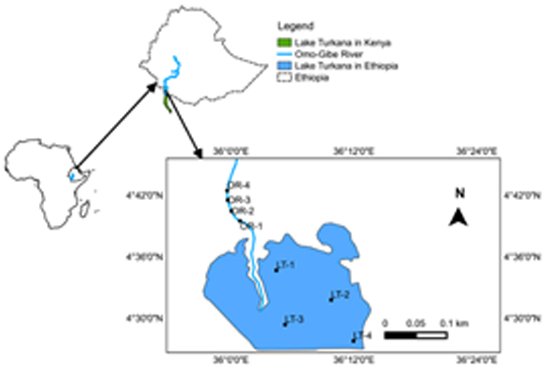
To address these gaps, fish were sampled from lower Omo River and Lake Turkana in Ethiopa. Structured questionnaires, focus group discussions, key informant interviews, and personal observations were used to gather data on the fisheries socio-economics and management problems.
The study recorded 79 valid native species for the entire basin and 69 for the part of the basin within the Ethiopian jurisdiction. The Omo River system was found to be richer in species, while Lake Turkana has a higher abundance.
This fertile fishing ground provides a key alternative livelihood for the riparian community (particularly, the Daasanach in Ethiopia), which has much fewer livelihood options apart from pastoralism. However, effective development of fisheries is marred by lack of material and technical support to the fishers, lack of government commitment to capacitate relevant institutions, illegal fishing, and lack of security due to conflicts arising between the Ethiopian and Kenyan fishers in an apparent competition over a fertile fishing ground.
A solution to the development of fisheries therefore requires an approach that integrates conflict resolution and co-management arrangement by the two countries. Moreover, it is highly imperative to capacitate and sustain the scientific roles of the Lake Turkana Advisory Group, a team of professionals from various institutions in Ethiopia and Kenya established in 2019 and supported by the African Center for Aquatic Research and Education. Its goal is to pursue a collaborative, holistic, and integrated approach to a more comprehensive assessment of the basin biodiversity and its management to guide the nations’ policy development and actions.