Crisis. Emergency. Disaster. Catastrophe. Hyperbole? Unfortunately not. Those words all serve as reasonable descriptors of the global state of freshwater biodiversity. By all accounts, freshwater ecosystems and their biota are in trouble. Freshwater ecosystems are among the most threatened systems on the planet—on the same plane as tropical rainforests that are being clearcut. The WWF Living Planet Index assesses the change in population status of various freshwater organisms relative to 1970. It reveals declines of over 85%, which is higher than that of either marine or terrestrial systems. Amphibians are among the most threatened taxa on the planet, with freshwater fish not far behind. From headwater streams to wetlands, and from water-filled caves to the world’s largest inland lakes, no system is immune to anthropogenic threats.
Work by David Dudgeon and colleagues in 2006 identified several key threats facing freshwater biodiversity: habitat alteration, invasive species, pollution, overexploitation, and climate change. Some 15 years later, Andrea Reid and colleagues revisited the threats facing freshwater biodiversity and revealed that not only do those threats persist, but there are emerging threats and greater evidence of complex interactions among threats that make things even more dire for freshwater biodiversity.
In recognition of the grim state of freshwater biodiversity, David Tickner from WWF recently led an initiative focused on creating an Emergency Recovery Plan intended to “bend the curve” for freshwater biodiversity. The plan consists of six priority actions: accelerating implementation of environmental flows; improving water quality; protecting and restoring critical habitats; managing the exploitation of freshwater ecosystem resources, especially species and riverine aggregates; preventing and controlling non-native species invasions; and safeguarding and restoring freshwater connectivity.
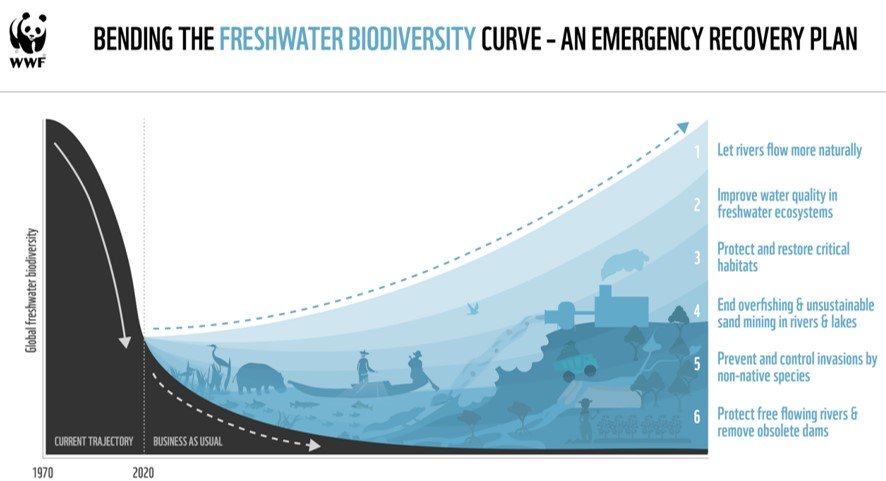
The plan itself is rather simple, yet there remain many challenges with implementation. On the global scale, freshwater ecosystems and biodiversity are often forgotten when it comes to discussions about the United Nation's Sustainable Development Goals, the Convention on Biological Diversity, and other international policy instruments and initiatives. At a regional level, those tasked with managing or restoring freshwater biodiversity are often under-resourced and faced with continual pressure to trade off biodiversity for short-term economic gain. Underpinning these challenges is the reality that freshwater ecosystems are often not valued, making it difficult for decision makers to comprehend the benefits of putting freshwater biodiversity ahead of economic development. Nutritional security, cultural services, livelihood support, nutrient cycling, and the many other freshwater ecosystem services are massive yet difficult to quantify and easy to ignore.
Although research needs related to freshwater biodiversity and management certainly exist, what is really needed is action. In the developed world, there is reasonable capacity for freshwater management, yet most efforts focus on organisms of socio-economic value (e.g., gamefish) and fail to approach management from a holistic perspective. For the most part, we know what works, yet lack the courage to make good decisions that value freshwater biodiversity.
A new toolbox has been developed with the intention of equipping practitioners with the evidence needed to guide decision making about freshwater management interventions. Such an approach will hopefully help the Emergency Recovery Plan move from something that is aspirational to something that is realized.
It has only been two years since the WWF Emergency Recovery Plan was developed, and it remains unclear the extent to which it has been embraced. What is clear is that we need all hands on deck. If there was ever a call to arms for freshwater biodiversity, this is it. Beyond the specific actions that constitute the Emergency Recovery Plan, there are many other ways to engage, including building public appreciation for freshwater ecosystems and demonstrating their value to politicians, leading stakeholder events that involve hands-on restoration, or enabling community monitoring.
I strongly encourage all IAGLR members to take the time to familiarize themselves with the Emergency Recovery Plan for freshwater biodiversity and consider what they can do to aid in its implementation. It is time to bend the curve for freshwater biodiversity and begin to restore our damaged ecosystems and rebuild our imperiled populations. The plan is grand and will take decades to be fully realized, but time is ticking and there is real urgency. Unfortunately, the tale I tell is not hyperbolic, and if anything may understate the true state of affairs. Fortunately there are exceptions, but they are far too few. I consider the WWF Emergency Recovery Plan to be a must-read. Please check it out.