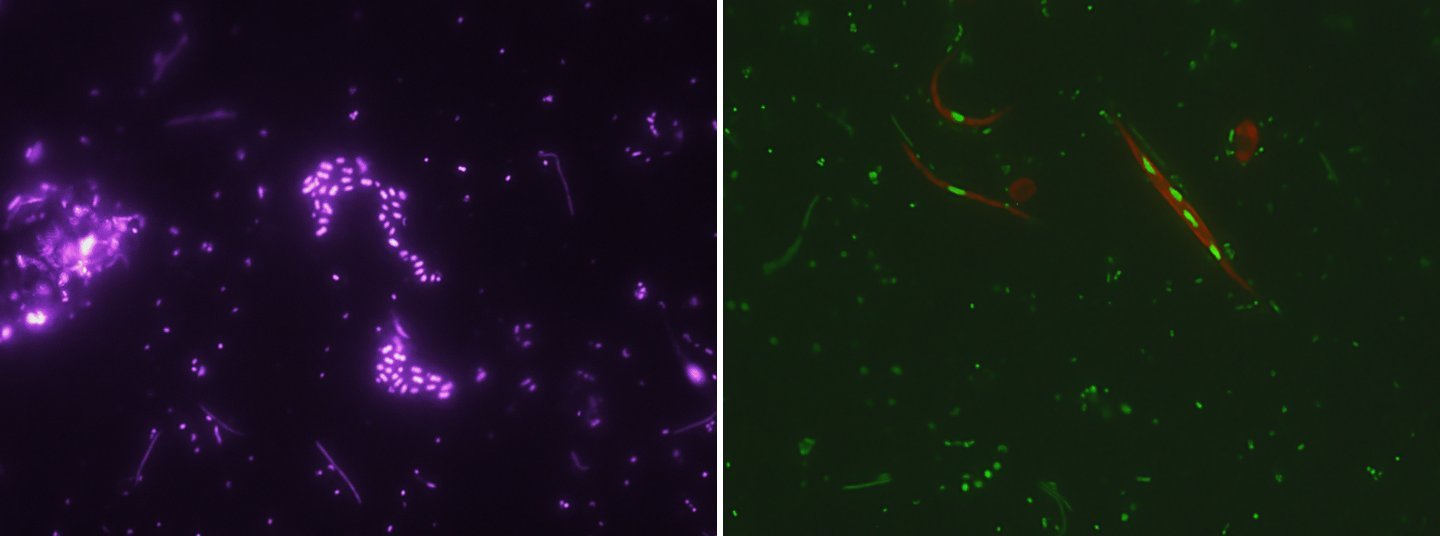
Dip a glass into the surface water of Lake Superior and it probably looks indistinguishable from bottled water—clear, empty, lifeless. Yet every liter of this lake water is teeming with life, including nearly a billion tiny cells and 10 billion viruses. Together these microorganisms (“microbes” for short) perform critical functions that support the rest of the ecosystem. Understanding these invisible functions, and the microbes responsible, is an urgent challenge as lakes worldwide face rapid environmental change.
The microscopic aquatic jungle holds enormous biodiversity. There are the familiar phytoplankton—single-celled algae and cyanobacteria with the superpower to turn sunlight, carbon dioxide, and water into the complex molecules that make up cells. But there are also countless species of bacteria and archaea, once lumped together as simple, primitive “prokaryotes.” We now recognize that these microbes hold far more genetic diversity than plants and animals combined. And they are not so simple: microbes are capable of breathing oxygen (like us), but also sulfate, arsenic, solid minerals, and solvents like tetrachloroethylene. Some can pull nitrogen from the air to fertilize plants and algae, while some produce or consume potent greenhouse gases like methane and nitrous oxide. They perform all these functions as part of their everyday lives, extracting energy and nutrients from their surroundings in order to survive and reproduce.
This microbial growth is balanced, over time, by death. The killers of microbes are often microbial themselves, including diverse single-celled protists and viruses. Most viruses in lakes infect bacteria and reprogram the cell into a virus factory. When the cell bursts, dozens of progeny viruses are released, along with the molecular remains of the cell. Both protistan grazing and viral lysis are essential processes in lakes, because they recycle cellular carbon, nitrogen, and phosphorus back to the dissolved phase, where it can be taken up by other microbes and thereby keep the biogeochemical wheels turning.
We are now beginning to “see” the biodiversity that underlies this invisible microbial food web in lakes, thanks to new technologies. DNA sequencing of a universal barcode gene, the 16S/18S ribosomal RNA, has revealed hundreds, even thousands of new microbial species in lakes from Baikal to Tanganyika to Superior. The exact number is anyone’s guess, since we lack a consensus definition of a bacterial species. Another sequencing approach, metagenomics, links species with their genetic potential for functions like nitrogen fixation, methane consumption, and toxin production. By applying these methods across lakes and across time, we can extract patterns in microbial species and functions, and relate them to broader ecosystem dynamics.
We are now faced with an urgent question: how is the invisible microbial biodiversity in lakes responding to climate change? With microbes, the priorities for biodiversity conservation are not necessarily particular species, but the functions performed by a healthy and resilient community. What’s crystal clear is that the microbes still have much to teach us.