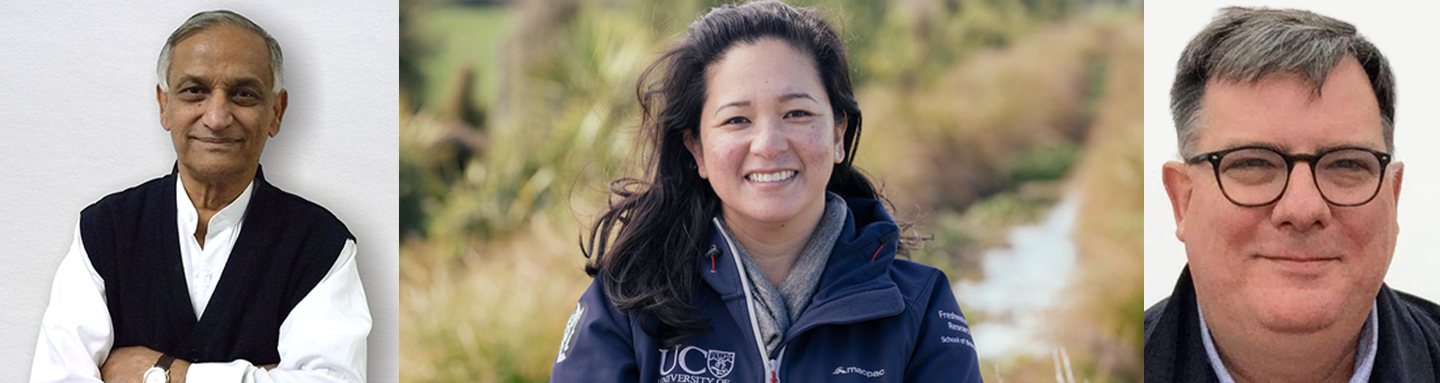
We asked three members with experiences from around the world to share their perspectives on international collaboration.
In what ways does international collaboration influence science?
CF: It brings perspectives and expertise from outside your local research community. Knowledge may exist elsewhere, and you can uncover it by engaging with colleagues globally. It also makes the science more robust because it brings the skills you need to the table and ensures that you’re assembling the best team for the science challenge.
MM: International collaboration helps researchers to take a holistic view and to broaden our scientific vision. My love for international collaboration was influenced by working with great limnologists like Jacob Verduin, Richard Vollenweider, and Jack Vallentyne who all promoted an ecosystem-based approach and the application of holistic strategies globally. The ecosystem approach that emerged from the Laurentian Great Lakes inspired the creation of the AEHMS, which has gone on to spread this approach across the world via its conferences, journal, and Ecovision World Monograph Series. This is a power example of how international collaboration can spread ideas.
RS: International collaboration helps to bring the best and most suitable minds together to work on science’s biggest challenges. In so doing, it can bring the right teams together to address problems no matter where on the globe they occur. Though we are a global scientific community, different countries or regions have their own scientific strengths. Some have exceptional infrastructure or do a better job supporting technical staff, while others are more comfortable with risk. Some have extraordinary natural resource assets. Science needs all of this.
How has working internationally changed your perspective?
CF: Working internationally is my norm. I grew up in the Great Lakes region, but I was not born here. I grew up speaking and hearing different languages and participating in different cultures. These experiences have enriched my work life as they’ve taught me there are many ways to see an issue and approach a solution. As a scientist, I’ve also always been trained through an interdisciplinary lens, and thus pursuing international literature and experts is simply a way to ensure that the best science is being delivered.
MM: Working internationally for 30 years has taught me to view the environment holistically and globally, to understand various problems from a top-down perspective, and to share solutions and assist in local capacity building. It also has made me question the practicality of applying western science to other parts of the world, especially to developing countries with limited facilities and resources.
RS: My graduate training included a semester-long tropical ecology course in Central America. Every temperate biologist needs to immerse themselves in the tropics at least once. My perspective also was shaped in important ways during my postdoctoral years when I worked for just over a year in a Max Planck Institute in Germany. The strengths and ways of thinking I absorbed there complemented my graduate training and made me a much more well-rounded scientist. Later, work I did in collaboration with Jim Elser at the Experimental Lakes Area in Canada allowed us to pursue our interest in stoichiometry at the whole-lake level—work that would have been impossible at our home institutions, which lacked the “lakes as test tubes” facilities that ELA was and still is.
What advice do you have for those interested in collaborating internationally?
CF: Learn how to listen. Be open to learning new skills and taking risks, but learn from them, and move forward. I often ask myself and others: “Do I want to be right? Or do I want to learn, build a bridge, and/or solve the problem?” It’s typically the latter of these two, which is why collaboration skills are so important.
MM: Be willing to help others, and treat international colleagues as equals. Share and exchange knowledge with scientists of different backgrounds, needs, and cultures. Invite local input, and do not impose your own ideas; instead, foster an exchange of ideas and approaches.
RS: Your approach to international work depends entirely on what part of the world we are talking about, but, no matter where you work, keep in the front of your mind that you are a guest in that country. Do your science, and take advantage of opportunities to advance your work, but also learn about cultures different from your own, and do your best to understand different perspectives than those you grew up with. On the flip side, represent your own culture well. You are serving as an example. Doing these things will make you a better global citizen and a better collaborator.
What personality traits and personal skills are best suited for international work?
CF: Everyone can and should work internationally, but effective international collaboration will require more than a set of personality traits such as being a good listener. It also will require a shift in our scientific community’s values toward the creation of inclusive research environments that acknowledge privilege and inequities, involve local knowledge holders, and allow time for things to proceed meaningfully and effectively.
MM: Patience and a friendly disposition are personal assets well suited for international work. The ability to communicate simply and thoroughly so that local people can understand and respond is a fundamental skill. In addition, the ability to adapt a sharing, rather than teaching, approach is helpful in most situations. Yet being able to train others in how to prepare manuscripts and presentations is needed, too.
RS: Again, this depends very much on what part of the world we’re discussing, but flexibility and a willingness to learn and sometimes look stupid are important assets.
What are some of the challenges you’ve found in collaborating outside of your home country?
CF: When it comes to science and research, the hardest challenges are perhaps the time zone changes and flips in seasons, but that’s nothing that a good Doodle poll and platforms such as Zoom, Skype, FaceTime, Facebook Messenger, and Google Drive haven’t been able to help solve.
MM: Some of the challenges I’ve encountered include language barriers, a lack of time management skills, and the need to communicate on weekends with scientists located elsewhere who are more available to work at that time.
RS: Well, it is usually very difficult to synchronize funding across international borders. The political reality is that countries want, first and foremost, their resources to benefit themselves, and each country’s funding apparatus is almost entirely built and run with an inward, not outward, perspective. There are some bodies that think and fund globally, but few of these have a basic science mission. So, assembling your dream team of international scientists will require creativity in funding. At a more pragmatic level, moving expensive or sensitive scientific instrumentation across borders can sometimes be a daunting and frustrating experience.
Anything else to add?
MM: Consider the planet as one large ecosystem for conservation. Do not assume the application of western science as a solution to all the world’s problems. Learn and adopt techniques from other countries and cultures. Adopt a helpful, compassionate attitude of service to humanity.
RS: Working internationally is fun! It adds richness to your life, and you should take advantage of it.
Meet the Experts
Catherine Febria is a Canada Research Chair in Freshwater Restoration Ecology at the University of Windsor’s Great Lakes Institute for Environmental Research. She was previously a director and scientist with the Canterbury Waterway Rehabilitation Experiment in Canterbury, New Zealand. She is a nominated expert in the UN Intergovernmental Science-Policy Platform on Biodiversity and Ecosystem Services.
Mohiuddin Munawar is a research scientist with Fisheries and Oceans Canada and is the only recipient of IAGLR’s four professional awards. He is president of the Aquatic Ecosystem Health and Management Society and chief editor of the society’s journal, Aquatic Ecosystem Health and Management, which fosters international and cross-sectorial communications. In this capacity with AEHMS, he has 30 years of international experience in approximately 30 countries on six continents.
Robert Sterner is the director of the Large Lakes Observatory at the University of Minnesota Duluth, which has as its mission to perform scientific studies on the large lakes of Earth. He has had experiences and collaborations with scientists in Canada, Costa Rica, Germany, Japan, Malawi, and Norway.