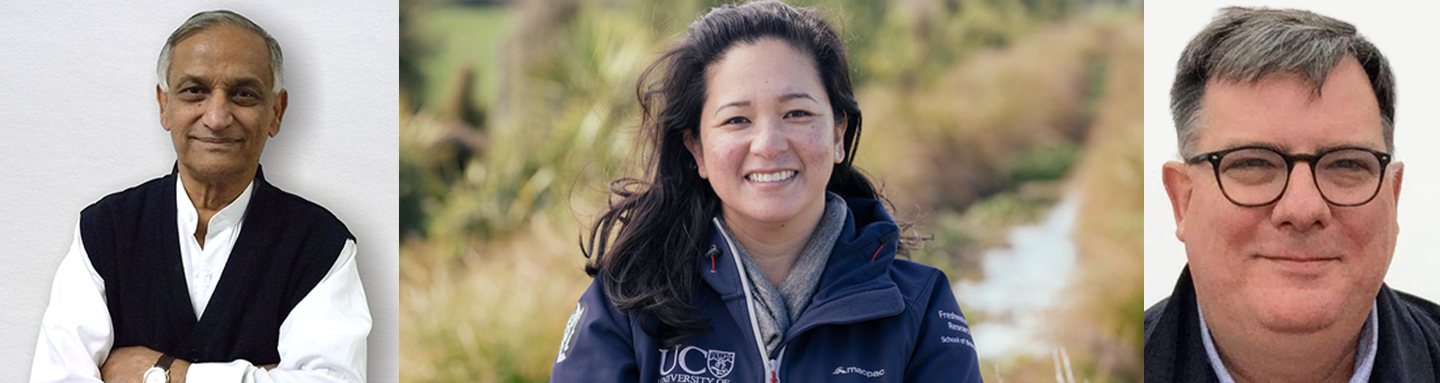
My research focuses on monitoring and modeling nuisance benthic algae. Most of my past work and some of my ongoing work involves modeling the growth of Cladophora, a nuisance filamentous green alga, in the Laurentian Great Lakes. I use mechanistic modeling approaches supported by field and experimental data. In New Zealand, I am currently involved in developing new monitoring and modeling methods for stream periphyton. To monitor periphyton cover and biomass, we are using aerial (drone) and stationary imagery, which shows promise for increasing the spatial and temporal resolution. To support periphyton modeling, I am leading experimental work using respirometers (benthic chambers) to measure periphyton metabolism and nutrient uptake rates and thus help define model parameters.
What inspired you to enter this work?
My high school physics teacher encouraged me to consider studying engineering, and water as the source of life has always fascinated me spiritually and scientifically. When I researched different engineering disciplines, I realized I wanted to become an environmental engineer. But how did I get into algae? My Ph.D. advisor, Dr. Marty Auer, drew me in with his work on real-life problems and his solution-driven research. I was also inspired by his passion for teaching and community outreach. Generally, I am driven by a desire to contribute to the enhancement of surface water quality, sustainability, and the protection of human and ecosystem health.
What body of knowledge would you like to build on?
My professional goal is to help improve water quality modeling, especially to develop appropriate growth models that may be used to predict blooms and thus inform environmental management. I see a need for improvements in linking hydrodynamic, hydrologic, and water quality models from the mountains to the sea (or ki uta ki tai in New Zealand’s native Māori language) so that managers can be informed with better predictions of the likely environmental responses to various scenarios such as changes in land use, point source discharges, urban development, and climate. Why? Because I would like future generations to be able to enjoy our planet’s fresh waters, and I think te mana o te wai (Māori for the well-being of the water) is best realized and protected by making water management decisions based on sound science and traditional ecological knowledge.
If you could change something about how science is done, what would it be?
I think we need to improve our communication skills and increase transdisciplinary research. This is not a new thought, but it is a widely discussed topic that I think merits further attention. Though using scientific jargon may make us feel like intellectuals, it can obscure our messages and delay or impede management and research. When I speak or write, I try to remember KISS—Keep It Simple, Stupid. I strive to break down barriers in language use, overcome my fears of appearing ignorant, and work up the courage to ask more questions, listen, simplify my language, and ask for help.
What might be surprising about research or lakes in your area?
New Zealand does not boast lakes of comparable size to the Laurentian Great Lakes, but its deepest lake, Lake Hauroko (462 m), is deeper than Lake Superior (406 m). New Zealand also is home to the world’s clearest lake, Blue Lake, also known as Rotomairewhenua. Hydroelectric schemes supply more than half of New Zealand’s electricity, and water abstraction supports New Zealand’s agriculture, especially its dairy industry. But alongside the economic benefits come eutrophication problems as river flows decrease and nutrient loads increase. Further contributors to environmental issues are invasive algal species, such as Lindavia and Didymosphenia and toxic Phormidium and Microcoleus blooms.
How long have you been an IAGLR member? Why did you join?
I joined IAGLR as a student in 2012. I was eager to meet members of the academic Great Lakes community, to reach beyond my home research institution, and to meet leaders in my field.