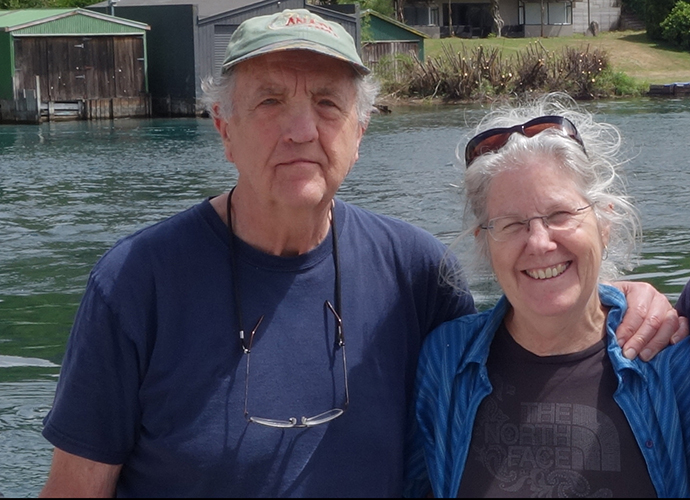
How did a boy from Akron, Ohio, and a girl from Halifax, Nova Scotia, grow up to meet, marry, and build shared careers focused on the African Great Lakes? Their story is one of formative years as children spent exploring the out-of-doors, the happenstance of an advisor to nudge the course of a career, and a habit of remaining open to the possibilities that life presents. Most of all, it’s a story about relationships built along the way and the impact that ripples out from these connections—in the lives of their students around the world, and in the practice of lake science in North America and, especially, on a continent far away.
Bob Hecky grew up in the Cuyahoga River Valley where, by the time he was born, the river had already caught fire seven times. It would do so several more times on its way to becoming a poster child for industrial abuse of the nation’s waters. But to a young boy, the mountains of detergent suds flowing down the river were a source of delight. Hecky, following the river’s example, made his way to Lake Erie for his first encounter with the Great Lakes. He marveled at the fishing and the emergence of the mayflies known locally as Canadian soldiers. “Those experiences likely influenced me more than I appreciated at the time,” he reflects.
Meanwhile, in Nova Scotia, Stephanie Guildford was spending her summers at the seaside. “I was fortunate to have parents that let me sail boats by myself,” she recalls. “I loved being outside and preferably on large, remote waterbodies.” She went on to study marine biology at Dalhousie University in Halifax, and upon graduation she took her first job at the Bedford Institute of Oceanography across the harbor in Dartmouth. But Guildford was keen to see the world, and when an opportunity opened for her to join the Department of Fisheries and Oceans’ newly established Freshwater Institute in Winnipeg, she headed west, leaving the ocean behind. “The more I learned the more I wanted to understand how lake ecosystems functioned, and how we could prevent or remediate eutrophication,” she says. “This motivated me to do my graduate degrees.” Guildford enrolled at the University of Manitoba and went on to earn her Ph.D. in botany.
Hecky was also interested in a career of studying the sea. After graduating from Kent State University, he headed to graduate school at Duke University intent on becoming a marine biologist. Yet his plans changed under the influence of his advisor. “I was very fortunate to be assigned to Professor Dan Livingstone,” Hecky says. “As a palynologist, he was studying the history of climate change in East Africa, and how it shaped the evolution of humans and their cultures.” Hecky did his Ph.D. on paleolimnology of saline lakes in Tanzania and “became imprinted on Africa and its lakes.” After a postdoc at Woods Hole Oceanographic Institution—where he studied lakes Kivu, Edward, and Albert—he joined the Freshwater Institute in Winnipeg.
It was there that Guildford and Hecky met and worked together for several years studying the impact of flooding on a large lake in northern Manitoba. They eventually married and have been working on large lakes in North America and Africa ever since. They are well known to the research communities on both continents. Hecky is an advisor for several groups in Africa and North America including the Great Lakes Fishery Commission for which he serves as a commissioner, and his work has been honored by multiple awards. Since 2012, Hecky and Guildford also have served as co-editors of IAGLR’s Journal of Great Lakes Research (JGLR).
Hecky and Guildford each have a history of substantive research focused on large lakes, according to Jim Bence, chair of IAGLR’s Publications Committee. “After extensive work on African large lakes, Bob started his Laurentian Great Lakes research by showing how invasive mussels were substantially altering phosphorus dynamics in the lakes through the now well-known nearshore phosphorus shunt. More generally, he has made many contributions to the understanding of nutrient cycling in large lakes and how the biota influences this cycling,” Bence notes. “Stephanie has also conducted research on both African and Laurentian Great Lakes, and she has made major contributions to understanding the determinants of phytoplankton productivity and the role of nutrient regeneration in the lower food web.”
While some people marvel that spouses can work together, it has been a good life for Hecky and Guildford. “We have enjoyed truly rich, shared careers,” Hecky says. “Working together has always seemed natural for us. We take our mutual trust and respect for granted.”
Guildford also notes the benefits of shared careers. “You can always talk about your work, and you see a lot of each other,” she says. On the other hand, “you can’t use your spouse as a reference, and you see a lot of each other.” Yet their biggest challenge was to find two professional positions together. “I hope it is better these days,” she says, “but hiring spouses was not common in the past.” In spite of this challenge, they went on to positions at the University of Waterloo and then at the University of Minnesota Duluth where each now has emeritus status.
Working together enabled Hecky and Guildford to share research journeys with their five sons. The two eldest spent several field seasons with them in northern Manitoba, while the younger three spent time at their field locations on Lake Malawi in Africa. “All five loved their experiences,” Guildford says, “but, like most siblings, they continue to discuss who got the better deal.”
The example the couple set raising five children while pursuing two busy academic careers was not lost on their students. “They served as fantastic role models of a healthy work-life balance,” says Rebecca North, an assistant professor of limnology at the University of Missouri. “I had my first child while I was a Ph.D. student working with Stephanie. She was the most supportive advisor a student could have in that situation. At a point where many women leave academia due to the demands of young children, it was her support and encouragement that kept me going.”
This family-friendly attitude shaped the couple’s working style. “Perhaps it was the nature of their relationship being an academic couple,” North says, “but, when you worked with one of them, you were working with both, and you weren’t a colleague, you were a family member.” This connection was on display at a recent African Great Lakes workshop in Entebbe, Uganda. “During introductions,” co-organizer Jessica Ives recalls, “almost every other person was saying ‘Hello, I’m so and so, and I’m an academic child or grandchild of Bob Hecky.’”
Such fondness is no surprise considering the couple’s longtime commitment to the lakes and people of Africa. Over the years, Hecky and Guildford have identified and trained young African scientists with the potential to play leading roles in African lake science, says Richard Ogutu-Ohwayo, who recently retired from the National Fisheries Resources Research Institute in Uganda where Hecky started an analytical lab in the early ’90s. Ogutu-Ohwayo credits the couple with helping him to attend the University of Manitoba for his Ph.D. and, more recently, to secure positions as IAGLR’s first international board member and as an associate editor of the JGLR. “Bob is a black man in white skin,” he says fondly when reflecting on Hecky’s dedication to Africa.
Other students also comment on the couple’s personal focus. “They have been successful in their international work because they have been able to establish strong partnerships with scientists in Africa, and those partnerships are built on mutual trust and respect,” notes Harvey Bootsma who did his Ph.D. with Hecky and is now an associate professor at the University of Wisconsin–Milwaukee.
Despite their profound impact, when Guildford and Hecky are asked what makes them most proud, they readily say it’s their students from around the world. “We were so fortunate to work with so many students who were so keen and dedicated and collegial,” Guildford says. “They have done amazing work and have gone on to such important positions where now many are training their own students and advising policy makers on the health of freshwater and marine ecosystems around the world.”
Hecky and Guildford were thought-provoking and respectful mentors, which endear them to their many students, Bootsma says. “Bob and Stephanie’s sincere interest in the results of my research, no matter how trivial I thought they might be, was a great form of encouragement.”
When North thinks back to her undergraduate years, she recalls that Guildford had a great reputation among students as being friendly and approachable. That support has continued. North says she can always run an idea by Guildford, even now, and receive an insightful and supportive response. “This type of lifelong coach is unusual in academia,” she says. “I am extremely fortunate.”
Hecky’s students share similar stories. “As a supervisor, in spite of having many students, Bob was always accessible,” recounts Piet Verburg, now a lake scientist in New Zealand. “He truly cares about people and feels responsible for the welfare of his charges more than just as a supervisor.” Verburg also reflects on Hecky’s passion for his work. “As a scientist, Bob is extremely conscientious, and very knowledgeable. He is very driven, and both the science and environmental problems affecting lake water quality are important to him.”
Perhaps that is what led Hecky to once dive into Lake Simcoe after a sonde that had detached from its lowering line. “Undeterred, Bob jumped in to retrieve the sonde, now lying on the bottom,” recounts former student David Depew, now a research scientist at Environment and Climate Change Canada. “Bob returned to the vessel, promptly plugged in the sonde, and marveled at the dissolved oxygen readings it had collected while sitting on the lake bottom.”
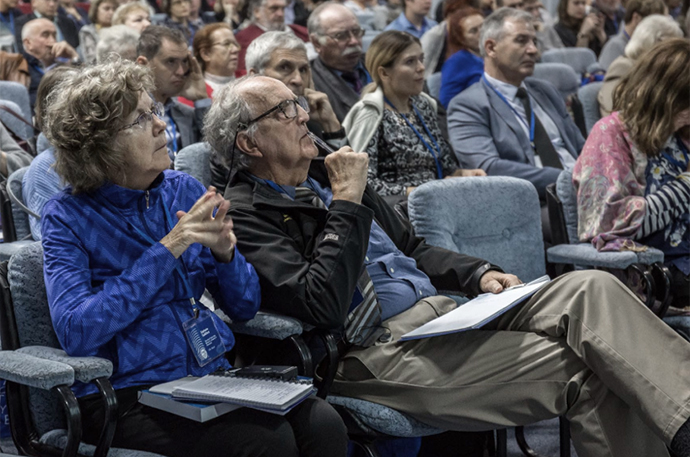
Curiosity about how lakes work has kept him going, Hecky says. And it also likely explains the enjoyment he finds in editing the JGLR. During their tenure as editors, Hecky and Guildford have tirelessly promoted the journal, traveling to international conferences and facilitating special sections highlighting large lake research outside of North America. According to Bence, the result has been an increase in both international submissions and published articles, an increase in the overall number of journal articles per year with the highest number of submissions ever in 2019, and a higher impact factor that reflects a growing reputation for the JGLR. At the same time, Bence says, the editors have insisted on keeping the journal accessible to those publishing good research focused on specific Laurentian Great Lakes issues.
“I am hopelessly biased toward international, collaborative research and very pleased that IAGLR has become more international over the last several years,” reflects Guildford. “However, I want IAGLR to keep its core strengths—the conferences and JGLR—strong. IAGLR’s leadership role in helping to keep North American Great Lakes research strong and healthy while fostering collaborative opportunities is the best way IAGLR can support global great lakes health.”
Hecky notes that the association is the world’s largest community of scientists, managers, and stakeholders concerned with large lakes. As such, it leads and sets the standard for appropriate research and management of these lakes, he says. Other large lakes, especially those shared internationally, can learn from and incorporate that experience.
“I encourage all IAGLR members to appreciate that role and become interested in the problems that other great lakes are suffering as well as how our collective and individual activities can have impact at that global scale,” he says. “Lakes everywhere follow the same physical, chemical, and biological processes; but climate, geology, and evolution impose different expressions of those processes. I believe we will not really understand any great lake, or what is possible for it, until we understand all great lakes.”
With climate change, eutrophication, invasive species, and habitat alteration threatening the world’s lakes, such an understanding—and the international collaboration it requires—has never been more urgent. Hecky and Guildford have done their part to pave the way forward.